
A Japan Non-Disclosure Agreement (NDA) is a contract designed to protect confidential business information, trade secrets, and personal data shared in commercial or employment contexts while complying with Japanese statutes and court practice.
What is a Japan NDA?
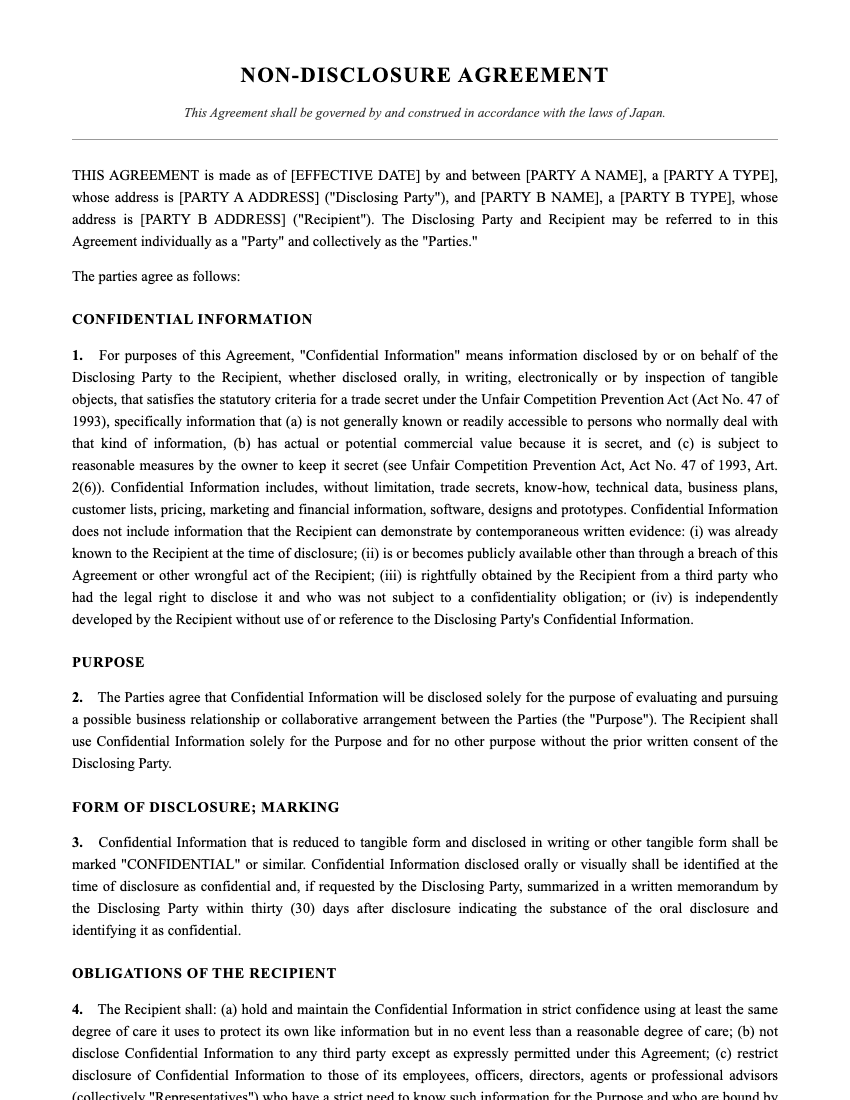
Definition: In Japan, NDAs are used to protect “undisclosed technical or business information” falling under the Unfair Competition Prevention Act (UCPA). The UCPA (Act No. 47 of 1993, amended 2018) defines trade secrets and provides civil and criminal remedies (see UCPA Article 2(6) for the modern statutory definition of trade secret).
Unlike some jurisdictions with blanket bans or federal whistleblower notice rules, Japan treats confidentiality, trade-secret protection, post-termination restraints, and personal data handling as overlapping but distinct issues regulated by:
- Unfair Competition Prevention Act (UCPA) — trade secret protection (see Article 2(6) and remedy provisions);
- Civil Code (Minpō) — public-order limitations on contracts (Article 90) and general obligations;
- Act on the Protection of Personal Information (APPI) — obligations when personal data is disclosed or processed;
- Act on Electronic Signatures and Certification Business — recognition of electronic signatures (Article 3).
A well-drafted Japan NDA protects commercially valuable information, complies with APPI when personal data is involved, and avoids overbroad post‑termination restraints that Japanese courts may invalidate under Civil Code principles.
For a complete guide to NDA terms, duration, and standard exclusions, see our NDA Agreement Guide.
Why generic NDAs are dangerous in Japan
Many off-the-shelf NDAs were written for U.S. common-law contexts. In Japan they can create three key risks:
- Unenforceable post‑termination restraints. Japan has no single “non‑compete statute,” but Civil Code Article 90 (acts contrary to public order and morals) and court practice require that any restriction on former employees be necessary, reasonable in geographic and temporal scope, and — in practice — supported by compensation. Overbroad clauses (indefinite duration, global scope, no compensation) are likely to be struck down.
- Mis-handling of personal data. If the disclosure includes personal information, the APPI (Act on the Protection of Personal Information) imposes security, purpose‑limitation and cross‑border transfer obligations. An NDA that ignores APPI requirements can create regulatory exposure even if it protects trade secrets.
- Weak trade-secret safeguards. After the 2018 UCPA amendments (Act No. 22 of 2018), Japanese law gives enhanced remedies for trade-secret misappropriation—but only when the information meets the statutory definition (economic value from secrecy and reasonable secrecy measures). Calling everything a “trade secret” without showing reasonable protective steps can defeat a claim.
Paradigm-shifting insight: In Japan, you cannot rely on bare contractual language alone — enforceability turns on demonstrable necessity and balance. For post‑termination restraints, courts routinely require either prior compensation or a demonstrable impossibility to protect the employer by other less-restrictive means. In short, Japanese law treats NDAs as part of a package of operational protections (access controls, labeling, limited distribution, employee training, APPI compliance) rather than a stand-alone cure.
Real legal development to watch
The 2018 amendment to the UCPA significantly strengthened trade-secret protection and clarified definitions and remedies (effective implementation in 2019). The Japan Patent Office and METI issued accompanying guidance encouraging corporate safeguards and internal rules. See the Ministry guidance and coverage in local press describing the expanded civil and criminal penalties for theft of trade secrets.
Key clauses adapted for Japan
- Clear definition of Confidential Information and separate, narrow definition of Trade Secrets tied to UCPA Article 2(6).
- Purpose and limited-use clause (tie permitted use to specific project or evaluation).
- Reasonableness parameters for post‑termination restrictions: if you include non‑compete language, specify duration (typically 6–24 months), geographic scope, and (importantly) compensation or consideration for restrictive covenants.
- APPI compliance clause: responsibilities for personal data handling, security measures, and cross‑border transfer rules.
- Security and marking obligations: explicit labeling, access control, and recordkeeping requirements to show “reasonable efforts” to maintain secrecy under the UCPA.
- Remedies and injunctive relief: mirror UCPA remedies and provide for injunctive relief but avoid unconscionable liquidated damages that may be reduced by courts.
- Electronic signature and language clause: confirm electronic execution under the Act on Electronic Signatures and Certification Business (Article 3) and specify the governing language (Japanese or bilingual).
Who needs this document?
| User Persona | Usage Scenario | Key Benefit (Japan) |
|---|---|---|
| Exporting manufacturer | Sharing specs with foreign OEM | Protects design specs; aligns with UCPA and APPI cross‑border rules |
| Japanese startup | Pitching to investors or partners | Preserves trade-secret value while avoiding unenforceable non‑competes |
| Employers | Hiring mid‑level engineers | Limits on post‑termination work are narrowly tailored and compensated |
| Consultants / Freelancers | Contracting with Japanese clients | Defines permitted use and APPI responsibilities when personal data is involved |
How to execute a valid Japan NDA
- Choose the right type: unilateral (one‑way) if only you disclose; mutual when both parties will share confidential information.
- Define purpose and scope narrowly: specify the project, the permitted uses, and limit duration. For trade secrets, describe how information qualifies under UCPA Article 2(6).
- Show reasonable protective measures: mark materials, limit recipients, require password control, and document internal procedures — these operational steps are essential evidence under the UCPA.
- Sign and consider compensation for restraints: if you include any post‑termination restriction, provide clear, reasonably calculated compensation or alternative consideration to improve enforceability under Civil Code balancing principles.
Already getting NDAs from clients?
When a client sends you an NDA, read it for vague “forever” restraints, absence of APPI obligations if personal data is involved, and overly broad trade‑secret definitions. an AI contract review tool flags these Japan‑specific risks, compares terms against UCPA and APPI obligations, and recommends negotiation points.
Related NDA Templates
Get the Template
Sign up for our newsletter to receive the template.
Frequently Asked Questions

About Designer Content
Designer Content creates practical legal document resources for landlords, contractors, and small business owners. We simplify complex legal concepts into actionable guidance. Connect with us on LinkedIn.