
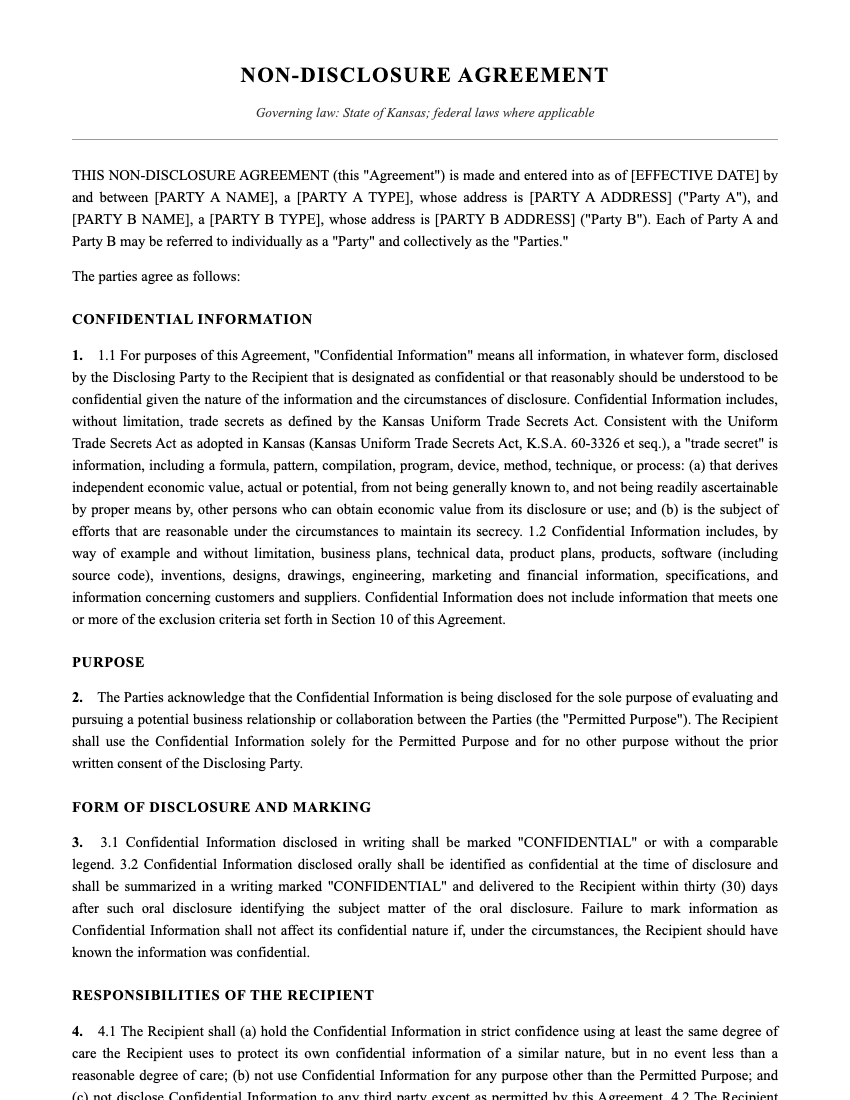
A Kansas Non-Disclosure Agreement (NDA) is a contract used to protect confidential business information and trade secrets under Kansas law. Unlike states that categorically ban non-competes, Kansas enforces restrictive covenants and confidentiality restrictions so long as they are reasonable and tied to a legitimate business interest. This template is tailored to Kansas statutory and common-law rules—highlighting trade secret protection under the Kansas Trade Secrets Act (K.S.A. 60-3320 et seq.), the five-year limitations period for written contracts (K.S.A. 60-511), and practical drafting traps that frequently trip up employers and founders.
What Is a Kansas NDA?
Definition: A Kansas NDA is a written agreement in which a Receiving Party agrees to keep specified information confidential and to use it only for a defined business purpose. NDAs in Kansas can protect trade secrets, customer lists, pricing, processes, software, and other confidential business data—so long as the information qualifies as protectable and the restrictions are reasonable in scope and duration.
Kansas has no wholesale prohibition on non-competes or confidentiality-based restraints. Instead, courts evaluate NDAs and restrictive covenants under a reasonableness test: is the restriction no broader than necessary to protect a legitimate business interest such as trade secrets, customer relationships cultivated by the employer, or specialized training?
For a complete guide to NDA terms, duration, and standard exclusions, see our NDA Agreement Guide.
Why Generic NDAs Are Dangerous in Kansas
Many free templates were drafted for jurisdictions with different rules. Using them in Kansas creates several risks:
- Overbroad "no use" provisions become de facto non-competes. Kansas courts will enforce restraints that have the practical effect of preventing competition if they are reasonable—so vague, sweeping prohibitions can produce unintended injunctive relief.
- Failure to define trade secrets consistently with K.S.A. 60-3320 et seq. can make it impossible to obtain injunctive relief or recover damages for misappropriation.
- Wrong statute of limitations planning: written contracts in Kansas generally have a five-year statute of limitations (K.S.A. 60-511). Don’t assume longer common-law protections without tailoring your remedies and timing.
Paradigm-shifting insight (Kansas-specific): In Kansas, the critical battleground isn’t whether confidentiality clauses are permitted (they are) but whether they are tied to a legitimate protectable interest and narrowly tailored. A surprisingly common trap is labeling routine business data as "confidential" forever—Kansas judges will evaluate whether the asserted interest (trade secret, customer relationships, or specialized training) actually exists. If it doesn’t, an otherwise enforceable restraint can be weakened or denied. In short: Kansas will enforce reasonable NDAs—but overclaiming protection (calling everything a trade secret) often backfires and can produce costly injunctions or litigation defeat.
Real case study / development
Kansas adopted the Uniform Trade Secrets Act framework in its statutes (K.S.A. 60-3320 et seq.), aligning state remedies with the federal Defend Trade Secrets Act (DTSA). Practitioners in Kansas regularly rely on this statutory framework in trade-secret litigation and injunction requests. When planning NDAs, anticipate both state-law remedies under K.S.A. 60-3320 et seq. and potential federal claims under the DTSA (18 U.S.C. § 1836 et seq.), which carries its own notice and remedy considerations.
Key Clauses (What this template includes)
- Clear Definition of Confidential Information vs. Trade Secrets: Separates general confidential data (time-limited protection) from trade secrets that satisfy the statutory elements in K.S.A. 60-3320 et seq.
- Purpose Limitation: Narrowly states the business reason for disclosure to avoid later arguments that the NDA is an unreasonable restraint on trade.
- Use and Non-Disclosure Obligations: Prohibits use except for the agreed Purpose and limits disclosure to employees and contractors who need to know.
- Non-Solicitation & Non-Competition Carve-Outs: Optional clauses drafted narrowly to align with Kansas’s reasonableness standard—time limits, geographic scope, and subject-matter limitations.
- Residuals Clause (Optional): A narrowly worded memory-based carve-out so that unaided recollection of general ideas isn’t treated as misappropriation.
- Required Whistleblower/DTSA Notice: Includes DTSA-compliant notice language (18 U.S.C. § 1833(b)) so the disclosing party preserves eligibility for enhanced DTSA damages in federal cases.
- Remedies and Limitations: Injunctive relief language and reference to the five-year written-contract limitations rule (K.S.A. 60-511) to clarify timing expectations.
- Severability and Reformation: Drafted to help a Kansas court reform overbroad provisions where permitted.
Who Needs This Document?
| User Persona | Usage Scenario | Key Kansas Benefit |
|---|---|---|
| Kansas startups | Sharing code or investor pitches | Preserves trade secret claims and limits overbroad restraints |
| Manufacturers in KS | Disclosing designs to vendors | Establishes narrow use limits and vendor obligations |
| Professional service firms | Protecting client lists and pricing | Ties restrictions to customer relationships recognized by Kansas courts |
| Employers | Onboarding employees with access to secrets | Integrates reasonable duration and geography for enforceability |
How to Execute a Valid Kansas NDA
Step 1: Choose One-Way or Mutual. Use One-Way when only one side discloses; Mutual when both exchange information.
Step 2: Define the Purpose and the Confidential Information with specificity. Kansas courts pay close attention to whether the claimed interest is concrete.
Step 3: Mark and Limit. Label materials "CONFIDENTIAL" and limit disclosure internally. Demonstrating reasonable secrecy efforts strengthens trade-secret claims under K.S.A. 60-3320 et seq.
Step 4: Sign Before Sharing. Execute the NDA before disclosures. Electronic signatures are generally enforceable under the federal E-SIGN Act (15 U.S.C. § 7001) and Kansas practice—document the signature and date.
Sending vs. Receiving NDAs
If a client sends you an NDA, review it for overbroad definitions, sweeping non-compete-like prohibitions, and missing DTSA notice language. an AI contract review tool can scan agreements to flag Kansas-specific risk: overbroad geographic or temporal scope, undefined "trade secrets," and missing whistleblower language.
Related NDA Templates
Get the Template
Sign up for our newsletter to receive the template.
Frequently Asked Questions

About Designer Content
Designer Content creates practical legal document resources for landlords, contractors, and small business owners. We simplify complex legal concepts into actionable guidance. Connect with us on LinkedIn.