
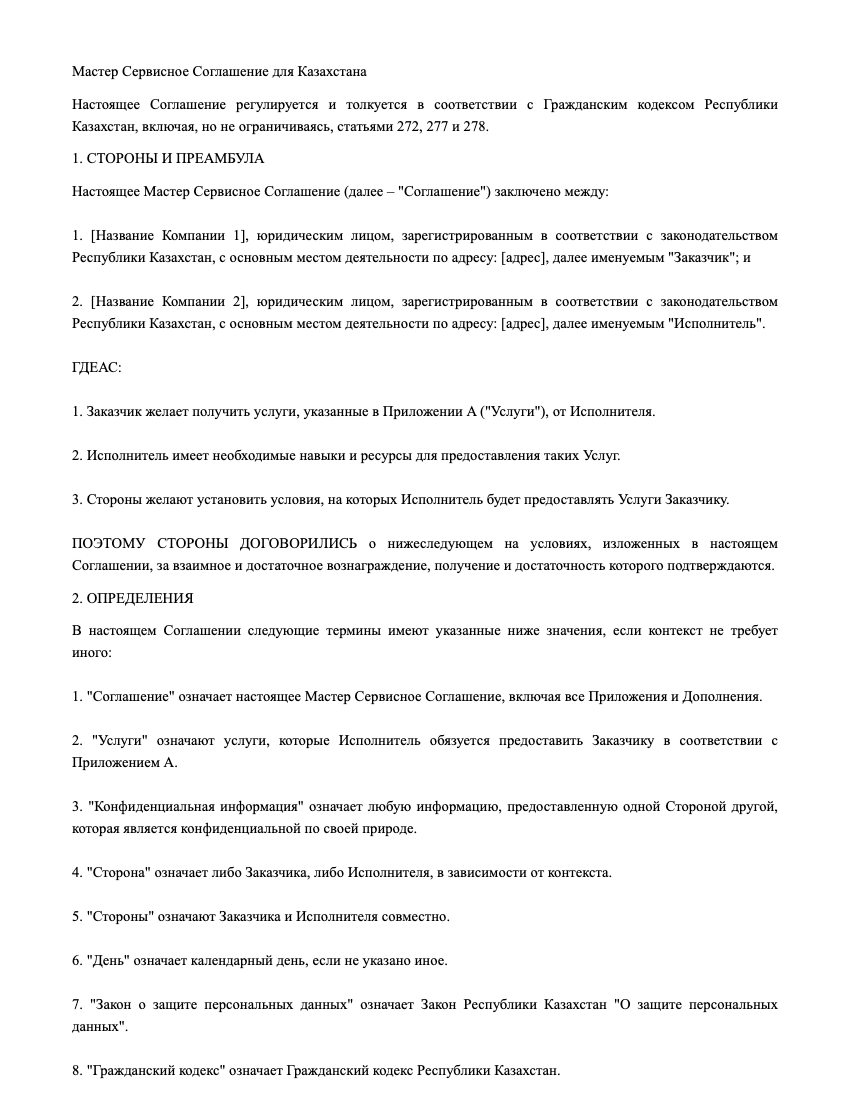
A Kazakhstan Master Services Agreement (MSA) is a framework services contract that fixes the basic terms of collaboration in Kazakhstan and applies to all future projects through separate Tasks/Statements of Work (SOW).
Opening
MSA for Kazakhstan is the primary contract between the client and the contractor, which pre-negotiates payment, acceptance procedure, liability, rights to the work results, and dispute resolution rules. Unlike one-off contracts, the MSA is signed once, and specific projects are documented via separate SOWs/Technical assignments. For small businesses and consultants, this reduces legal costs, speeds up the kickoff of new work, and simplifies risk management under Kazakhstan law.
For a comprehensive guide to structuring MSAs and SOWs that protect your business, see our Freelancer Contracts Guide.
Definition Box
Definition: A Master Services Agreement (MSA) in Kazakhstan is a framework civil-law contract that establishes uniform rules for a series of services/work: the process for issuing tasks (SOW), prices and payment terms, acceptance of the result, confidentiality, transfer of rights to intellectual property, limits of liability, and force majeure. Each individual project is described in an SOW (scope, timelines, rates, deliverable), but the legal “base” remains in the MSA. This structure is especially useful when you regularly perform services for a single counterparty and want to avoid redrafting the full contract.
Why You Cannot Use a Generic MSA in Kazakhstan
The template “for any country” often conflicts with mandatory Kazakhstan norms and the real-world practice of checks, courts, and accounting/document flow. Mistakes in an MSA usually surface not at signing, but later: during a tax audit, employment dispute, payment collection, or data leak. Below are three areas where universal forms most often fail.
Worker Classification Rules
In Kazakhstan, a key risk is substituting labor relations with civil-law services. If your “contractor” actually works as a full-time employee (obeys internal rules, has a fixed schedule, a permanent workplace, regular salary, and is managed by a supervisor), the relationship can be recharacterized as employment. The basics: employment relationships are governed by the Labour Code of the Republic of Kazakhstan, and an employment agreement is mandatory when the work is performed in an employment function with subordination to the employer (the general logic of the Labour Code of the Republic of Kazakhstan on employment contracts and signs of employment relations).
Practical takeaway for the MSA: you cannot copy Anglo-American “independent contractor” formulations without backing by the actual model. The template should include: a project-based nature of services, absence of schedule and subordination, autonomous organization of the execution process by the contractor, absence of providing “a workspace as an employee,” and payment for the result by the SOW. Otherwise the client faces risks of additional mandatory payments, penalties, and employee-benefit obligations (vacations, payouts), while the contractor may encounter status and tax disputes.
Non-Compete Enforceability
In Kazakhstan, a non-compete clause cannot be inserted into an MSA without regard to labor and antimonopoly regulation and the principle of freedom of enterprise. For B2B contractors (IP/LLC), more viable are not “total” non-competes but targeted restrictions: (1) prohibition on using confidential information and trade secrets, (2) prohibition on poaching staff/clients within reasonable bounds, (3) prohibition on working with a specific client of the contractor only in relation to a specific project and only for a limited period.
If you still want a non-compete, make it proportional: limit by territory, duration, and object (specific market/project), and tie it to a legitimate objective — protection of confidential information and client investments. Civil-law mechanisms important here include: clear definition of “competitive activity,” demonstrable damages, and contractual liability. Termination of obligations and grounds for termination should be linked to the Civil Code of the Republic of Kazakhstan (for example, the general norms on termination of obligations — Civil Code of the Republic of Kazakhstan, Art. 272) so it’s clear what happens to restrictions after the project ends.
IP/Work-for-Hire Considerations
For services where materials, code, design, and reports are created, it’s important to spell out the fate of rights. In the continental system of Kazakhstan you typically cannot rely on “work made for hire” as a universal magic phrase. You need: (1) an explicit assignment/transfer of exclusive rights or grant of a license, (2) the moment of transfer of rights (often after full payment), (3) a list of deliverables in each SOW. It’s also prudent to secure the contractor’s right to use general know-how without disclosing confidential client data. If the project involves personal data, tie the transfer of results to the requirements of the Law of the Republic of Kazakhstan “On Personal Data and its Protection” (Arts. 6–7).
What's Included in This Template
Flexible SOW Structure
The MSA sets the “rules of the game,” and the SOW captures the specifics: scope, timelines, deliverable format, acceptance criteria, price (fixed/Time & Materials), expenses, and contacts. This reduces scope creep risk: all changes are documented in an additional SOW or an amendment to it, not in informal agreements.
Kazakhstan-Specific Indemnification
The liability section in the template relies on the possibility of contractual limitation of liability under the Civil Code of the Republic of Kazakhstan (Art. 359) and separately configures: exceptions for intent/gross negligence, allocation of risk for client data and materials, and late payment interest (Civil Code of the Republic of Kazakhstan, Art. 353).
Dispute Resolution and Venue
The template offers a clear dispute-resolution scheme: negotiations and a written claim, then court at the defendant’s location or arbitration (including the option of the AIAC/MCIA if the parties find it suitable). It’s important to fix the contract language (Russian), governing law (Kazakhstan), and the process for electronic document exchange.
Additionally, the template provides:
- Interest for late monetary obligation (Civil Code of the Republic of Kazakhstan, Art. 353).
- Contractual limitation of liability and cap (Civil Code of the Republic of Kazakhstan, Art. 359).
- Grounds for termination of obligations/completion of the project (Civil Code of the Republic of Kazakhstan, Art. 272).
- Provisions on processing and protection of personal data (Law of the Republic of Kazakhstan “On Personal Data and its Protection,” Arts. 6 and 7).
Who Needs This Document?
| User Type | Relationship | Key Benefit |
|---|---|---|
| IT‑studios and developers | Long-term enhancements/support | SOW simplifies recurring tasks and acceptance |
| Marketing agencies | Retainers and campaigns | Scope fixation and additional work, fewer disputes |
| Consultants (finance/HR/operations) | Series of consultations | Convenient payment terms and liability cap |
| Engineering/design/creative | Project outcomes | Clear transfer of rights and quality criteria |
How to Use This MSA Template
Step 1: Fill in the parties’ details
Provide exact names (IP/LLC), BIN/IIN, addresses and signatories based on the charter/Power of Attorney. Ensure the banking details match the payment invoice.
Step 2: Agree on term and termination procedure
Define the term (for example, 12 months) and the conditions for early termination: notice, settlement for actually performed services, and the fate of unfinished tasks.
Step 3: Attach the first SOW
Describe deliverables, deadlines, submission format, acceptance criteria, and price. Specify what materials the client provides and who is responsible for access credentials.
Step 4: Sign and set up the document workflow
Sign the MSA and SOW (paper or EDI/EDO). Specify which e-mails count as official, and the response times for acts/remarks.
Already Receiving Contracts from Clients?
If you more often receive an MSA from a client than you send yours, don’t sign “as is.” In Kazakhstani and cross-border contracts you’ll often see: unlimited liability with no cap, unilateral transfer of all rights “from the moment of creation,” penalties for any shortcoming, and inconvenient jurisdiction. Also review the personal data and confidentiality sections to ensure they comply with the Law of the Republic of Kazakhstan and your actual practice. For a quick initial check, use: an AI contract review tool.
Download Options
Free PDF Version: PDF template MSA for review, agreement with the counterparty, and printing.
Editable Word/Google Docs Version: editable version with fields and example phrases for SOW, acceptance, and transfer of rights, to quickly tailor the agreement to your services, rates, and risks.
Disclaimer
This material is for informational purposes and does not constitute legal advice. For your situation in Kazakhstan, consult a qualified lawyer.
Related MSA Templates
Get the Template
Sign up for our newsletter to receive the template.
Frequently Asked Questions

About Designer Content
Designer Content creates practical legal document resources for landlords, contractors, and small business owners. We simplify complex legal concepts into actionable guidance. Connect with us on LinkedIn.