
A Kazakhstan Non-Disclosure Agreement (NDA) is a contract that creates enforceable confidentiality obligations under the Civil Code of the Republic of Kazakhstan (Grazhdanskiy Kodeks RK) and other local laws. A properly drafted Kazakhstan NDA protects trade secrets and confidential information while respecting local limits on post‑employment restraints, personal data obligations, and formal execution requirements.
What is a Kazakhstan NDA?
Definition: Under the Grazhdanskiy Kodeks RK and related legislation, an NDA is a bilateral or unilateral contract in which parties agree to keep certain information confidential and to use it only for a specified purpose. Trade secrets in Kazakhstan receive protection where information possesses commercial value due to secrecy and where the owner has taken reasonable measures to keep it confidential.
Unlike common-law jurisdictions, Kazakhstan’s civil law regime emphasizes statutory requirements and demonstrable secrecy measures. NDAs must be drafted to show concrete protective steps (technical and organizational) and a clear contractual purpose to obtain strong court protection.
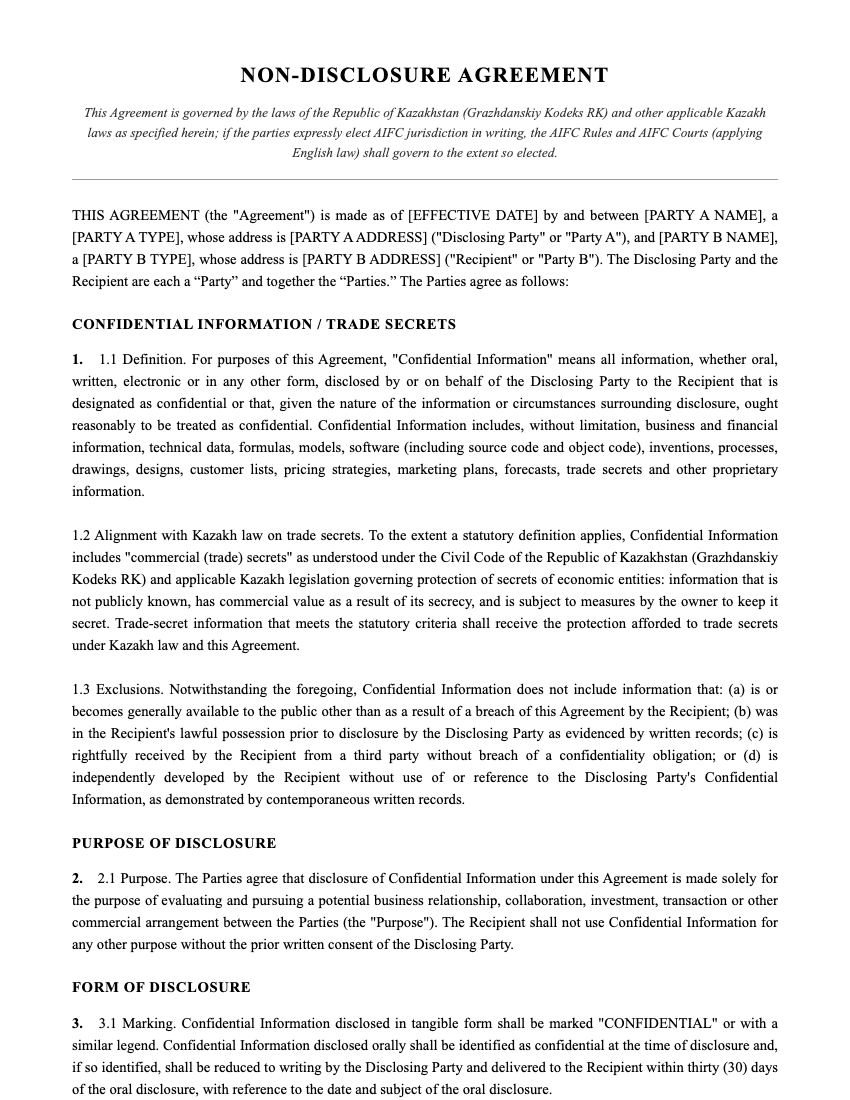
For a complete guide to NDA terms, duration, and standard exclusions, see our NDA Agreement Guide.
Why “generic” NDAs are dangerous in Kazakhstan
Using a generic, foreign NDA template can create four local legal traps.
- Trade-secret proof: Kazakh courts treat trade-secret protection as fact‑specific. If you don’t document the “reasonable measures” (access controls, marking, limited distribution), a court may refuse injunctive relief. Generic templates that only label everything "confidential" are weak evidence in court.
- Personal data exposure: Kazakhstan’s Law on Personal Data and Its Protection (and related rules) restricts the transfer, processing, and cross‑border transfer of personal data. An NDA that allows broad copying or transfer of files without addressing lawful basis and security may create regulatory liability.
- Employment restraints: While Kazakhstan permits certain post‑employment restrictions, labour rules require that non‑compete or restrictive clauses be reasonable and—where the Labour Code or practice requires—compensated. Using a standard foreign non‑compete clause without compensation language or a time limit risks invalidation and employer liability.
- Choice of law and forum confusion: Kazakhstan parties sometimes assume local courts will apply foreign law. If you want English‑style remedies (injunctions, expedited relief), consider AIFC jurisdiction clauses: the Astana International Financial Centre (AIFC) provides an English‑law regime and AIFC Court enforcement for eligible contracts, often delivering faster injunctive relief for international disputes.
Paradigm‑shifting insight: In Kazakhstan, the difference between winning a trade‑secret case and getting an injunction often hinges not on the clause’s wording alone but on demonstrable organizational measures and the chosen forum. A well‑drafted NDA that combines clear confidentiality definitions, documented secrecy practices, and (where appropriate) an AIFC choice of law/forum clause can make the difference between an unenforceable promise and effective protection.
Real legal development: In recent years Kazakhstan has strengthened data and commercial secrecy enforcement by clarifying personal‑data obligations and encouraging corporate data security measures. Courts have increasingly required concrete evidence of secrecy measures (access logs, internal policies, marked documents) when granting provisional measures and damages.
Key clauses adapted for Kazakhstan practice
- Purpose and scope: Narrow purpose clauses tied to a specific project or transaction (e.g., "to evaluate the Vendor's software licence for Project X") reduce disputes under civil‑law import requirements.
- Definitions: Distinguish "Personal Data" (subject to the Law on Personal Data and Its Protection) from "Trade Secrets/Confidential Information." Add express carve‑outs for information subject to personal‑data consent, public domain, independently developed information, and legally compelled disclosure.
- Trade‑secret protection: Add an obligation on the disclosing party to mark materials and on the receiving party to implement and maintain technical and organizational security measures (passwords, limited access, secure storage). These evidentiary steps are essential in Kazakhstan courts.
- Employment and non‑competition: Avoid blanket restraints. If you include a post‑termination restriction for employees, make it time‑limited, geographically reasonable, and provide express compensation if required under the Labour Code or local practice.
- Electronic signatures and execution: Reference Kazakhstan law on electronic documents and e‑signature to permit qualified electronic signatures for execution, and include instructions for exchange of signed scanned copies if needed.
- AIFC option: Provide optional clauses for parties that prefer to submit disputes to the AIFC Court and AIFC Arbitration Centre (English governing law available for eligible parties), which can be attractive for foreign investors and cross‑border matters.
- Whistleblowing and legal disclosures: Include an explicit carve‑out permitting disclosures required by law, regulatory reporting, or internal/external whistleblowing (also necessary to align with public‑interest reporting and personal data rules).
Who needs this document?
| User Persona | Usage Scenario | Key Kazakhstan Benefit |
|---|---|---|
| Local tech startup | Pitching to strategic partner or investor | NDA ties confidentiality to demonstrable security measures required by courts |
| Manufacturer | Sending prototypes to a factory | Prevents misuse while addressing personal data of suppliers/employees |
| Employer | Hiring senior managers | Limits scope of post‑employment restraints and adds compensation language if needed |
| International buyer | M&A due diligence | Option to choose AIFC jurisdiction for stronger cross‑border enforcement |
How to execute a valid Kazakhstan NDA (practical steps)
- Define the purpose precisely and mark materials "CONFIDENTIAL" at the time of disclosure. Courts look for contemporaneous markings.
- Require the recipient to maintain technical and organizational measures (passwords, logging, restricted access). Keep copies of policies as evidence.
- Address personal data explicitly: identify categories, lawful bases, and any required consents or local processing obligations and restrictions.
- Sign with an agreed method: physical signatures, qualified electronic signatures, or AIFC‑approved electronic execution for international contracts. Exchange fully signed executed copies before sharing sensitive information.
Already Receiving NDAs from Clients?
When you receive an NDA in Kazakhstan, check for unsupported foreign non‑compete language, missing data‑processing safeguards, vague definitions that could force you to mishandle personal data, and whether the forum selection makes enforcement practical. an AI contract review tool automates clause detection and highlights Kazakhstan‑specific risks so you can negotiate faster.
Related NDA Templates
Get the Template
Sign up for our newsletter to receive the template.
Frequently Asked Questions

About Designer Content
Designer Content creates practical legal document resources for landlords, contractors, and small business owners. We simplify complex legal concepts into actionable guidance. Connect with us on LinkedIn.