
A Kentucky Non-Disclosure Agreement (NDA) is a written contract that protects confidential business information and trade secrets while aligning with Kentucky's contract law, statutory trade-secret protections, and the state's generally pro-enforcement stance on reasonable post-employment restraints.
What Is a Kentucky NDA?
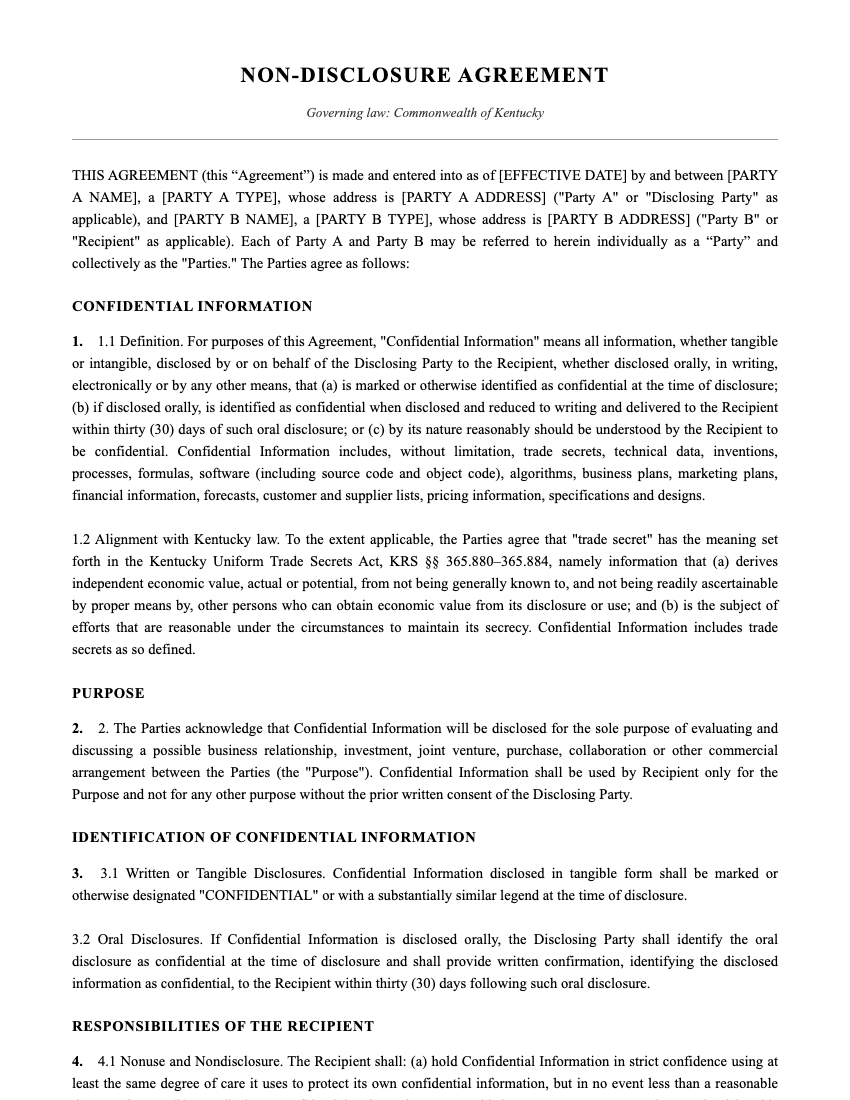
Definition: A Kentucky NDA is a contractual promise—signed by parties in writing—limiting disclosure and use of Confidential Information (customer lists, formulas, source code, pricing models) and providing remedies (injunctions, damages) for breach. Trade-secret claims in Kentucky are governed by the Kentucky Uniform Trade Secrets Act (KUTSA), codified in KRS Chapter 365 (KRS 365.880 et seq.), and federal trade-secret remedies can also be pursued under the Defend Trade Secrets Act (DTSA), 18 U.S.C. § 1836.
Kentucky permits reasonable non-compete and restrictive covenants in many contexts. Unlike jurisdictions that void non-competes, Kentucky courts will enforce restraints that are reasonable in duration, geography, and scope and supported by adequate consideration. That practical reality changes NDA drafting: an overbroad clause might be reformed by a court, but Kentucky employers can include strong protective language when properly tailored.
For a complete guide to NDA terms, duration, and standard exclusions, see our NDA Agreement Guide.
Why “Generic” NDAs Are Dangerous in Kentucky
Most online NDA templates are generic. In Kentucky, that creates at least three real risks:
- Enforceability gaps (consideration and reasonableness). Kentucky requires adequate consideration for covenants not to compete and enforces only reasonable scopes. Using boilerplate duration or territorial restrictions can make an otherwise valid NDA vulnerable to narrowing or rejection by the court.
- Long-tail litigation exposure. Kentucky’s statute of limitations for written contracts is unusually long: KRS 413.090 provides a 15-year limitation for written obligations. That means a written NDA can be litigated many years after a disclosure, so you must think long-term about survival clauses and evidence preservation.
- Missing federal DTSA notice. The DTSA (18 U.S.C. § 1833(b)) gives trade-secret owners access to exemplary damages and attorney’s fees only if the employment agreement contains an express notice allowing employees to report suspected violations to government officials. Many templates omit this and thus sacrifice enhanced remedies in federal cases.
Paradigm-shifting insight (Kentucky): the combination of Kentucky’s pro-enforcement posture for reasonable restraints and the 15-year written-contract limitation means NDAs can have long, enforceable lifespans—provided they are tailored to reasonableness. In other words, Kentucky firms can achieve durable protection, but only if they carefully calibrate duration, scope, and consideration; a poorly drafted long-term NDA is both overreaching and exposes you to reformation or attack years down the road.
Real-World Development
While Kentucky lacks a single blockbuster Supreme Court ruling that rewrote NDA law, local appellate decisions consistently apply the traditional reasonableness test and frequently uphold confidentiality covenants when supported by adequate consideration and narrow scope. Employers should also follow federal developments: DTSA (2016) has meaningfully changed remedies for trade-secret theft nationwide, including in Kentucky federal courts.
What’s Included in This Template? (Key Clauses)
- Mutual vs Unilateral: Two versions included—One-Way for employers/owners disclosing to vendors or contractors, and Mutual for bona fide two-way negotiations.
- Precise Definitions: Separate “Trade Secrets” (KUTSA-style elements) from general “Confidential Information.” Trade secrets require economic value from secrecy and reasonable secrecy measures; general confidential data gets time-limited protection (commonly 2–5 years).
- Duration & Survival: Customize duration for general confidential information (commonly 2–5 years) and allow trade secrets to survive as long as they remain secret; include an express survival clause calibrated to Kentucky’s 15-year written-contract window if you need long-tail enforcement planning.
- Use & Non-Competition Carve-Outs: Kentucky allows reasonable restraints; the template avoids naked blanket non-competes but includes narrowly drafted non-solicitation and limited non-compete options with optional consideration language (continued employment, bonus, or other bargained-for consideration).
- Injunctive Relief & Remedies: Provides for equitable injunctive relief (customary in Kentucky) and includes DTSA whistleblower notice language required to preserve enhanced federal remedies.
- Exclusions: Public domain, independently developed information, prior-known info, and compelled disclosure carve-outs.
- Residuals: Optional residuals clause for ideas retained in unaided memory; use only where appropriate (software, R&D) and negotiate scope.
Who Needs This Document?
| User Persona | Usage Scenario | Why This Template Helps in Kentucky |
|---|---|---|
| Employers & Startups | Protecting IP from departing employees | Kentucky will enforce reasonable covenants; this template balances enforceability with reasonableness |
| Manufacturers | Sharing specs with suppliers | Labels trade secrets vs. confidential production info for long-term protection |
| Service Providers | Working with enterprise clients in KY | Includes mutual NDA and contractor-friendly options to preserve client relationships |
| Investors & Acquirers | Due diligence in an M&A process | Allows limited, narrowly-tailored disclosure while preserving trade-secret claims |
How to Execute a Valid Kentucky NDA
- Choose the Right Form: Use One‑Way if only you disclose; use Mutual only when both sides will genuinely exchange confidential information.
- Define Purpose Narrowly: Limit permitted use to the specific transaction (e.g., "evaluate licensing of Product X"). Broad purposes invite later disputes.
- Provide Consideration for Restrictive Covenants: If you want a post-employment restriction, ensure adequate consideration (continued employment, new benefits, or specific compensation). Kentucky courts look for real bargained-for value.
- Sign and Preserve Evidence: Execute in writing with clear signatures and dates. Because KRS 413.090 gives a 15‑year written-contract limitation, preserve the signed agreement and document confidentiality measures (labels, access controls) to support future trade-secret claims.
Receiving an NDA from a Client?
Don’t sign on the dotted line without checking for overbroad scope, indefinite durations, unfair consideration clauses, or missing DTSA notice language. This template’s language can be used as a negotiation baseline.
an AI contract review tool can instantly flag risky clauses, compare terms against Kentucky law and DTSA requirements, and generate negotiation redlines—saving hours of review.
Related NDA Templates
Get the Template
Sign up for our newsletter to receive the template.
Frequently Asked Questions

About Designer Content
Designer Content creates practical legal document resources for landlords, contractors, and small business owners. We simplify complex legal concepts into actionable guidance. Connect with us on LinkedIn.