
Opening
The Master Services Agreement (MSA) in Kyrgyzstan is a framework contract between a client and a contractor that predefines the key terms of cooperation for future projects. Instead of rewriting the contract from scratch each time, you sign one Master Services Agreement, and carry the specifics (scope of work, timelines, price) into separate Tasks/ToR (SOW). For small businesses this speeds up approvals, reduces disputes about “what exactly was promised,” and helps discipline payments.
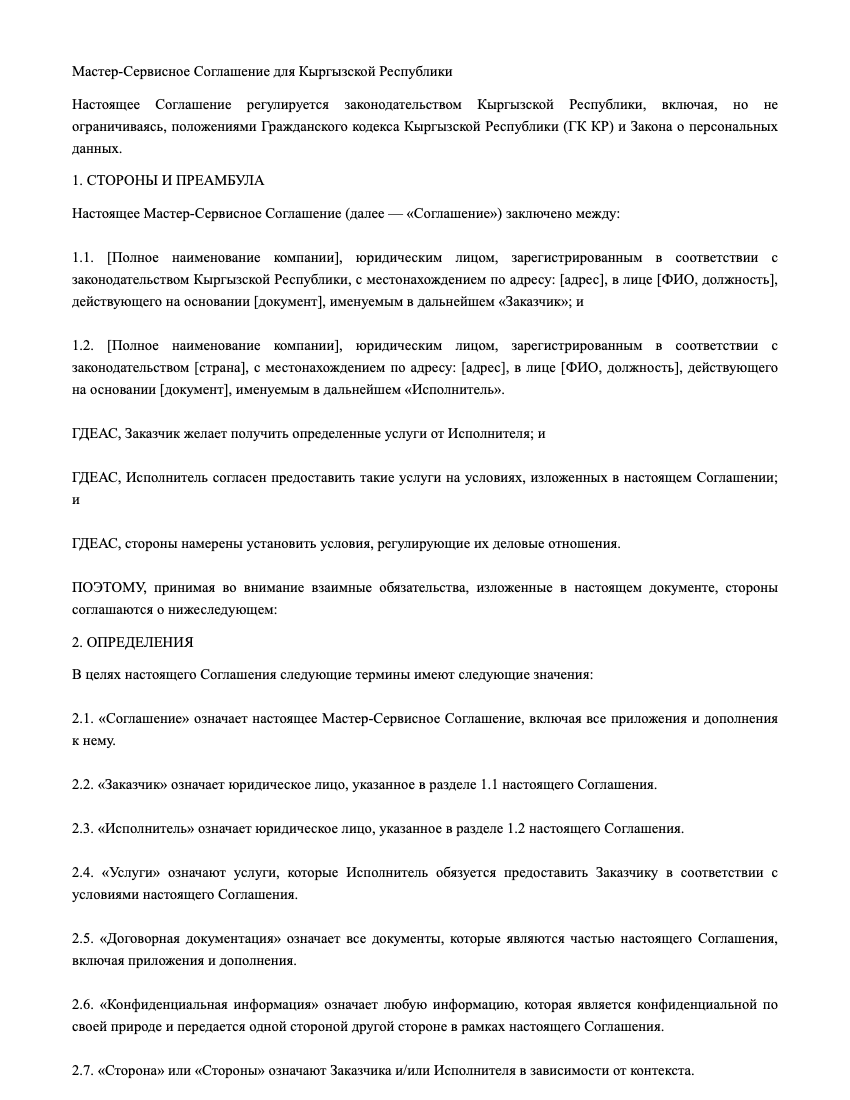
For a comprehensive guide to structuring MSAs and SOWs that protect your business, see our Freelancer Contracts Guide.
Definition Box
Definition: Master Services Agreement (MSA) for the Kyrgyz Republic — this is a basic civil-law contract that establishes the general rules for providing services/performing work between two commercial parties: the process for concluding Statements of Work (SOW), acceptance requirements, payment, liability, confidentiality, and dispute resolution. In each separate project the parties sign an SOW (or an order attachment), and the MSA automatically “pulls through” uniform legal terms. This format is especially useful for agencies, IT contractors, and consultants who work in series of projects with a single client.
Why You Cannot Use a Generic MSA in Kyrgyzstan
Standard international MSA templates are often drafted for Anglo-Saxon practice or for another CIS country. In Kyrgyzstan, the norms of the continental civil-law system apply, and even “trifles” like late-payment interest, statutes of limitations, formulations of liability, and handling of personal data are better tied to local norms. Otherwise you will get an agreement that is difficult to enforce in court, and negotiations with the counterparty will be prolonged due to conflicting provisions.
Worker Classification Rules
A key risk for service companies is when the relationship with a natural person‑contractor effectively looks like employment but is formalized as a civil-law arrangement. In Kyrgyzstan, the distinction is usually based on the character of subordination and organization of work: an employment contract implies including the worker in the payroll, compliance with internal rules, a work-time regime, and supervision of the process, whereas a civil-law contract is the result and autonomy of the contractor. The basic guidelines are set by the Labor Code of the Kyrgyz Republic (general indicators of employment relationships and labor contracts), as well as the practice of applying the norms on contracts for work/assured services in the Civil Code of the Kyrgyz Republic.
Why this matters for an MSA: if you rewrite the “command-and-control” aspects from a foreign template (rigid schedule, daily reports, ban on other clients), it may look like an employment relationship. The consequences are usually expressed in requirements to formalize an employment contract, accrue mandatory payments/contributions, and pay any arrears. Therefore the MSA template for the Kyrgyz Republic should emphasize the contractor’s independence, pay-for-result under the SOW, and the absence of internal subordination.
Non-Compete Enforceability
Unlike jurisdictions with strict prohibitions, in Kyrgyzstan competition restrictions are more often addressed through a combination of confidentiality, non-solicitation, and protection of trade secrets, rather than through a “classic” non‑compete that directly prohibits a person from working in the industry. For relationships with individuals (as potential employees) post‑contract non‑compete restrictions can be vulnerable if they are excessive and effectively restrict the right to work.
A practically safe alternative for B2B is: (1) strict confidentiality and data handling regime; (2) narrow non-solicitation (not poaching employees/customers, with a reasonable term); (3) contractual liability provisions for disclosure or use of information. In a Kyrgyz MSA template, it is wiser to avoid a “total prohibition on competing” and rely on civil-law tools to protect interests to improve enforceability of the terms.
IP/Work-for-Hire Considerations
With IP in service projects, the main pitfall of “one-size-fits-all” templates is the automatic transfer of rights without a clear description of the deliverable, transfer moment, and scope of rights. For Kyrgyzstan, it is more practical to specify: what materials are created under the SOW, who owns the exclusive rights, when the transfer occurs (usually after full payment), and what rights the contractor retains (for example, on know-how/libraries). If the project includes software or design, the MSA should separate “pre-existing materials” and “created work” to avoid disputes over what was included in the price.
What's Included in This Template
Flexible SOW Structure. The MSA template sets the umbrella of terms, and each new assignment is documented in a separate SOW: description of services, deadlines, price, deliverable format, and acceptance criteria. This reduces the risk of scope creep: anything not in the SOW is considered additional and agreed separately.
Kyrgyzstan-Specific Indemnification. In the liability section there is a clear cap and exceptions for willful misconduct/gross negligence, as well as a mechanism for damages reimbursement to the extent permitted by civil law. For “monetary discipline” the late-payment interest is reflected at Civil Code of the Kyrgyz Republic, Article 359 (18% per annum).
Dispute Resolution and Venue. The template offers choosing a court of jurisdiction in Kyrgyzstan and separately indicating arbitration/tribunal proceedings if the parties use it. It also provides for a claims/notice period and linkage to the three-year general limitation period (Civil Code of the Kyrgyz Republic, Article 230).
Additionally in the template:
- Late-payment interest: Civil Code of the Kyrgyz Republic, Article 359.
- Liability cap/limitation: Civil Code of the Kyrgyz Republic, Article 333.
- Compliance with personal data processing rules: Law of the Kyrgyz Republic “On Personal Data,” Article 7.
Who Needs This Document?
| User Type | Relationship | Key Benefit |
|---|---|---|
| IT‑firms and developers | Phase-based projects and support | Uniform acceptance criteria and transfer of IP after payment |
| Marketing agencies | Retainer/monthly services | Control of scope creep via SOW and additional charges |
| B2B consultants | Long-term advisory contracts | Clear boundaries of responsibility and confidentiality |
| Contractors/service firms | Series of works on client sites | Order process, timelines, and acceptance for each order |
How to Use This MSA Template
Step 1: Identify the parties and details
Fill in the precise legal names, TIN/OKPO where available, addresses, and representatives, to avoid later disputes about who exactly signed the agreement. For sole proprietors and individuals, it is important to provide passport details/address if required by your documentation workflow practice.
Step 2: Set the term and termination
Determine whether the MSA will be permanent with a termination-on-notice right or for a fixed term. Specify that started SOWs will either be completed or terminated under separate rules.
Step 3: Attach the first SOW
Put into the SOW the subject matter/scope, deadlines, price, format of the deliverable, and acceptance criteria. This reduces the risk of misalignment and protects payment for additional work.
Step 4: Sign and organize document management
Sign the MSA once, and going forward sign only the SOWs and acts. Keep correspondence and versions of attachments: this is important if a dispute arises about timetables, scope, or payment.
Already Receiving Contracts from Clients?
If a client sends their MSA, do not sign it automatically: foreign templates often include one‑sided penalties, “eternal” transfer of IP, inconvenient jurisdiction, and vague acceptance. Check whether late-payment interest, the claim period, and the liability cap align with what you are actually willing to accept, and whether data privacy requirements are met. For a quick initial check, use: an AI contract review tool.
Download Options
Free PDF Version: The PDF version is suitable for quickly showing the client the structure and agreeing on key terms. Editable Word/Google Docs Version: an editable file convenient for tailoring to your business: add industry-specific SOWs, rates, SLAs for support, and the process for transferring exclusive rights after payment.
Disclaimer
The material is for informational purposes and is not legal advice. For high-risk transactions, consult a lawyer in the Kyrgyz Republic.
Related MSA Templates
Get the Template
Sign up for our newsletter to receive the template.
Frequently Asked Questions

About Designer Content
Designer Content creates practical legal document resources for landlords, contractors, and small business owners. We simplify complex legal concepts into actionable guidance. Connect with us on LinkedIn.