
A Kyrgyzstan Non-Disclosure Agreement (NDA) is a contract governed by Kyrgyz civil law (Grazhdanskiy Kodeks KR) that sets out parties' obligations to keep confidential information secret. Because Kyrgyzstan follows a civil-law, codified approach, NDAs must be drafted so they meet formal contract requirements, respect personal-data rules and consumer-protection norms, and preserve evidence for enforcement within the local 3‑year prescription period (iskovaya davnost).
What is a Kyrgyzstan NDA?
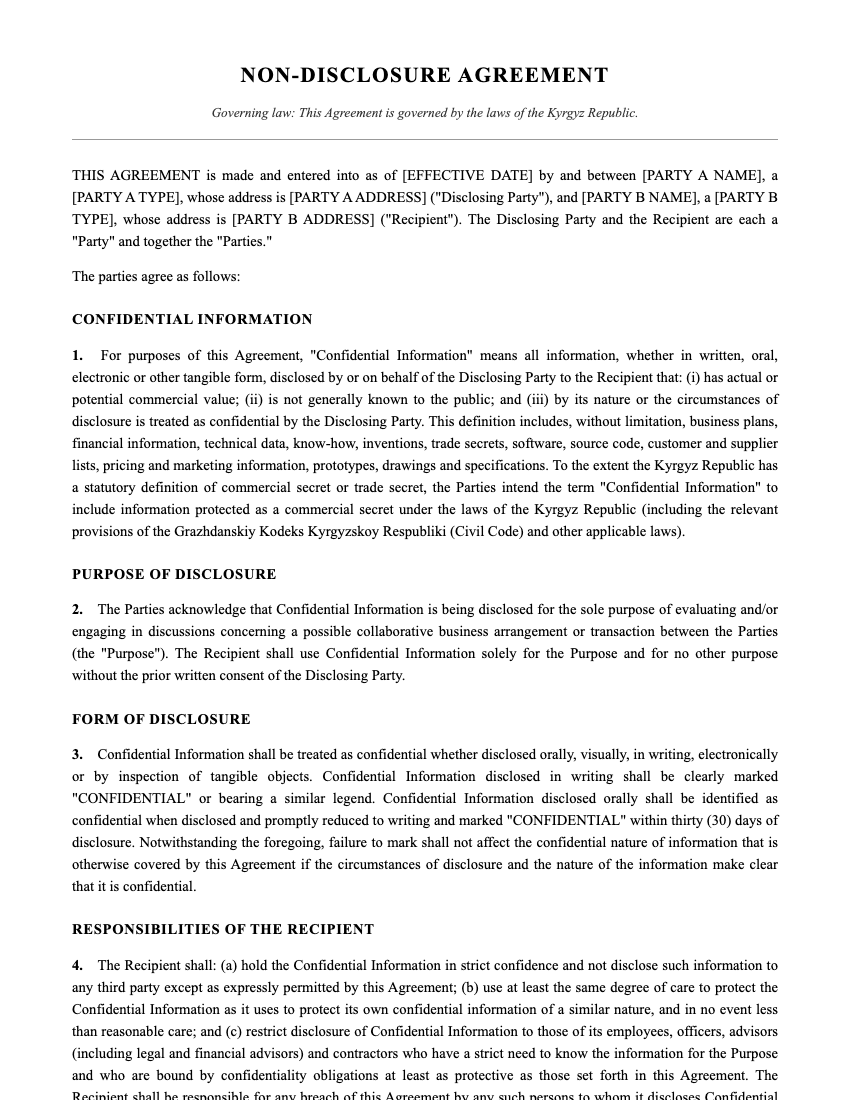
Definition: A Kyrgyzstan NDA is a written agreement in which one or both parties agree to keep specified Confidential Information secret and to use it only for a limited Purpose. NDAs in Kyrgyzstan derive their legal effect from the Civil Code (Grazhdanskiy Kodeks KR), relevant sectoral laws (for personal data and consumer protection), and administrative rules on electronic signatures.
In practice, that means three local legal features matter more than in many common-law jurisdictions: (1) personal-data consent and processing rules under the Law on Personal Data; (2) formal written-form requirements and recognition of electronic signatures; and (3) short limitation periods—generally a 3‑year prescriptive period for claims under civil law.
For a complete guide to NDA terms, duration, and standard exclusions, see our NDA Agreement Guide.
Why "Generic" NDAs Are Dangerous in Kyrgyzstan
Many free NDA templates are drafted for common-law markets and omit civil-law specifics. In Kyrgyzstan, those omissions trigger four common traps:
- Personal-data compliance trap
Most NDAs share names, CVs, client lists, or contact data. The Law on Personal Data requires lawful grounds (usually consent or other statutory basis) to process personal data and imposes duties on the data controller. If you disclose personal data in breach of the law, you can face administrative liability and weaken your civil remedies. Always include a lawful-processing clause and obtain the necessary consents before sharing. - Formality and evidence trap
Civil-code practice emphasizes documentary form. While electronic signatures are recognized under Kyrgyz law, evidence of signature and timestamps matter. A poorly documented exchange (an unsigned email with attachments) can be challenged as unenforceable or difficult to prove in court. - Limitation-period trap
Kyrgyz civil practice generally applies a three-year limitation period (iskovaya davnost) for contractual claims. If you delay enforcement beyond that period, you risk losing the right to sue. That makes prompt marking, logging, and action important. - Overbroad restraint trap (the "hidden restraint") — paradigm-shifting insight for Kyrgyzstan
There is no single, express nationwide statute that mirrors California's Section 16600 or Germany's mandatory non-compete compensation rules. Instead, Kyrgyz courts apply public-policy and good-faith principles from the Civil Code when assessing restrictions on former employees or contractors. The paradigm-shifting insight: in Kyrgyzstan NDAs that attempt to function as backdoor non-competes (broadly prohibiting use of any knowledge or future competitive activity) risk being recharacterized or partially invalidated under general contract law and consumer/employee protections. The enforcement outcome frequently turns on whether the clause is a legitimate confidentiality measure (protectable trade secret) versus an unlawful restraint on trade or employment. Therefore, focus NDAs on identifiable confidential items and reasonable use limits rather than sweeping prohibitions.
Real development to watch
Regulatory focus on personal-data enforcement has increased in recent years; international legal analyses and local regulator notices have stressed consent, purpose limitation and logging of processing operations. This means NDAs that involve customer or employee data must expressly allocate responsibilities for compliance and breaches.
Key Clauses to Include (Kyrgyzstan-adapted)
- Purpose and narrow definition of Confidential Information: list categories and exclude publicly known information.
- Personal Data & Processing Consent: explicit consent language where personal data will be processed, plus allocation of controller/processor duties and breach notification responsibilities (to align with the Law on Personal Data).
- Reasonable Secrecy Measures: describe how information will be marked and stored so a court can find the parties made reasonable efforts to keep secrets.
- Limited Use and No Backdoor Restraint: prohibit disclosure and misuse but avoid blanket non-compete wording—frame obligations as confidentiality-focused, not employment restraints.
- Term & Survival: two-tier approach — limited-term protection (e.g., 2–5 years) for general confidential info and indefinite protection for true trade secrets so long as secrecy is maintained.
- Remedies & Limitation: reserve injunctive relief and contractual damages, note the local 3‑year limitation period for bringing claims, and keep evidence-preservation obligations.
- Electronic Signature & Execution: confirm agreement may be signed electronically under local e-signature laws, and specify acceptable platforms and verification methods.
Who Needs This Document?
| User Persona | Usage Scenario | Local Benefit |
|---|---|---|
| Startups in Bishkek | Sharing pitch decks with investors | Protects commercial plans while ensuring personal-data consent for investor reviews |
| Software shops | Hiring freelance developers | Preserves source-code confidentiality while avoiding invalid employment restraints |
| Exporters / Manufacturers | Sharing designs with factories abroad | Clarifies trade-secret status and required secrecy steps under Civil Code |
| Law firms & consultants | Reviewing client lists, staff mobility | Preserves client relationships while respecting local employee protections |
How to Execute a Valid Kyrgyzstan NDA
Step 1 — Choose the correct form: One-way (unilateral) when only one party discloses; mutual when both parties exchange information. Be explicit about who is controller/processor of personal data.
Step 2 — Narrow the Purpose: Describe the commercial purpose precisely (e.g., "evaluate X supply agreement") so courts will enforce limits on use.
Step 3 — Mark and log: Label documents "CONFIDENTIAL," keep disclosure logs, and secure electronic access with audit trails. This evidences the "reasonable secrecy measures" courts expect.
Step 4 — Sign and preserve signatures: Use a recognized electronic signature method or wet-ink signing. Save signed copies and transaction metadata immediately; act promptly if you anticipate enforcement because of the three-year limitation.
Receiving an NDA from a Counterparty?
If a client or employer sends you an NDA, review it for hidden restraints, unclear personal-data allocations, and vague confidentiality definitions. Watch for clauses that require you to indemnify the other side for broader liabilities (including personal-data fines).
an AI contract review tool (our contract review tool) can scan NDAs for risky language under Kyrgyz law: it flags overbroad confidentiality definitions, missing personal-data consent language, and clauses that function as backdoor restraints on trade—saving you negotiation time.
Related NDA Templates
Get the Template
Sign up for our newsletter to receive the template.
Frequently Asked Questions

About Designer Content
Designer Content creates practical legal document resources for landlords, contractors, and small business owners. We simplify complex legal concepts into actionable guidance. Connect with us on LinkedIn.