
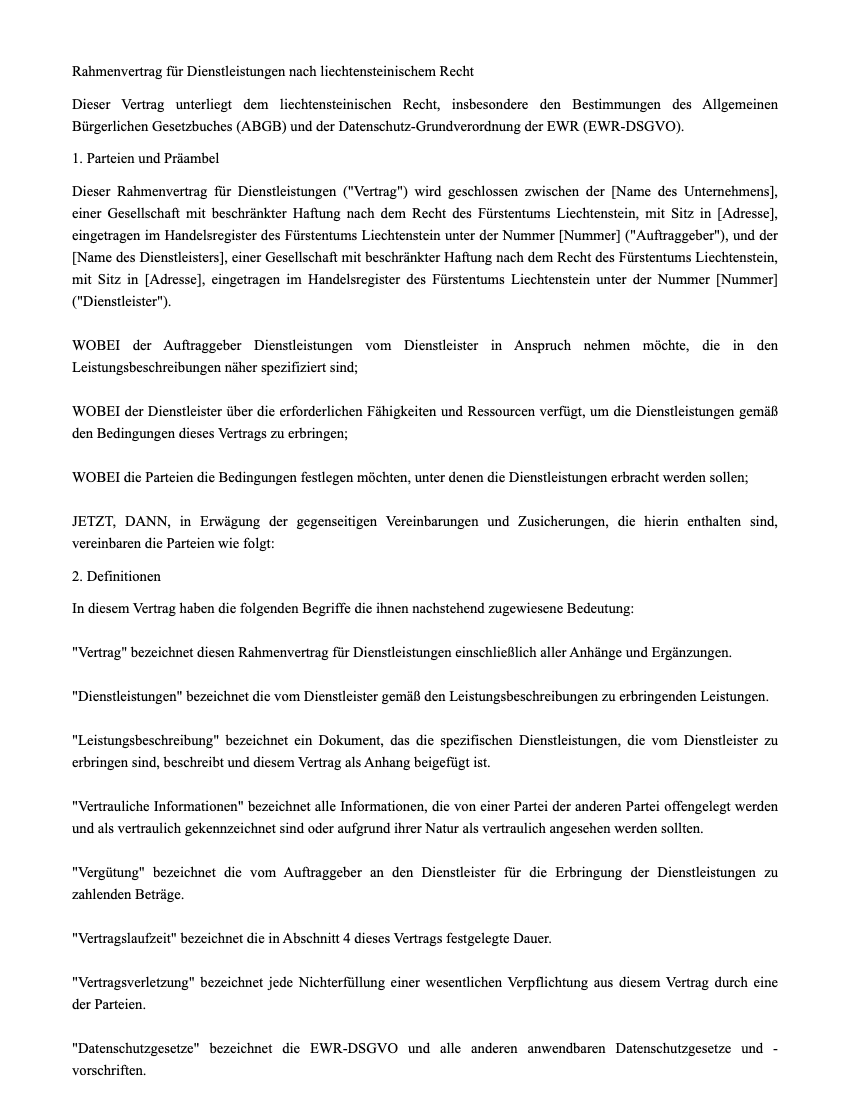
A Liechtenstein Master Services Agreement (MSA) is a reusable framework contract for B2B services under Liechtenstein law that lets you run multiple projects on short Statements of Work (SOWs) without renegotiating core legal terms each time. It’s the document that sets your payment rules, delivery acceptance, liability limits, confidentiality, IP ownership, and dispute resolution—then each new project simply plugs in scope, deadlines, and fees. For SMB owners, agencies, and freelancers, a Liechtenstein-specific MSA is also about compliance: the ABGB rules on damages and interest, the EWR-DSGVO requirements for processors, and enforceable dispute/venue language for Vaduz.
Definition: A Liechtenstein Master Services Agreement (MSA) is a long-form “umbrella” agreement governed by Liechtenstein civil law (typically the ABGB as applied in Liechtenstein) that defines the baseline legal and commercial terms for a continuing service relationship. Individual projects are then documented in separate Statements of Work (SOWs) that incorporate the MSA by reference. This structure reduces transaction cost and speeds up procurement while keeping risk predictable: late-payment interest, warranty standards, confidentiality, data-processing obligations under the EWR-DSGVO (notably Article 28), and dispute resolution (courts or arbitration in Vaduz) are set once and reused.
Why You Cannot Use a Generic MSA in Liechtenstein
Generic MSAs are usually drafted around U.S. common-law assumptions (broad “work made for hire,” aggressive limitation-of-liability clauses, or vague data-processing language). In Liechtenstein, enforceability depends on how the contract fits into the ABGB framework and mandatory rules around employment, unfair terms, and data protection. A template that ignores Liechtenstein specifics can fail in exactly the clauses you rely on when something goes wrong: non-payment, a data incident, or a dispute about whether deliverables can be reused.
3a. Worker Classification Rules
If your “service provider” is really working like an employee, the contract label won’t save you. In Liechtenstein, employee relationships are primarily governed by the Arbeitsvertragsrecht in the ABGB and the Liechtensteinisches Arbeitsgesetz (ArG), and authorities look at substance over form: integration into the client’s organization, instructions/control, fixed working times, and economic dependence. A generic MSA that pretends every engagement is independent contracting—while the SOW sets daily hours, requires exclusivity, and places the worker in the client’s internal reporting lines—creates misclassification risk.
For a comprehensive guide to structuring MSAs and SOWs that protect your business, see our Freelancer Contracts Guide.
Why it matters: misclassification can trigger obligations for wages and employment protections, and it can also create social security exposure. In practice, disputes often end up focusing on the ABGB’s employment-contract concepts and mandatory worker-protection rules rather than what the MSA calls the relationship. Your Liechtenstein template should therefore include (i) clear independent-contractor representations, (ii) a “no authority to bind” clause, (iii) control-limiting language (provider chooses means and schedule), and (iv) a safety valve allowing either party to restructure the engagement if it starts to look like employment. This is not about dodging law; it’s about aligning the operational reality with the legal structure.
3b. Non-Compete Enforceability
Unlike California, Liechtenstein can enforce post-termination non-competes in an employment setting, but they must be drafted carefully. For employees, the relevant rules are found in Liechtenstein’s ABGB provisions on employment and post-contractual restraints (often applied similarly to Austrian doctrine), where enforceability typically depends on legitimate business interest and proportionality (scope, duration, and geographic reach). Overbroad restrictions can be reduced or disregarded by a court.
For B2B MSAs between companies (or genuine freelancers), non-competes are not automatically “void,” but they are still scrutinized under civil-law principles such as good faith and reasonableness, and—if the clause effectively prevents someone from practicing their trade—courts may view it as excessive. A generic U.S.-style non-compete (“any competitive activity worldwide for 2 years”) is a common fail.
A Liechtenstein-friendly template uses narrower, defensible alternatives first: (1) confidentiality and trade-secret protection; (2) non-solicitation of the other party’s employees/customers for a limited period; and (3) project-specific exclusivity only when the client pays for it. If you do include a non-compete, keep it tied to the actual service field, define competitors, cap the duration, and add a severability/reduction mechanism. Pair it with clear consideration (commercial rationale) so the clause looks like risk allocation rather than punishment.
3c. IP/Work-for-Hire Considerations
Liechtenstein follows civil-law concepts: ownership in deliverables usually stays with the creator unless rights are transferred. A generic “work made for hire” clause is not a safe shortcut outside U.S. copyright logic. Your MSA should therefore (i) define background IP vs. project IP, (ii) use an explicit assignment (Abtretung) or license grant for deliverables upon full payment, and (iii) reserve the provider’s tools, templates, and know-how. For custom software, specify whether the client receives source code and what third-party/open-source terms apply. This avoids later ABGB-based disputes about intent, defects, and damages (ABGB § 1293).
What’s Included in This Template
Flexible SOW Structure
The MSA sets stable legal terms once, while each SOW defines scope, milestones, acceptance criteria, and fees. This prevents “scope creep” and keeps each new project to a short, signable appendix that automatically inherits the core terms.
Liechtenstein-Specific Indemnification
The indemnity and damages section is drafted to align with ABGB concepts of fault and damage, including a clear carve-out for intent and gross negligence and a pragmatic exclusion of indirect/consequential losses—structured to be readable and enforceable under Liechtenstein civil-law reasoning (ABGB § 1293).
Dispute Resolution and Venue
The template offers a court venue option in Liechtenstein and an arbitration option seated in Vaduz, Liechtenstein. This avoids the practical problem of being dragged into a foreign forum and makes enforcement and procedure more predictable.
Additional Liechtenstein-specific provisions include:
- Late-payment interest aligned with ABGB § 1332 (Verzugszinsen).
- A limitation period reminder referencing ABGB § 1489 (often applied as a 10-year period for certain claims).
- Data-processing (processor) terms compliant with EWR-DSGVO Article 28 (mandatory contract contents).
- Mistake/gross disparity guardrails referencing ABGB § 934 (laesio enormis) to reduce “unfair bargain” challenges.
Who Needs This Document?
| User Type | Relationship | Key Benefit |
|---|---|---|
| IT & Software Agencies | Ongoing development and support | Reusable SOWs; IP transfer only on payment; clear acceptance |
| Management Consultants | Retainers and advisory projects | Controls scope creep; sets rates, expenses, and confidentiality |
| Marketing/Freelance Creatives | Campaign-by-campaign work | Predictable payment/late interest; portfolio and usage rights rules |
| Cross-border Service Providers | Serving Liechtenstein clients from the EEA | EWR-DSGVO Art. 28 terms + Vaduz dispute option |
How to Use This MSA Template
Step 1: Identify the Parties
Use full legal names, registration details, and business addresses. If a signatory is acting for a company, specify their authority to sign.
Step 2: Set Term, Termination, and SOW Priority
Choose a fixed term or evergreen renewal and define notice periods. Add a clear priority clause: SOW overrides MSA only where it explicitly says so.
Step 3: Attach Your First SOW
Keep deliverables out of the MSA. Put them in the SOW with a timeline, acceptance test, and fees (fixed, milestone, or time-and-materials).
Step 4: Sign and Operationalize
Sign the MSA once, then reuse it for each project by signing new SOWs. Put invoicing contacts, PO rules, and a change-request process into your workflow.
Related MSA Templates
Get the Template
Sign up for our newsletter to receive the template.
Frequently Asked Questions

About Designer Content
Designer Content creates practical legal document resources for landlords, contractors, and small business owners. We simplify complex legal concepts into actionable guidance. Connect with us on LinkedIn.