
A Liechtenstein Non‑Disclosure Agreement (NDA) is a written contract that protects business secrets and confidential information while respecting Liechtenstein's civil‑law formalities, the national Trade Secrets Act (GeschGehG) and EWR‑level data protection (EWR‑DSGVO/GDPR). Unlike short online templates built for common‑law jurisdictions, a Liechtenstein NDA must align with codified definitions, permissible post‑employment restraints and personal‑data rules.
What is a Liechtenstein NDA?
Definition: Under the Gesetz über den Schutz von Geschäftsgeheimnissen (GeschGehG) a "Geschäftsgeheimnis" is information that (i) is secret in the relevant circles, (ii) has commercial value because it is secret and (iii) is subject to reasonable secrecy measures by the holder (see GeschGehG Art. 2). An NDA documents the parties' expectations, complements the statutory protection, and creates contractual remedies for breaches not covered or fully remedied by statute.
A carefully drafted Liechtenstein NDA protects what is legally protectable (trade secrets and confidential business information) without accidentally creating invalid or excessively burdensome restraints on employment or data processing.
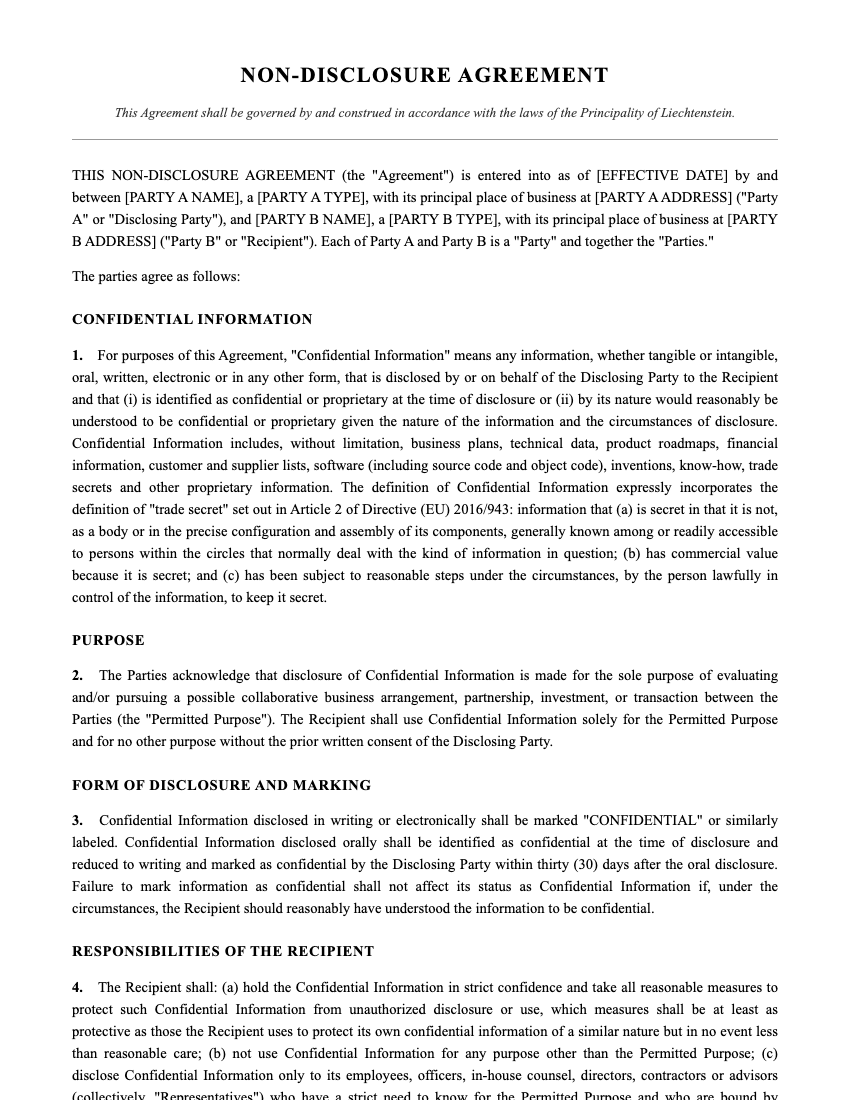
For a complete guide to NDA terms, duration, and standard exclusions, see our NDA Agreement Guide.
Why generic NDAs are dangerous in Liechtenstein
Using a boilerplate NDA not tailored to Liechtenstein creates three common traps you must avoid.
- Overbroad post‑employment restraints (Karenz) disguised as confidentiality
Liechtenstein follows continental practice: post‑contractual non‑compete (Karenz) and non‑solicit covenants in employment law are enforceable only if they meet strict requirements (scope, duration, geographic limitation and, importantly, compensation—"Karenzentschädigung"). A confidentiality clause that effectively prevents a former employee from working in their field can be recharacterised as a prohibited restraint and be reduced or struck down by courts. If you need post‑employment protection, use an express Karenz clause with lawful compensation rather than burying restrictions inside the NDA.
Paradigm‑shifting insight: In Liechtenstein the real risk is not that NDAs are void as a whole (as in some US jurisdictions), but that a badly drafted NDA will be re‑characterised as an unlawful or undercompensated "Karenz" and either be unenforceable or expose the employer to claims for unpaid compensation. Think compensation first; confidentiality language second.
- Ignoring EWR‑DSGVO when sharing personal data
If your confidential materials include personal data (employee lists, candidate CVs, contact databases), the EWR‑DSGVO (Regulation (EU) 2016/679 as applied in the EEA) governs lawful processing and transfers. Your NDA must specify lawful bases and technical/organisational safeguards; otherwise, contractual confidentiality cannot cure GDPR non‑compliance.
- Failing to track statutory exceptions and remedies under GeschGehG
The GeschGehG preserves certain permitted disclosures (e.g., reporting to public authorities, whistleblowing) and sets out remedies and provisional measures (Art. 6–10). NDAs that attempt to bar lawful disclosures or ignore statutory interim relief can be partially unenforceable.
Real legislative development: Liechtenstein implemented the EU Trade Secrets Directive through the GeschGehG in 2019–2020. That law harmonised civil remedies for trade secret misuse and clarified the role of confidentiality agreements as supplementary contractual protection.
Key clauses in a Liechtenstein NDA (and why they matter)
- Definition of Confidential Information / Trade Secrets. Distinguish between ordinary confidential business information (time‑limited) and trade secrets protected under GeschGehG Art. 2 (potentially protected indefinitely while secret).
- Purpose limitation. Narrowly state the permitted use (e.g., "for evaluating a distributor relationship for Product X"). Broad "business discussions" phrases can be reinterpreted by courts and defeat enforceability.
- Exclusions. Carve out information that: was public, already known, independently developed, or lawfully disclosed. Include lawful whistleblowing exceptions consistent with GeschGehG and public‑interest disclosures under EWR‑DSGVO.
- Duration. Use a two‑tier approach: ordinary confidential info (customary 2–5 years); trade secrets (no fixed term — protected while secret under GeschGehG and general limitation rules).
- Post‑employment restrictions. If you need a Karenz, draft a separate clause with explicit compensation terms (Karenzentschädigung), clear temporal/geographic scope, and reference to applicable employment law standards.
- Data protection addendum. Where personal data is involved, include a GDPR/EWR‑DSGVO‑compliant processing annex stating legal bases, security measures and cross‑border transfer safeguards.
- Remedies and provisional measures. Reference statutory remedies under GeschGehG (injunctive relief, preservation measures) and state law choice and competent courts.
- Electronic execution. Specify that electronic signatures compliant with eIDAS (Regulation (EU) No 910/2014) are valid, and require qualified signatures for particularly sensitive transfers if needed.
Who needs this document?
| User Persona | Usage Scenario | Key Local Benefit |
|---|---|---|
| Financial services in Vaduz | Sharing client onboarding data with advisors | Adds trade‑secret protection while complying with EWR‑DSGVO |
| Family office / family business | Disclosing tax planning models to advisors | Protects valuation models under GeschGehG while respecting ABGB duties |
| Tech or medtech startups | Pitching to investors or dev partners | Keeps IP safe and avoids invalid Karenz traps |
| Employers | Offboarding key staff | Separates confidentiality from any lawful Karenz (with compensation) |
How to execute a valid Liechtenstein NDA (practical steps)
- Choose the right instrument: unilateral NDA for one‑sided disclosure; mutual for reciprocal exchanges. If you seek employee restraint, use a separate Karenz clause with explicit compensation.
- Define purpose precisely and limit use. State the project, parties and permitted recipients.
- Mark documents and adopt reasonable secrecy measures. Labelling, access controls and documented password policies support a GeschGehG claim.
- Sign before sharing. Use an eIDAS‑compliant electronic signature for speed; for high‑value secrets consider a qualified signature or in‑person signing in Liechtenstein.
If you receive a counterparty NDA, watch for disguised restraints, incompatible GDPR terms, or jurisdiction clauses that place enforcement outside Liechtenstein without clear reason.
an AI contract review tool can instantly flag Liechtenstein‑specific risks—hidden Karenz language, missing data‑processing notices and non‑compliant remedy clauses—so you can negotiate safely.
Related NDA Templates
Get the Template
Sign up for our newsletter to receive the template.
Frequently Asked Questions

About Designer Content
Designer Content creates practical legal document resources for landlords, contractors, and small business owners. We simplify complex legal concepts into actionable guidance. Connect with us on LinkedIn.