
A Louisiana Non-Disclosure Agreement (NDA) is a contract designed to protect confidential business information, trade secrets, and proprietary materials under Louisiana law. Unlike some jurisdictions that void non-compete clauses wholesale, Louisiana enforces reasonable restrictive covenants. But Louisiana’s civil-law rules—especially the 10‑year prescriptive period for contracts (La. C.C. Art. 3499)—and the state’s adoption of the Louisiana Uniform Trade Secrets Act (LUTSA) make careful drafting essential.
What is a Louisiana NDA?
Definition: In Louisiana, an NDA is a bilateral or unilateral contract that defines what information is “Confidential,” limits the Receiving Party’s use and disclosure, and sets remedies for breach. For trade-secret protection and statutory remedies you should expressly align the agreement with the Louisiana Uniform Trade Secrets Act (La. Rev. Stat. § 51:1431 et seq.).
Key statutory references you should know:
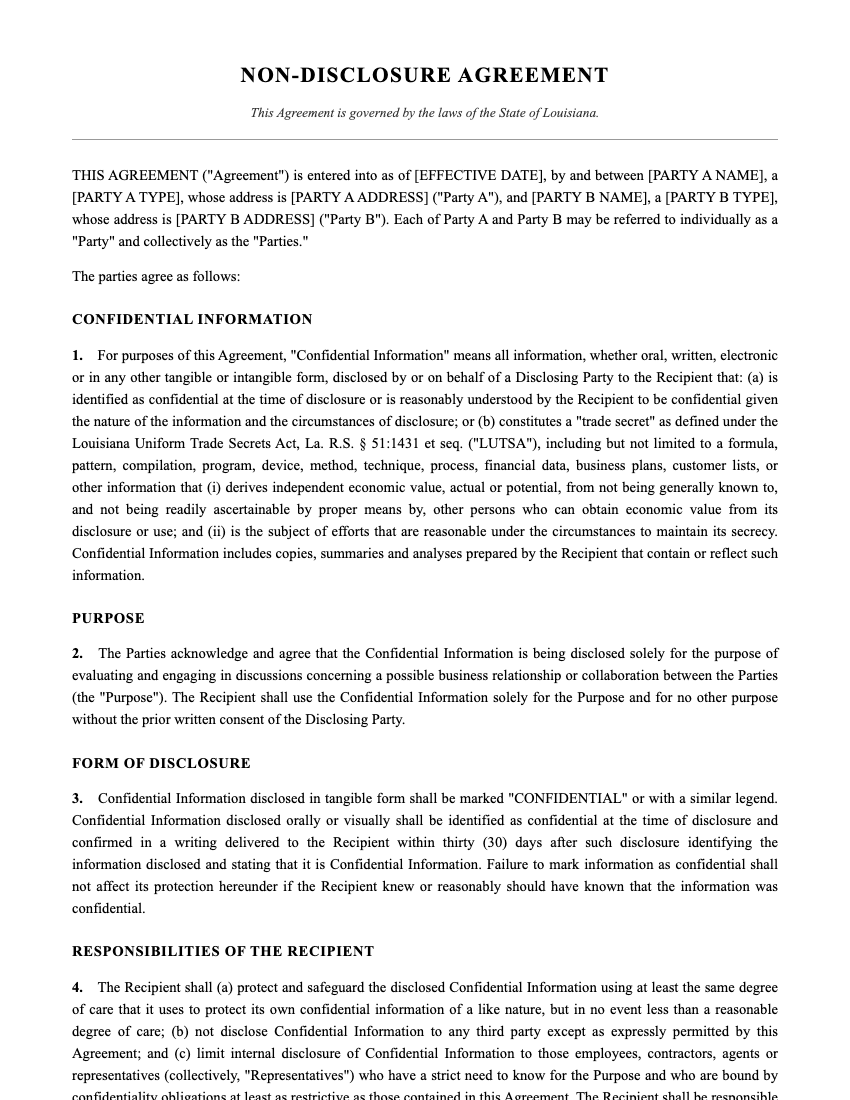
- Louisiana Uniform Trade Secrets Act (LUTSA): La. Rev. Stat. § 51:1431 et seq. (statutory misappropriation claims, injunctions, damages, and possible attorney’s fees)
- Louisiana Civil Code Art. 3499 (10‑year prescriptive period for written contracts)
- Louisiana Uniform Electronic Transactions Act (UETA): La. R.S. 9:2600 et seq. (electronic signatures valid)
- Louisiana Unfair Trade Practices and Consumer Protection Law: La. Rev. Stat. § 51:1401 et seq. (supplemental remedies in business litigation)
For a complete guide to NDA terms, duration, and standard exclusions, see our NDA Agreement Guide.
Why “Generic” NDAs Are Dangerous in Louisiana
Using a boilerplate NDA from another state can produce three Louisiana‑specific
traps:
- Mischaracterizing protections as pure contract claims (the 10‑year trap). Under La. C.C. Art. 3499, ordinary contract claims prescribe after ten years. If your protection strategy relies only on contract breach remedies, you may lose leverage over long‑running confidential information. In contrast, trade secret misappropriation under LUTSA is premised on ongoing secrecy and statutory remedies—so the NDA should expressly preserve LUTSA remedies.
- Drafting a disguised non-compete. Louisiana enforces covenants not to compete if they are reasonable in time, geography, and scope. An overbroad NDA that prohibits the Receiving Party from working in a field or soliciting clients can be recharacterized as a non-compete and partially or wholly voided. Because LA courts apply a reasonableness standard rather than an absolute ban, you must draft narrowly: prohibit use/disclosure of specific confidential information and use limited, tailored non-solicitation clauses when appropriate.
- Missing the federal whistleblower/DTSA notice. If you later bring a federal trade-secret claim under the Defend Trade Secrets Act (DTSA, 18 U.S.C. § 1836), you can obtain enhanced damages and attorney’s fees only if your NDA includes the DTSA whistleblower notice (18 U.S.C. § 1833(b)). Many templates omit it.
Paradigm-shifting insight: The interplay between Louisiana’s civil‑law prescription rules and statutory trade‑secret remedies means your NDA should do two things simultaneously—(a) preserve statutory misappropriation remedies under LUTSA (so secrecy, not just contract, underpins your protection), and (b) avoid turning confidentiality rules into sweeping restraints on trade that trigger non‑compete analysis. In short: anchor protection in LUTSA and draft narrow use/scope limits to survive Louisiana’s reasonableness review.
Real legal development to note
Louisiana codified trade-secret protection with LUTSA (La. Rev. Stat. § 51:1431 et seq.), giving state courts explicit statutory authority to order injunctive relief, award damages for actual loss and unjust enrichment, and award exemplary damages and attorneys’ fees for willful misappropriation. That statutory framework is the backbone for durable NDAs in Louisiana—do not rely on contract terms alone.
What’s Included in This Template? (Key Clauses)
- Clear definition of Confidential Information and separate “Trade Secret” category tied to LUTSA protections
- Purpose limitation clause (explicit business purpose; use‑limited language)
- Narrow non‑solicit and non‑interference language (optional addenda) drafted to satisfy Louisiana’s reasonableness test
- Residuals clause with negotiable language for ideas retained in unaided memory
- Required DTSA whistleblower notice (per 18 U.S.C. § 1833(b)) to preserve federal remedies
- Remedies and injunction language that references LUTSA and Louisiana remedies
- Choice of law and forum clause (recommend: Louisiana law and local parish or federal district, but consider enforceability and forum non conveniens)
- Electronic signature clause referencing La. R.S. 9:2600 et seq. (UETA)
Who Needs This Document?
| User Persona | Usage Scenario | Key Louisiana Benefit |
|---|---|---|
| Oil & Gas service companies | Sharing processes with contractors | Trade‑secret protection under LUTSA plus enforceable injunctive relief |
| Healthcare clinics | Protecting patient‑list analytics | Narrow non‑solicit provisions and compliance with HIPAA considerations |
| Tech startups in New Orleans | Raising capital or hiring contractors | Preservation of statutory trade‑secret claims beyond ordinary contract prescription |
| Manufacturers | Working with overseas manufacturers | Clear export and disclosure limits; DTSA notice for federal remedies |
How to Execute a Valid Louisiana NDA
Step 1: Pick One‑Way or Mutual. Use One‑Way when only you disclose. Use Mutual for joint due diligence. Choosing the wrong form creates unnecessary obligations under LA civil law.
Step 2: Tie Trade‑Secret Claims to LUTSA. If information is a trade secret, label it and state in the NDA that misappropriation claims are governed by La. Rev. Stat. § 51:1431 et seq. This preserves statutory relief beyond simple contract breach.
Step 3: Mark and Document Secrecy Efforts. Demonstrate reasonable steps to keep information secret (legends, access logs, limited distribution). Louisiana courts look at such efforts when assessing trade‑secret status.
Step 4: Sign Before You Share. Use UETA‑compliant e‑signatures (La. R.S. 9:2600 et seq.) or wet signatures. Ensure execution is contemporaneous with disclosure to avoid disputes over timing.
Already Receiving NDAs from Others?
When a counterparty sends you an NDA, check for hidden non‑compete language, overly broad “use” restrictions, and absence of DTSA notice. If the counterparty is Louisiana‑based, the NDA’s reasonableness will be assessed under Louisiana standards, so carveouts and precise definitions matter.
an AI contract review tool can scan NDAs for Louisiana‑specific risks—spot disguised covenants, missing DTSA language, and clauses that might run afoul of La. C.C. Art. 3499 or LUTSA—so you can negotiate from a position of knowledge.
Related NDA Templates
Get the Template
Sign up for our newsletter to receive the template.
Frequently Asked Questions

About Designer Content
Designer Content creates practical legal document resources for landlords, contractors, and small business owners. We simplify complex legal concepts into actionable guidance. Connect with us on LinkedIn.