
Opening
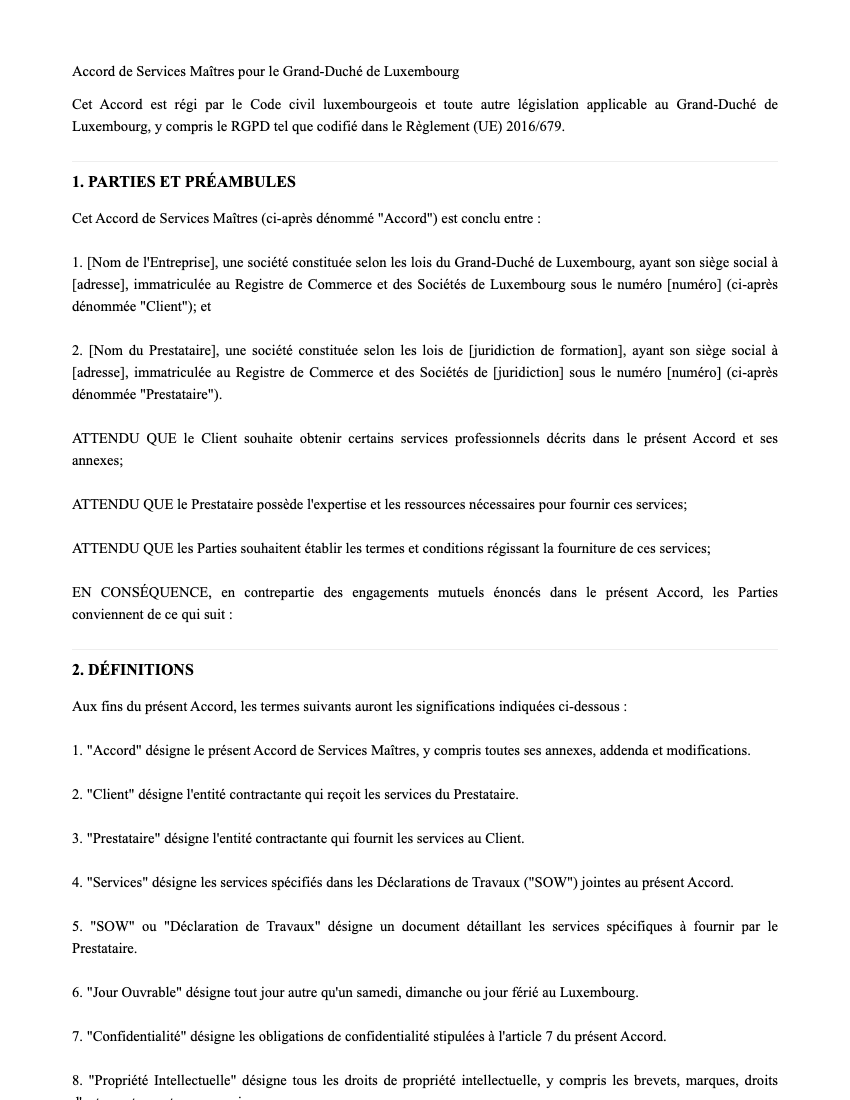
A Master Services Agreement (MSA) in Luxembourg is a B2B framework agreement that sets the legal rules (pricing, liability, confidentiality, data, intellectual property) applicable to all your future engagements, through separate Statements of Work (SOW). For an SME, a consultant, or an agency, it helps avoid renegotiating the same baseline for each project. In Luxembourg, a generic template is risky, notably regarding worker/employee classification, non-compete clauses, and the GDPR.
For a comprehensive guide to structuring MSAs and SOWs that protect your business, see our Freelancer Contracts Guide.
Definition Box
Definition: A Luxembourg MSA is a framework agreement for services between a Service Provider and a Client, designed to govern a recurring business relationship. The MSA contains the “stable” clauses (payment terms, late payment interest, limitation of liability, insurance, confidentiality, data processing, intellectual property, termination, governing law and competent court). Each engagement is then described in a SOW (purchase order, signed quotation, appendix) specifying deliverables, deadlines, price, and acceptance criteria. In case of conflict, the MSA + SOW package prevails over informal exchanges.
Why You Cannot Use a Generic MSA in Luxembourg
“International” templates drafted for the United States or the United Kingdom often assume concepts that do not translate into Luxembourg civil law. Result: unenforceable clauses, reclassification risks, and enforcement difficulties before Luxembourg courts. A local MSA must speak the expected legal language (obligations, written evidence, contractual liability, late-performance penalties) and incorporate the applicable texts, notably the Code du travail, the Code civil, and the RGPD.
Worker Classification Rules
In Luxembourg, the red line is the reclassification of an “independent contractor” as an employee if a relationship of subordination is demonstrated (instructions, control, integration into the organization, imposed working hours, absence of economic risk). Luxembourg law relies on the definition of the employment contract and the employer’s managerial authority (see Code du travail, art. L.121-1, which governs the employment relationship). A generic MSA that imposes daily reporting, fixed hours, exclusivity, or mandatory use of the client’s internal tools can provide indicia of subordination. In case of reclassification, the client company may face back payments of social security contributions, wages and leave, and sanctions for concealed work depending on the classification retained. A Luxembourg MSA must therefore include safeguards: autonomy in performance, absence of hierarchical integration, freedom of organization, and lump-sum or deliverable-based invoicing.
Non-Compete Enforceability
Unlike certain jurisdictions, non-compete clauses are possible in Luxembourg but regulated, especially in the context of the employment contract. For employees, the Code du travail imposes strict conditions of validity (notably time and geographic limits) via l’article L.125-8. Many generic templates copy a very broad non-compete (“worldwide, 5 years”) that becomes hard to defend, or even unenforceable. In a purely B2B context, a non-compete may exist under freedom of contract, but it must remain proportionate to the legitimate interest (protection of trade secrets, clientele) and compatible with public policy. In practice, for an independent service provider, more robust alternatives are preferred: enhanced confidentiality, non-solicitation of employees/clients (short duration), and information-protection clauses. Your template should provide a very targeted “non-compete” option and a “no non-compete” option with equivalent protections.
IP/Work-for-Hire Considerations
Luxembourg does not reason like the American “work made for hire.” Copyright arises with the creator, and transfers/licenses must be clearly documented. For software and creations, a generic MSA that simply says “all rights belong to Client” may be insufficient if the assignment is not specific (scope, media, duration). The Luxembourg template should offer: (i) a limited license until payment is complete, then (ii) an assignment or broader license, with a warranty of title. For personal data, IP is combined with the GDPR processing obligation (art. 28).
What's Included in This Template
Flexible SOW Structure
The MSA serves as a legal “umbrella”: you sign it once, then add one SOW per engagement (scope, milestones, price, acceptance criteria). This reduces sales cycle time and limits scope creep, because any service outside the SOW triggers an amendment.
Luxembourg-Specific Indemnification
The indemnification clause is drafted to remain readable and enforceable under civil law: proportionate contractual liability, exclusions (gross negligence/intent), and alignment with professional liability insurance. The template may require professional civil liability insurance with a threshold (e.g., 1,000,000 €) if your sector requires it.
Dispute Resolution and Venue
The model provides for Luxembourg law and a jurisdiction clause designating the courts of Luxembourg-ville to avoid “remote” disputes. For international parties, this stabilizes enforcement (injunctions, debt collection, evidence) and reduces costs.
Additional clauses included (with references):
- Personal data subcontracting compliant with RGPD art. 28 (instructions, security, onward subcontractors, audits)
- B2B late payment interest under loi du 18 avril 2004, art. 12 (late payments)
- Good-faith performance and binding force of agreements clause (Code civil luxembourgeois, art. 1134)
- “No unfair clause” warning for mixed situations inspired by the Code de la consommation, art. L.212-1
Who Needs This Document?
| User Type | Relationship | Key Benefit |
|---|---|---|
| Agencies (marketing/IT) | Recurring services + retainer | Fast SOWs, stable limitation of liability |
| Consultants (finance, compliance) | Successive engagements | Clear framework on deliverables, confidentiality, invoicing |
| Developers and SaaS services | Maintenance and projects | IP clauses + RGPD art. 28 + acceptance |
| B2B Freelancers | Multiple clients | Reduces reclassification via autonomy clauses |
How to Use This MSA Template
Step 1: Correctly identify the parties
Indicate the exact name, form (SARL, SA, independent) and registered office address. For groups, specify the contracting entity and the invoiced entity.
Step 2: Choose the term and termination
Define a term (12 months) or automatic renewal, and provide for termination for convenience with notice. Add immediate termination for a material breach that is not remedied.
Step 3: Draft the first SOW
Describe deliverables, schedule, acceptance criteria, price, and assumptions. Clarify what is “out of scope” and the change process.
Step 4: Sign and manage subsequent SOWs
The MSA remains the same; each new project is done via a signed SOW. Keep an audit trail (PDF, e-signature) for evidence and collection.
Already Receiving Contracts from Clients?
Even if you have your own template, it is common for clients to send you their MSA (often Anglo-Saxon) with unlimited liability clauses, overly broad IP rights, or non-compliant data processing. Before signing, compare: late payment interest, limitation of liability, GDPR subcontracting (art. 28), and competent court. For a quick triage of points to negotiate, use: an AI contract review tool.
Download Options
Free PDF option: ideal for reading, sharing internally, or validating your negotiation positions.
Editable Word/Google Docs option: recommended to adapt the fields (SOW, pricing, insurance, GDPR clauses) and create an “agency,” “consultant,” or “IT” version. Then keep a standardized version.
Disclaimer
Informational B2B template in Luxembourg. Does not constitute legal advice. For a complex case (employment, regulated, sensitive data), consult a lawyer.
Related MSA Templates
Get the Template
Sign up for our newsletter to receive the template.
Frequently Asked Questions

About Designer Content
Designer Content creates practical legal document resources for landlords, contractors, and small business owners. We simplify complex legal concepts into actionable guidance. Connect with us on LinkedIn.