
A Luxembourg Non-Disclosure Agreement (NDA) is a contract that secures confidential business information while complying with Luxembourg’s civil-law formalities, labour-law restrictions on post‑employment restraints, and EU-level data-protection rules (GDPR). Because Luxembourg blends national codes with EU regulations, an NDA that looks “generic” can easily fail to deliver protection — or worse, contain unenforceable or unlawful provisions.
What is a Luxembourg NDA?
Definition: In Luxembourg, an NDA is a written contract in which one or both parties agree to keep specified information confidential and to use it only for a defined purpose. NDAs must be drafted with reference to: the Luxembourg Civil Code (Code civil), Luxembourg labour law (Code du travail) when employees are involved, and EU rules that Luxembourg applies directly (notably Regulation (EU) 2016/679 — the GDPR — and Regulation (EU) No 910/2014 on electronic identification and trust services (eIDAS)).
Two practical consequences follow: (1) contract claims are governed by civil‑law principles (including the common 10‑year prescription for contractual obligations); and (2) where the NDA implicates an employment relationship, additional statutory protections (including those governing post‑employment restraints and whistleblower disclosures) may apply.
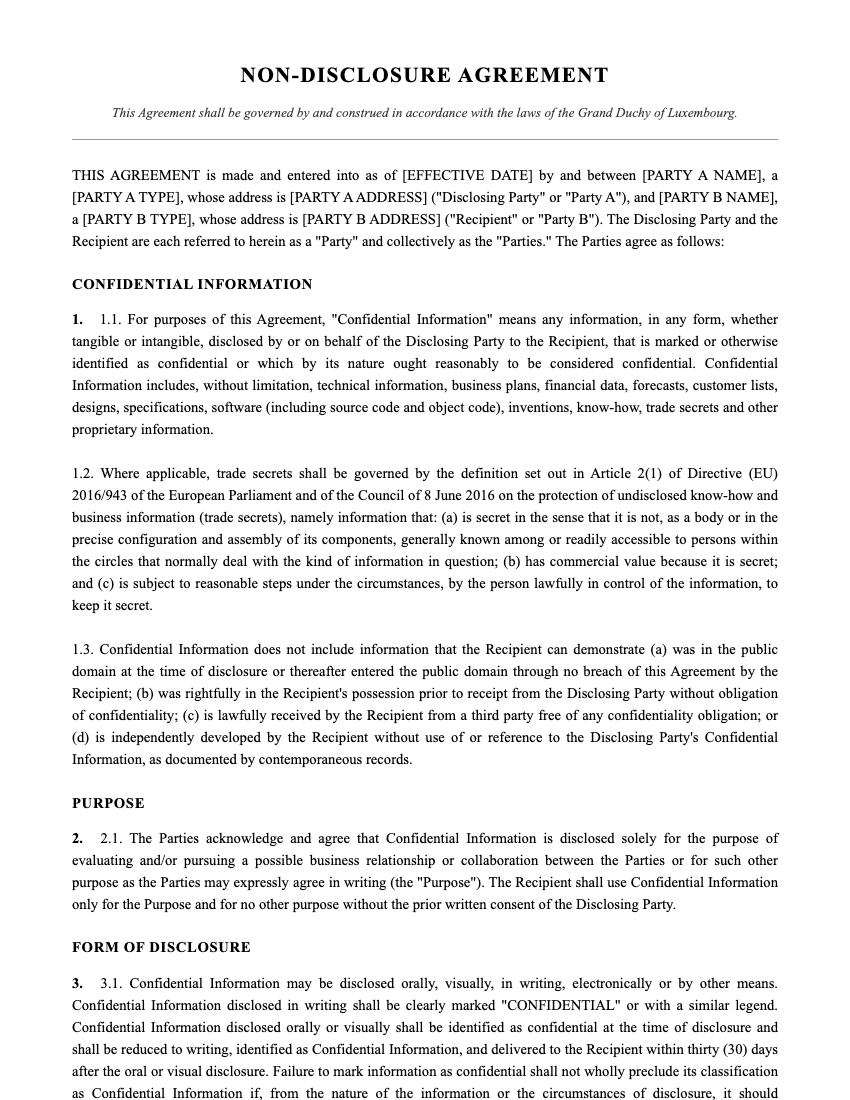
For a complete guide to NDA terms, duration, and standard exclusions, see our NDA Agreement Guide.
Why generic NDAs are dangerous in Luxembourg
Many online NDA templates are written for common‑law jurisdictions and omit crucial civil‑law formalities and EU mandatory rules. Below are the local traps most templates miss.
Paradigm‑shifting insight: the “compensation and form trap.” Unlike jurisdictions that simply invalidate overly broad post‑employment restraints, Luxembourg law generally recognises post‑contractual non‑compete clauses only if they meet strict formal requirements (written form, precise scope, reasonable duration/territory) and provide adequate financial compensation to the employee. A clause that attempts a prolonged or vaguely defined restraint without the required compensation is likely to be declared void — and can expose the employer to damages claims — but the confidentiality obligations in the same agreement can survive if properly separable. This means you must draft confidentiality and restraint provisions as discrete, compliant clauses rather than burying a restraint inside a sweeping “no use” clause.
Other local traps:
- Whistleblower protection and public‑interest reporting: following the EU Whistleblower Directive (2019/1937) and Luxembourg implementing measures, an NDA cannot validly prevent lawful disclosures to competent authorities or protect wrongdoing. Confidentiality language that attempts to silence protected reports can be unlawful.
- GDPR interaction: NDAs involving personal data must respect data subject rights and record lawful processing. Blanket “data secrecy” language does not satisfy GDPR documentation, security, or international transfer rules.
- Electronic execution & authentication: Luxembourg accepts electronic signatures under eIDAS (Regulation (EU) No 910/2014), but the evidentiary value of different signature levels varies; high‑risk transactions may require qualified electronic signatures or wet ink.
Real development: Luxembourg’s supervisory and legal community has emphasised these issues in guidance following the EU Trade Secrets Directive (Directive (EU) 2016/943) and GDPR enforcement. Local law firms and the Luxembourg Bar have published practical notes highlighting the need for separate, compensatory non‑compete clauses and GDPR‑compliant data processing addenda in NDAs.
Key clauses you need for Luxembourg
- Precise definition of Confidential Information — distinguish general business ideas (time‑limited protection) from trade secrets (protected as long as secrecy is maintained; reference EU Trade Secrets Directive principles).
- Purpose limitation and narrow permitted uses — tie disclosure to a specific project or evaluation period.
- Exclusions — public domain, independently developed, previously known, or lawfully received information.
- Duration — use a two‑tier duration: (i) a fixed short‑term period (e.g., 2–5 years) for ordinary confidential information; (ii) indefinite protection for bona fide trade secrets so long as secrecy is preserved.
- Residuals clause — optional, carefully worded to avoid creating an unlawful post‑employment restraint.
- Post‑employment restraints — if you include a non‑compete, put it in a separate clause, specify duration/territory/activity, and provide the contractual compensation required by Luxembourg labour law; make clear the clause applies only to employees (not independent contractors) when relevant.
- GDPR & data processing addendum — identify data controller/processor roles, lawful basis, retention, security measures, and cross‑border transfer mechanisms.
- Whistleblower carve‑out — expressly confirm that the agreement does not prevent lawful reporting to public authorities or protected whistleblowing channels.
- Governing law & jurisdiction — Luxembourg law is common, but where parties pick foreign law, ensure enforceability against employees and within Luxembourg borders.
Who needs this document?
| User Persona | Use Case in Luxembourg | Local benefit |
|---|---|---|
| Startups in Luxembourg | Pitching to investors or sharing roadmaps | Protects commercial secrets while respecting Luxembourg investor practices and GDPR requirements |
| International employers | Hiring Luxembourg-based employees | Lets you combine confidentiality with compliant non‑compete/compensation clauses and local employment law protections |
| Manufacturers & suppliers | Disclosing technical specs to fabricators | Protects trade secrets and allows injunctive relief under trade‑secret rules |
| Professional service firms | Sharing client lists or processes | Balances confidentiality with data‑protection obligations under GDPR |
How to execute a valid Luxembourg NDA (practical steps)
- Choose the right form (one‑way vs mutual) and separate restraints. If only you disclose, use a unilateral NDA. If both sides disclose, use a mutual NDA but keep any non‑compete clauses separate and tailored.
- Be specific about the purpose and the confidential items. Vague “business purposes” language reduces enforceability under civil‑law clarity requirements.
- Comply with employment formalities. For employees, ensure any post‑contractual restraint is in writing, describes the limited activities/territory/duration, and provides the legally required compensation.
- Sign correctly and preserve evidence. Use eIDAS‑compliant electronic signatures for speed; keep signed copies, delivery receipts, and marked documents (CONFIDENTIAL labels). If using e‑signatures for high‑risk clauses, consider a qualified electronic signature or wet‑ink to avoid evidentiary disputes.
Always sign (or exchange) the NDA before disclosing substantive materials. The agreement only protects information disclosed after execution.
When you receive an NDA from a counterparty
Carefully review for: unlawful gagging of whistleblowers, overbroad post‑employment restraints without compensation, missing data‑processing details under GDPR, and ill‑defined durations. Use an AI contract review tool to spot these risks automatically and compare submitted NDAs against Luxembourg legal norms.
Related NDA Templates
Get the Template
Sign up for our newsletter to receive the template.
Frequently Asked Questions

About Designer Content
Designer Content creates practical legal document resources for landlords, contractors, and small business owners. We simplify complex legal concepts into actionable guidance. Connect with us on LinkedIn.