
A Maine Non-Disclosure Agreement (NDA) is a contract that protects confidential business information and trade secrets while reflecting Maine’s common-law approach to restrictive covenants. Unlike jurisdictions that categorically invalidate non-competes, Maine enforces reasonable restraints when supported by legitimate business interests. This template is tailored to that reality and to Maine’s contract rules—most importantly the 6-year limitations period for contract claims under 14 M.R.S. §752.
What Is a Maine NDA?
Definition: A Maine Non-Disclosure Agreement is a legally binding contract in which one or both parties promise to keep specified information confidential and limit its use. In Maine, courts enforce NDAs and related covenants when the scope, duration, and geographic reach are reasonable and when the covenant protects a legitimate interest (customer relationships, trade secrets, specialized training).
Maine’s legal system gives parties considerable freedom to contract, but that freedom is bounded by reasonableness and public policy. An NDA that functions as an overbroad employment restraint can be attacked as an unenforceable covenant if it operates like a non-compete without the necessary justification.
For a complete guide to NDA terms, duration, and standard exclusions, see our NDA Agreement Guide.
Why "Generic" NDAs Are Dangerous in Maine
Most generic NDAs you find online are drafted for jurisdictions with either broad non-compete enforcement or strict bans (like California). Using them in Maine creates three risks.
- Backdoor Covenants: Generic forms often contain catch-all prohibitions on “using Confidential Information to compete.” In Maine, such language can be interpreted as a restrictive covenant. If it’s broader than reasonably necessary to protect a legitimate interest, a court may refuse enforcement—or worse, treat the entire agreement as ambiguous.
- Long-Tail Contract Exposure: Contract claims in Maine are governed by a 6-year statute of limitations for written contracts (14 M.R.S. §752). That makes it important to (a) clearly state the duration of confidentiality and (b) include survival and remedy provisions that reflect your intended exposure window.
- Missing Federal DTSA Notice: For companies that might bring federal trade secret claims under the Defend Trade Secrets Act (DTSA), NDAs should include the DTSA whistleblower immunity notice (18 U.S.C. §1833(b)). Without it, you may limit your ability to seek certain enhanced remedies in federal court.
Paradigm-shifting insight for Maine: Because Maine enforces reasonable covenants, the biggest drafting mistake is overbreadth, not absence. In California the problem is illegal restraints; in Maine the trap is imprecise language that courts construe as a de facto non-compete and then test for reasonableness—often leading to expensive litigation and reformation. Use tailored purpose, defined categories, and specific survival periods to avoid being drawn into a non-compete analysis.
Real case study / development
Maine has not adopted a blanket statutory ban on non-competes. National analyses (see NCSL and state surveys) show Maine remains in the group of states where properly drafted restrictive covenants are enforceable. That practical landscape means commercial parties operating in Maine must draft NDAs with precision rather than rely on “one-size-fits-all” forms.
What’s Included in This Template? (Key Clauses)
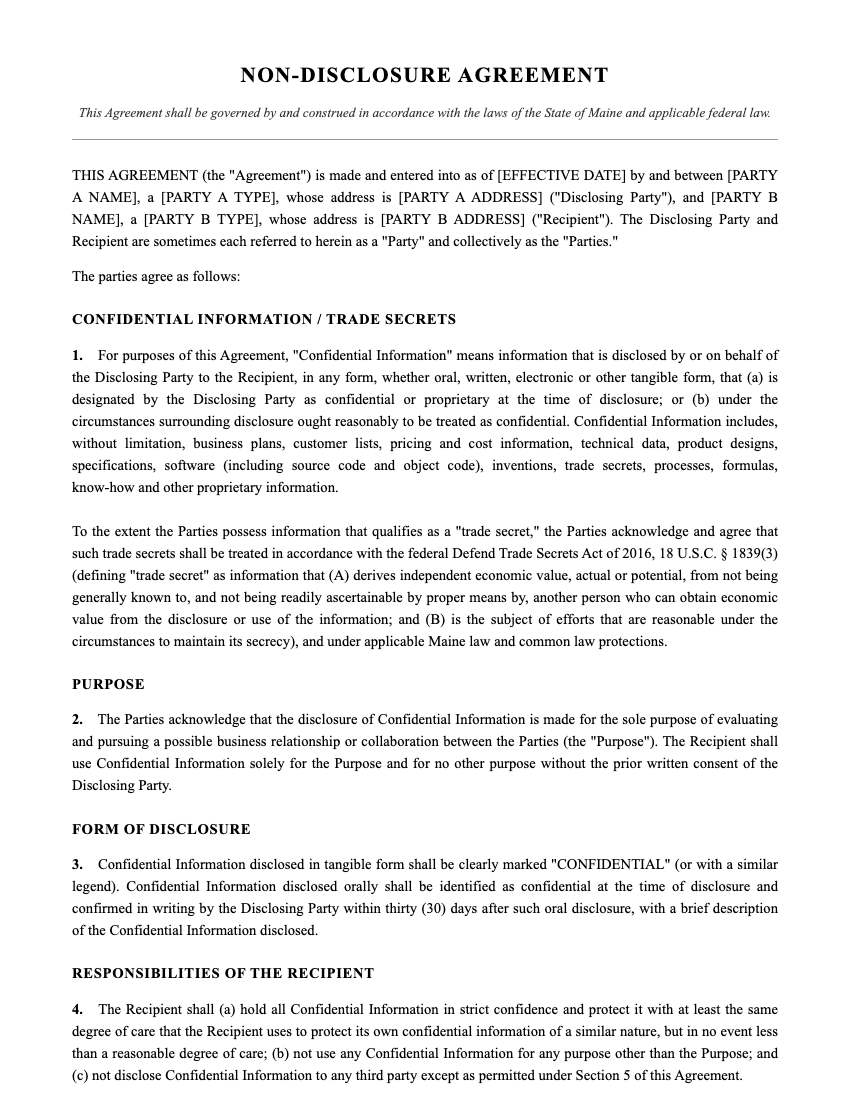
- Purpose clause: Narrowly limits permitted use (e.g., "evaluating a proposed software license for [Project X]").
- Clear definitions: "Confidential Information" vs. "Trade Secrets"—trade secrets are defined consistent with federal DTSA factors (value from secrecy + reasonable efforts to maintain secrecy).
- Duration: Two-tier protection—limited-term protection for general confidential business information (customizable 1–5 years) and indefinite protection for trade secrets so long as they remain secret.
- Use and non-use restrictions: Targeted prohibitions on use, reproduction, and disclosure; avoid broad language that effectively bars employment or competition.
- Non-solicitation carve-outs: If you need employee or customer non-solicits, include separate, narrowly tailored provisions and adequate consideration.
- Remedies and limitations: Injunctive relief, damages, and an express statement regarding survival; explicitly reference available federal remedies (DTSA) and the DTSA whistleblower notice.
- Choice of law and forum: Specify governing law (e.g., Maine) and a forum, but remember courts may refuse to apply foreign law if it contravenes Maine public policy.
Who Needs This Document?
- Tech startups: Protect code, algorithms, and investor pitch details during due diligence.
- Manufacturers: Protect product specs and supplier lists when engaging vendors in Maine or nearby states.
- Professional services firms: Safeguard client lists and pricing data—use narrowly drafted customer non-solicits if needed.
- Employers: Protect training materials and trade secrets, but treat employment restrictions as separate clauses backed by consideration.
How to Execute a Valid Maine NDA
Step 1: Choose One-Way or Mutual — Use One-Way when only you disclose; use Mutual for joint due diligence.
Step 2: Define the Purpose — Be specific. A narrowly phrased Purpose limits misuse and reduces the chance the clause will be read as a non-compete.
Step 3: Mark Your Documents — Label confidential materials and document your reasonable efforts to maintain secrecy (access controls, NDAs with vendors, confidentiality legends).
Step 4: Sign Before Sharing — Under federal law (ESIGN Act, 15 U.S.C. §7001) and Maine practice, electronic signatures are generally enforceable; still, get a signed NDA in place before sharing sensitive materials.
When You Receive an NDA from a Client
Carefully review any incoming NDA for overly broad use restrictions, perpetual survival clauses, or ambiguous definitions that could create downstream liability. If a clause looks like it limits post-employment work, negotiate it into a narrow non-solicit or remove it.
an AI contract review tool can quickly flag risky language, compare the agreement against Maine practice, and suggest edits—saving hours and minimizing negotiation risk.
Related NDA Templates
Get the Template
Sign up for our newsletter to receive the template.
Frequently Asked Questions

About Designer Content
Designer Content creates practical legal document resources for landlords, contractors, and small business owners. We simplify complex legal concepts into actionable guidance. Connect with us on LinkedIn.