
A Maryland Non-Disclosure Agreement (NDA) is a contract that protects proprietary information and trade secrets while aligning with Maryland statutory and common-law rules. Unlike California’s near-total ban on covenants not to compete, Maryland enforces post-employment restraints and carefully-policed confidentiality clauses so long as they are reasonable and supported by legitimate business interests.
What Is a Maryland NDA?
Definition: A Maryland NDA is a legally binding agreement under which a Receiving Party promises to keep specified Confidential Information secret and to use it only for a limited Purpose. Maryland’s trade secret statute (Maryland Uniform Trade Secrets Act, codified in the Commercial Law Article) works alongside common-law doctrines to shape what courts will protect.
Maryland treats restrictive covenants and confidentiality promises differently than some states. NDAs that simply protect identifiable trade secrets and narrowly limit use are routinely enforced. By contrast, broad restrictions that act like an impermissible restraint on trade or an unreasonable non-compete risk being invalidated or litigated away.
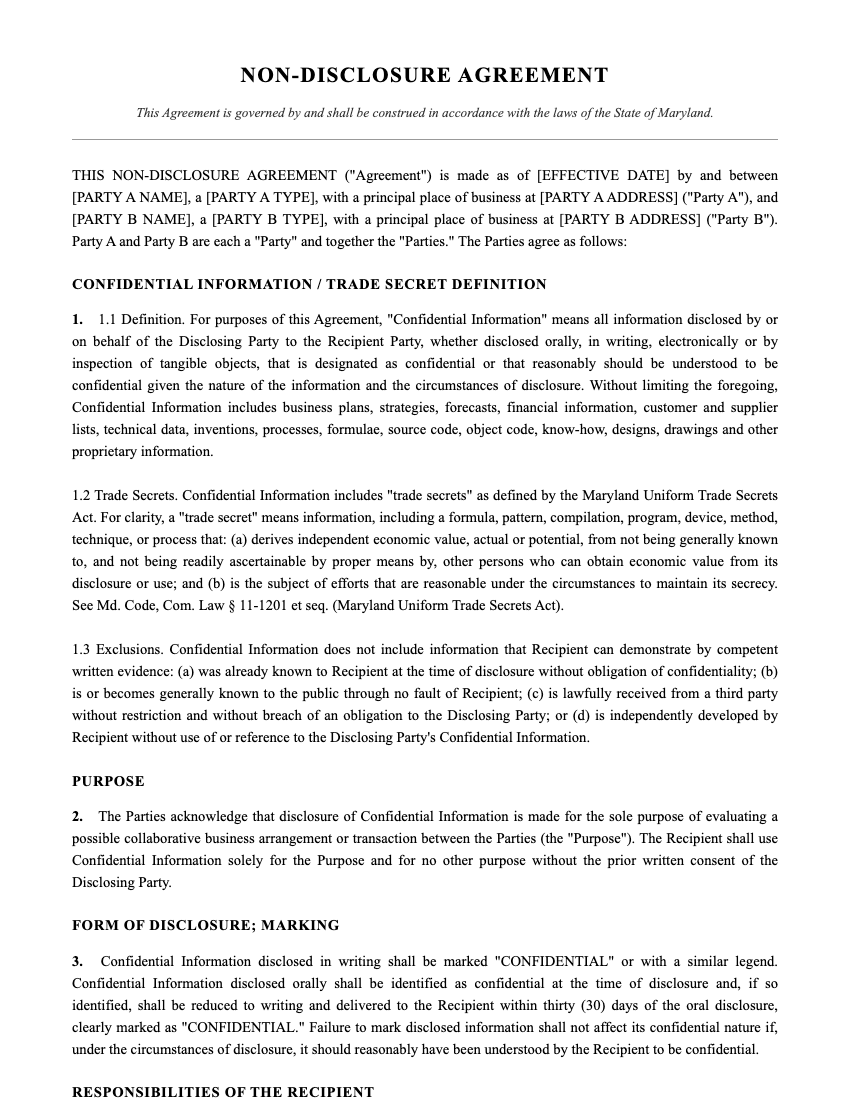
For a complete guide to NDA terms, duration, and standard exclusions, see our NDA Agreement Guide.
Why Generic NDAs Are Dangerous in Maryland
Most free NDA templates were drafted for jurisdictions with different non-compete philosophies or no state-specific trade-secret language. In Maryland, three common traps appear:
- Overbroad “no-use-to-compete” language. A clause that effectively prevents a person from using general skills or working in a line of business can be treated as a restraint. Maryland courts enforce restraints that are reasonable, but they will scrutinize vague, sweeping prohibitions.
- Failure to separate trade secrets from general confidential info. Maryland law protects trade secrets (see Md. Code, Com. Law § 11-1201 et seq.) but not every piece of confidential information. Calling everything a trade secret invites a court to deny protection altogether.
- Missing DTSA whistleblower notice. If you may ever sue in federal court under the Defend Trade Secrets Act (DTSA), you must include a notice that the employee can report wrongdoing to government officials or make protected disclosures under 18 U.S.C. § 1833(b) to preserve the right to seek enhanced damages and attorney’s fees.
Paradigm-shifting insight: Unlike California, Maryland will enforce reasonable non-solicit and narrowly tailored use restrictions — but only if the NDA reflects a legitimate protectable interest (client relationships, trade secrets, specialized training), reasonably limited duration and geography, and adequate consideration. In practice, this means NDAs in Maryland can include stronger protective language than in California — but poor drafting can convert an NDA into a litigated restraint that a court will reshape or void.
Real legal development to note
While Maryland has not banned non-competes, recent litigation and practitioner guidance emphasize scrutiny over overly broad secrecy obligations. Practitioners should assume trade-secret and contract claims are subject to Maryland’s statutes and a three-year statute of limitations for ordinary contract actions (Md. Code, Courts & Judicial Proc. § 5-101). Preserve evidence and act quickly: delay can jeopardize claims.
Key Clauses — Maryland-Focused
- Definitions: Distinguish "Trade Secrets" (as defined under Md. Code, Com. Law § 11-1201) from "Confidential Information." Limit the latter with time-based protections (commonly 2–5 years).
- Permitted Uses & Purpose: Narrow the Purpose to the business relationship (e.g., "evaluation of a distribution agreement for Product X"). Broad purposes weaken enforceability.
- Non-Solicit & Non-Competition Carve-Outs: If you need employee non-solicit or non-compete language, make them separate clauses with clear duration, geographic scope, and consideration. Maryland courts balance employer interest against employee mobility.
- Residuals: Optional clause allowing use of general skills retained in unaided memory. In Maryland it’s negotiable—include if you anticipate employee mobility where ideas (not secret specifics) are likely to be used.
- Exclusions: Standard carve-outs for public information, prior knowledge, independently developed info, and compelled disclosures.
- DTSA Whistleblower Notice: A short clause referencing 18 U.S.C. § 1833(b) preserves access to enhanced remedies in federal claims.
- Remedies & Limitations: Specify injunctive relief, permit equitable remedies, and state the applicable law (Maryland) and venue; note the three-year contract limitations for some claims (Md. Cts. & Jud. Proc. § 5-101).
Who Needs This Document?
| User Persona | Usage Scenario | Key Benefit in Maryland |
|---|---|---|
| Maryland startups | Pitching to investors | Protects pitch materials and trade secrets while avoiding overbroad restraints that scare investors |
| Employers | Hiring senior staff | Allows tailored non-solicit and confidentiality clauses that Maryland courts will consider enforceable |
| Service vendors | Work-for-hire projects | Keeps client lists and technical specs confidential, with time-limited protection for non-trade-secret info |
| Sellers | M&A due diligence | Enables safe data rooms with narrowly defined purposes and express trade-secret protection |
How to Execute a Valid Maryland NDA
Step 1: Choose the right type — unilateral vs. mutual — based on who shares information.
Step 2: Define the Purpose precisely; general phrases create ambiguity and risk.
Step 3: Mark and secure materials — label documents Confidential, use access controls, and record dissemination to demonstrate reasonable secrecy efforts under Maryland trade-secret law.
Step 4: Sign before sharing — Maryland recognizes electronic signatures (see federal E-SIGN and state UETA adoption), but for contentious deals get a clear, dated signature and retain audit trails.
Already Receiving NDAs from Clients?
If a client sends you an NDA, watch for hidden restraints (broad "no competition" language), ambiguous definitions that could chill your future work, or sweeping assignment clauses. This template helps you push back and propose Maryland-appropriate language.
an AI contract review tool can instantly flag risky clauses, compare terms to Maryland law principles, and produce negotiation talking points.
Related NDA Templates
Get the Template
Sign up for our newsletter to receive the template.
Frequently Asked Questions

About Designer Content
Designer Content creates practical legal document resources for landlords, contractors, and small business owners. We simplify complex legal concepts into actionable guidance. Connect with us on LinkedIn.