
A Massachusetts Non-Disclosure Agreement (NDA) is a written contract that protects confidential business information and trade secrets while staying within Massachusetts’s reformed non-compete framework. Unlike a generic NDA, a Massachusetts-focused NDA avoids disguised restraints on employment and satisfies federal DTSA notice requirements so you preserve maximum remedies.
What is a Massachusetts NDA?
Definition: A Massachusetts NDA is a confidentiality agreement that defines ‘‘Confidential Information’’ and binds recipients not to disclose or misuse that information. It must be drafted to avoid becoming an unlawful or unenforceable restraint under the Massachusetts Non-Compete Agreement Act (M.G.L. c. 149, § 24L) while preserving rights under the Massachusetts Trade Secrets Act (M.G.L. c. 93, § 42) and the federal Defend Trade Secrets Act (18 U.S.C. § 1833).
Massachusetts allows reasonable non-compete covenants, but only under strict statutory conditions. Most importantly, restrictions generally may not exceed 12 months, must be reasonable in scope, must be in writing and signed, and must be supported by garden leave or other mutually agreed consideration. Because of these limits, NDAs must avoid language that functions as a backdoor non-compete unless the parties intend—and comply with—the statutory scheme in § 24L.
For a complete guide to NDA terms, duration, and standard exclusions, see our NDA Agreement Guide.
Why generic NDAs are dangerous in Massachusetts
Three common traps make off-the-shelf NDAs risky in Massachusetts:
- Backdoor non-competes hidden in confidentiality language
Drafts that say the recipient ‘‘shall not use Confidential Information to compete’’ can be read as a restraint on post‑employment activity. Under M.G.L. c.149 § 24L, any restriction on an employee’s ability to work must meet specific formalities (writing, signed, reasonable duration—normally 12 months—and supported by garden leave or other consideration). If you rely on a generic template that includes broad use restrictions without meeting § 24L’s requirements, you risk the restriction being void and the entire agreement or significant remedies being lost.
Paradigm-shifting insight: In Massachusetts the real drafting trap isn’t only ‘‘non-compete’’ language — it’s confidential-use language that operates like one. Massachusetts’s statute forces employers to choose between narrowly protective confidentiality (no employment restraint) or a formal restrictive covenant that complies with § 24L (with garden leave or consideration). NDAs drafted without that choice in mind often fail to protect what matters most.
- Missing DTSA whistleblower notice (federal remedy risk)
If you ever sue in federal court under the Defend Trade Secrets Act (DTSA), 18 U.S.C. § 1833(b) requires an express notice enabling whistleblowers to disclose trade secrets to government officials or in court under seal. Without that clause you may still have a claim, but you forfeit enhanced damages and attorney’s fees that the DTSA otherwise makes recoverable. Many templates omit this protective sentence.
- Overbroad “trade secret” labeling
Massachusetts’s trade secret protection (M.G.L. c. 93, § 42) follows the typical elements: the information must derive independent economic value from not being generally known and be subject to reasonable secrecy efforts. Calling everything a ‘‘trade secret’’ invites a court to deny protection. A good NDA distinguishes between time‑limited confidential information and true trade secrets that may be protected indefinitely while secrecy is maintained.
Real legal development: 2018 Non-Compete Reform
The most consequential local development is the Massachusetts Non-Compete Agreement Act (M.G.L. c. 149, § 24L), effective October 1, 2018. That law overhauled enforceability rules for post‑employment covenants and forced employers and drafters to re-think NDAs so they do not functionally operate as unenforceable restraints. Use this template with the statute in mind; it is drafted to protect confidential and trade-secret information without unintentionally creating burdensome restrictions that trigger § 24L.
Key clauses in this Massachusetts NDA template
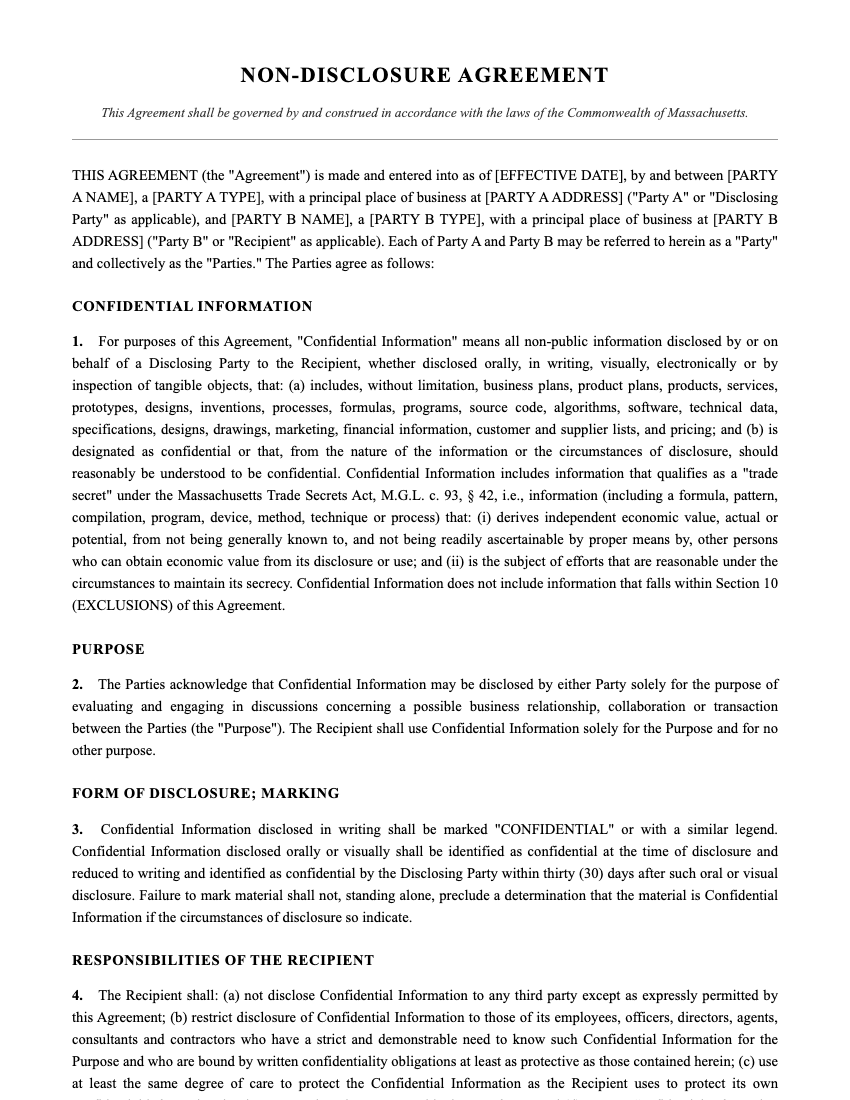
- Clear trade secret definition tied to M.G.L. c. 93, § 42 elements (economic value from secrecy + reasonable confidentiality measures).
- Narrow use restriction: prohibits misuse or disclosure of Confidential Information, but does not restrict lawful employment unless a separate § 24L-compliant covenant is attached.
- DTSA whistleblower notice (18 U.S.C. § 1833(b)) to preserve federal damages and fee-shifting.
- Duration provisions: two-tier protection—time-limited confidentiality for non‑secret business information (customizable 2–5 years) and indefinite protection for trade secrets while secrecy persists.
- Residuals clause option: limited language to allow unaided memory use of general skills and ideas while protecting specific confidential materials.
- Carve-outs: prior public knowledge, independently developed info, and compelled disclosures with notice to disclosing party.
- Electronic execution language: complies with Massachusetts UETA (see M.G.L. ch. 110G) acknowledging electronic signatures are enforceable.
Who needs this document?
| User Persona | Usage Scenario | Key MA Benefit |
|---|---|---|
| Startups (Boston/Cambridge) | Pitching investors, hiring engineers | Protects technical pitch material while avoiding hidden restraints that could violate § 24L |
| Employers | Onboarding employees or contractors | Provides confidentiality without presumptive non-compete language; if a covenant is required, it calls out § 24L formalities |
| M&A / Due diligence | Sharing sensitive financials | Mutual NDA suitable for both buyer and seller during diligence processes |
| Manufacturers / Suppliers | Sharing product specs | Protects know‑how and tooling details as trade secrets under M.G.L. c. 93 § 42 |
How to execute a valid Massachusetts NDA
Step 1: Choose one‑way (unilateral) or mutual. Use unilateral when only one party discloses; mutual for two-way diligence.
Step 2: Define ‘‘Purpose’’ narrowly. Avoid overly broad purposes that look like employment restraints.
Step 3: Mark and secure documents. Label files as ‘‘CONFIDENTIAL’’ and show reasonable secrecy measures to support trade secret status under M.G.L. c. 93 § 42.
Step 4: Sign before sharing. Ensure the agreement is in writing and signed (physical or electronic under Massachusetts UETA) before any sensitive material is disclosed.
Cross-sell: If you receive an NDA, use an AI contract review tool to flag hidden non-compete-type language, missing DTSA notices, or overbroad trade secret claims to speed negotiation.
Related NDA Templates
Get the Template
Sign up for our newsletter to receive the template.
Frequently Asked Questions

About Designer Content
Designer Content creates practical legal document resources for landlords, contractors, and small business owners. We simplify complex legal concepts into actionable guidance. Connect with us on LinkedIn.