
Section 1: Opening (75 words)
A Master Services Agreement (MSA) in Mexico is a framework contract that sets the legal and commercial rules for multiple service projects between a provider and a client, leaving operational detail to future Statements of Work (SOW). For SMEs, consultants, and agencies, this reduces friction: the “skeleton” (payment, liability, confidentiality, IP and disputes) is negotiated once and then short project-based SOWs are signed. When well executed, it also helps to avoid labor and data risks.
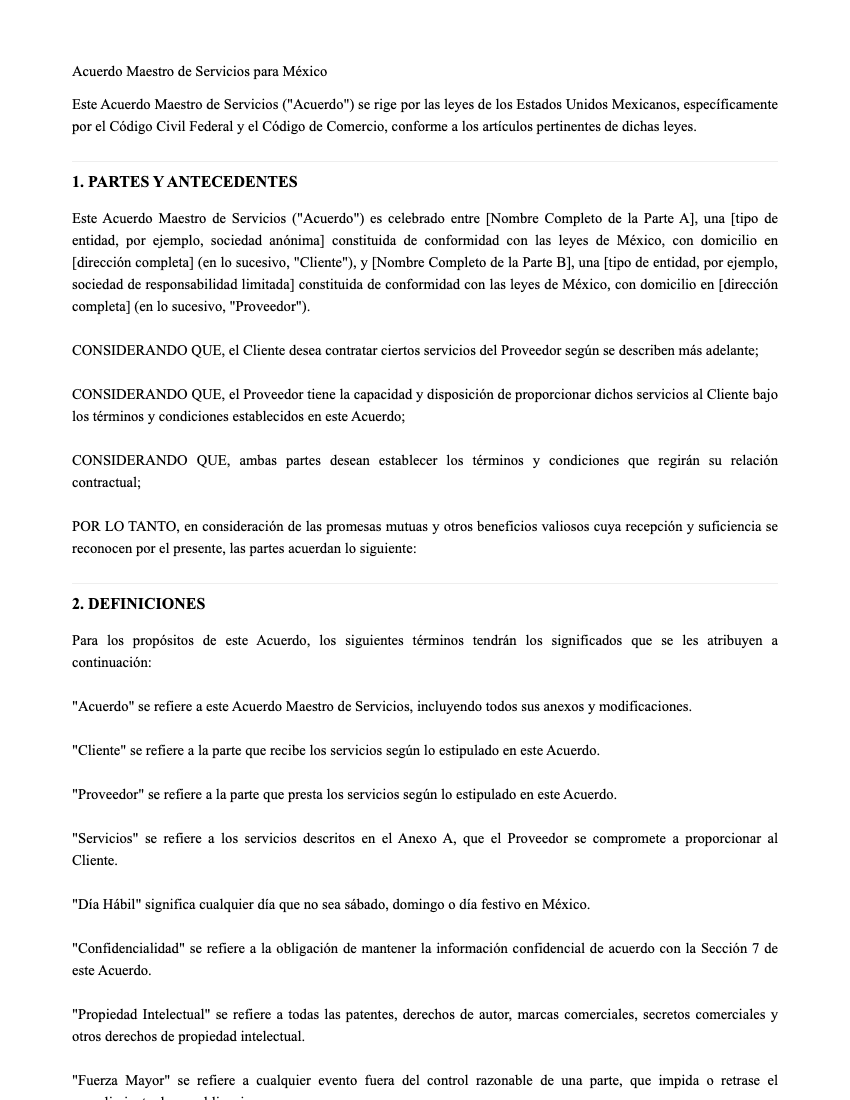
For a comprehensive guide to structuring MSAs and SOWs that protect your business, see our Freelancer Contracts Guide.
Section 2: Definition Box (100 words)
Definition: An Master Services Agreement (MSA) for Mexico is a civil/commercial law contract that establishes permanent terms applicable to any service the Provider will deliver to the Client in the future: invoicing, acceptance of deliverables, intellectual property, confidentiality, liability limits, handling of personal data and a mechanism for dispute resolution. Instead of renegotiating each project, the parties attach Statements of Work (SOW) or “Service Orders” with scope, timelines and prices. In Mexico, a solid MSA should also contemplate subcontracting rules, prescription (statute of limitations), and consent formalities for data.
Section 3: Why you can't use a generic MSA in Mexico (400 words)
Using an “international” template (or US-designed) typically fails in three critical areas in Mexico: (1) the line between independent services and an employment relationship, (2) the realistic and enforceable way to restrict competition, and (3) how intellectual property is transmitted in works and software. Additionally, a Mexican MSA must ground moratorium interests, prescription, and privacy on local laws, not concepts like “work for hire” from common law.
3a. Worker classification rules (150 words)
Mexico does not use the “ABC test.” The key standard is the existence of a relationship of work under the Ley Federal del Trabajo (LFT): the article 20 defines the labor relationship as the performance of personal, subordinate work through wage payment, and the 21 presumes the existence of the contract and the labor relationship between the person who performs personal work and the person who receives it. In practice, the determining element is subordination (direction, schedule, supervision, integration into the organization).
If a “provider” in the MSA operates as a disguised employee, the client may face claims before labor boards/courts for benefits, overtime and tenure, in addition to social security obligations. There are also risks from improper subcontracting: the LFT artículo 12 limits subcontracting of personnel; if the model involves placing personnel at the client's disposal (instead of a real specialized service), it can be challengeable. An MSA in Mexico should describe operational independence, deliverables-based results, and avoid employer-style control.
3b. Enforceability of non-competition (150 words)
In Mexico, non-compete clauses are more delicate than in many countries: the Constitution protects the freedom to work. The Artículo 5 de la Constitución Política de los Estados Unidos Mexicanos provides that no person can be prevented from pursuing the lawful profession, industry or work that suits them, except limitations by judicial resolution or by interference with third-party rights.
In B2B contracts, an “absolute prohibition” to compete is usually vulnerable. What typically works better is an approach of reasonable restrictions and alternative mechanisms: (i) robust confidentiality and protection of trade secrets, (ii) no-solicitation of personnel or clients (worded proportionally), and (iii) clauses on intellectual property and return of information. When attempting a non-compete, it must be justified by a legitimate interest (e.g., access to sensitive information), be limited in time, territory and activities, and avoid broadly restricting professional practice. In practice in Mexico, many companies prefer not to compete “de facto” through confidentiality and trade secrets before a frontal prohibition.
3c. IP considerations and “work-for-hire” (100 words)
The “work made for hire” does not operate the same in Mexico. Intellectual property is governed by the Ley Federal del Derecho de Autor (LFDA): the transfer of economic rights typically requires clear, written clauses with defined scope. In software, manuals, designs and content, your MSA should distinguish among: (a) preexisting provider IP (tools, libraries, templates), (b) project deliverables, and (c) licenses versus assignment. If the client requires exclusivity, a properly drafted exclusive assignment/license expressly agreed, tied to full payment and with carve-outs for the provider’s know-how, is advisable.
Section 4: What this template includes (150 words)
Flexible SOW structure (50 words). The MSA acts as an umbrella and each SOW defines scope, deliverables, acceptance criteria, timelines and fees. This avoids renegotiating confidentiality, IP or liability each time. It also enables handling changes (“scope creep”) with change orders and hourly rates.
Mexico-specific indemnification (50 words). The template contemplates balanced indemnification for IP infringement, breaches of confidentiality and data breaches, with caps and exclusions. It includes late interest as a commercial reference where appropriate, aligned with Código de Comercio, art. 362 (6% per annum) if no other rate is agreed.
Dispute resolution and venue (50 words). It includes an option for arbitration in Ciudad de México (CDMX) and Mexican governing law, useful to avoid foreign forums. It also incorporates civil prescription as a risk-mitigation reference: Código Civil Federal, art. 1159 (10 años) for civil obligations.
Other provisions (with citations):
- Default late-payment interest (Código de Comercio, art. 362).
- Recognition of civil prescription (Código Civil Federal, art. 1159).
- Processing of personal data and consent (LFPDPPP, arts. 6, 7 y 8).
Section 5: Who needs this document? (75 words)
| User Type | Relationship | Key Benefit |
|---|---|---|
| Marketing agency | Retainers and recurring campaigns | SOW per campaign without renegotiating IP and confidentiality |
| Strategy consultant | Monthly projects | Change control and clear rates for additional scope |
| Software developer | Milestone-based deliveries | Licensing/assignment rules and acceptance of deliverables |
| IT/support provider | Ongoing services | SLAs in SOW and liability limits in the MSA |
Section 6: How to use this MSA template (100 words)
Step 1: Define the parties
Use the full legal name, RFC (if applicable) and addresses. If signing as an individual with business activity, indicate this clearly for invoicing.
Step 2: Set the term and termination
Choose an initial term (e.g., 12 months) with automatic renewal or per project. Define notice periods and grounds for termination for breach.
Step 3: Attach your first SOW
Describe deliverables, acceptance criteria, schedule, price, taxes and reimbursable expenses. Keep the operational details in the SOW; the legal terms in the MSA.
Step 4: Sign and manage changes
Sign the MSA once and use SOWs for each project. Any scope change must be documented in writing (change order) to avoid disputes.
Section 7: Are you already getting client contracts? (75 words)
This template is ideal when you send the MSA, but often the client sends you their contract. In Mexico, review especially: clauses that resemble an employment relationship (mandatory hours, subordination), broad assignments of IP without contingent payment, overly aggressive non-compete restrictions, and data obligations without a basis in the LFPDPPP. For a quick initial review and to detect “red flags,” use: an AI contract review tool. Negotiating before signing is usually cheaper than litigating.
Section 8: Download options (50 words)
Free PDF option: download the MSA as a PDF for reading, internal comments, and comparison with client contracts.
Editable Word/Google Docs option: obtain a fully editable version with fields to complete, attach SOWs, and tailor IP, confidentiality, arbitration in CDMX and payment terms to your operation.
Section 9: Disclaimer (25 words)
This content is informational and does not constitute legal advice. Consult a lawyer in Mexico to tailor the MSA to your case.
Related MSA Templates
Get the Template
Sign up for our newsletter to receive the template.
Frequently Asked Questions

About Designer Content
Designer Content creates practical legal document resources for landlords, contractors, and small business owners. We simplify complex legal concepts into actionable guidance. Connect with us on LinkedIn.