
A Mexico Non-Disclosure Agreement (NDA) is a contract tailored to protect commercial secrets, confidential know‑how, and regulated personal data under Mexico’s civil and commercial codes, industrial property law and data protection regime. Because Mexico’s protections are split across multiple statutes and regulated by both civil and labor principles, an NDA that works elsewhere can be ineffective or risky here.
What is a Mexico NDA?
Definition: In Mexico, an NDA is a private contract that obligates one or both parties to keep "Información Confidencial" secret and limits its use to a stated Purpose. It must be drafted to interact with:
- Código Civil Federal and Código de Comercio (contract and commercial rules);
- Ley de la Propiedad Industrial (industrial secrets and related remedies, as adapted following USMCA/T‑MEC obligations);
- Ley Federal de Protección de Datos Personales en Posesión de los Particulares (LFPDPPP) when personal data is processed;
- Labor rules (Ley Federal del Trabajo) when the relationship involves employees.
The practical effect: NDAs in Mexico must balance civil contract freedom with sectoral rules—data‑privacy consents, industrial property protections, and labor law limits on restrictive covenants.
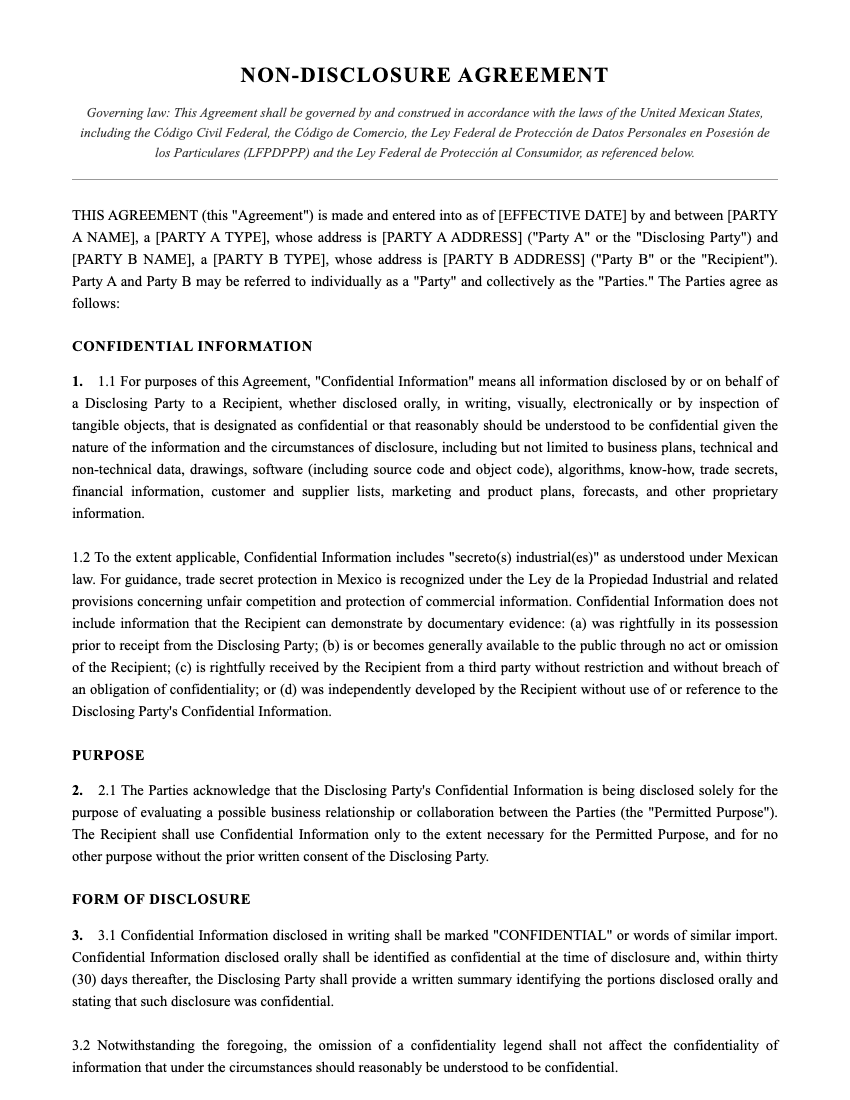
For a complete guide to NDA terms, duration, and standard exclusions, see our NDA Agreement Guide.
Why “Generic” NDAs Are Dangerous in Mexico
Using a one‑size‑fits‑all NDA drafted for the U.S. or Europe creates three main risks in Mexico.
- Fragmented trade‑secret law: Mexico does not rely on a single “trade‑secret statute” equivalent to the U.S. DTSA. Trade‑secret protection is derived from the Ley de la Propiedad Industrial (and related penal and civil provisions) and was strengthened to meet T‑MEC/USMCA commitments. If your NDA simply copies an Anglo template it may fail to reference the civil and criminal remedies available in Mexico or to ask for the particular measures that Mexican courts expect (e.g., showing specific secrecy measures).
- Employee vs. contractor regimes: Labor law can limit post‑employment restraints. When an NDA forms part of an employment contract, Mexican courts prioritize worker protections under the Ley Federal del Trabajo. Overbroad post‑employment non‑compete or exclusivity clauses can be challenged; courts scrutinize duration, geographic scope and consideration. Treat contractors and employees differently in drafting.
- Personal data obligations: If the confidential package includes personal data, the LFPDPPP requires specific notice, lawful basis (consent or other), and privacy safeguards. An NDA that ignores LFPDPPP disclosures can create regulatory exposure to INAI (the data protection authority).
Paradigm‑shifting insight: Mexico’s “dual‑track” protection—contractual remedies (Código Civil Federal / Código de Comercio) plus administrative/criminal enforcement under industrial property and data‑protection laws—means NDAs should not only state obligations but also map remedies across systems. In practice, the best NDAs in Mexico (1) define secrecy measures that courts will recognize, (2) include LFPDPPP‑compliant data processing clauses, and (3) carve out reasonable limits for labor contexts.
Real development to watch
As part of T‑MEC/USMCA implementation, Mexico updated industrial property enforcement and trade‑secret recognition to bring civil and criminal remedies closer to international standards. See IMPI guidance and the T‑MEC text for the trade‑secret chapter—this means better criminal enforcement for misappropriation but higher procedural expectations for plaintiffs.
Key Clauses Adapted for Mexican Practice
- Precise definition of Confidential Information: separate "Personal Data" (subject to LFPDPPP) and "Industrial Secrets / Trade Secrets" (identify categories and examples). Courts expect specificity.
- Limited Purpose: narrow purpose clause to satisfy both contract law and labor public‑policy tests.
- Duration and survival: distinguish general confidential information (typical 2–5 years) from industrial secrets (indefinite protection while secrecy is maintained). Remember civil prescription for obligations and claims: Código Civil Federal prescriptive periods apply (consult Article references for actions—civil claims commonly prescribe in 10 years).
- Employee/Contractor carve: separate provisions for employees (align with Ley Federal del Trabajo) including limits on post‑employment restraints and compensation where applicable; separate contractor clauses with IP assignment and confidentiality duties.
- Data protection clause: consent scope, purposes, retention, cross‑border transfer rules, data controller/processor allocation, rights transfer and INAI contact information to comply with LFPDPPP (Ley Federal de Protección de Datos Personales en Posesión de los Particulares).
- Remedies and interim relief: include express agreement to seek provisional measures (medidas precautorias) and to file civil/criminal complaints where applicable; state governing forum (local courts or arbitration) but be mindful labour disputes are adjudicated by labor boards.
- Electronic signature and execution: specify acceptance of electronic signatures and electronic delivery per Código de Comercio and applicable e‑signature rules.
Who Needs This Document?
| User Persona | Scenario in Mexico | Key Benefit |
|---|---|---|
| Startups (CDMX / Guadalajara) | Fundraising, tech transfer | Protects business model and source code while enabling cross‑border investor diligence under LFPDPPP rules |
| Manufacturers | Sharing specs with maquiladora | Prevents unauthorized use and supports criminal complaints under industrial property protection |
| Employers | Confidentiality during employment and after exit | Properly tailors post‑employment restrictions to Ley Federal del Trabajo standards |
| Service Providers | Outsourcing customer data processing | Ensures processor obligations meet LFPDPPP and contractual safeguards |
How to Execute a Valid Mexico NDA (Practical Steps)
- Choose the right form (Unilateral vs Mutual) and classify recipients (employee vs independent contractor).
- Explicitly identify Confidential Information and flag any Personal Data; attach exhibits or lists when possible.
- Include LFPDPPP‑compliant data processing and consent language if personal data is shared.
- Sign using accepted electronic signature methods and keep evidence of execution (timestamped files, email confirmations). When in doubt, notarize physical signatures for higher evidentiary weight in civil proceedings.
Cross‑sell: If you receive an NDA, use an AI contract review tool to spot Mexican‑specific red flags—overbroad employee restraints, missing LFPDPPP disclosures, or improper remedy clauses—faster than manual review.
Related NDA Templates
Get the Template
Sign up for our newsletter to receive the template.
Frequently Asked Questions

About Designer Content
Designer Content creates practical legal document resources for landlords, contractors, and small business owners. We simplify complex legal concepts into actionable guidance. Connect with us on LinkedIn.