
What Is a Michigan NDA?
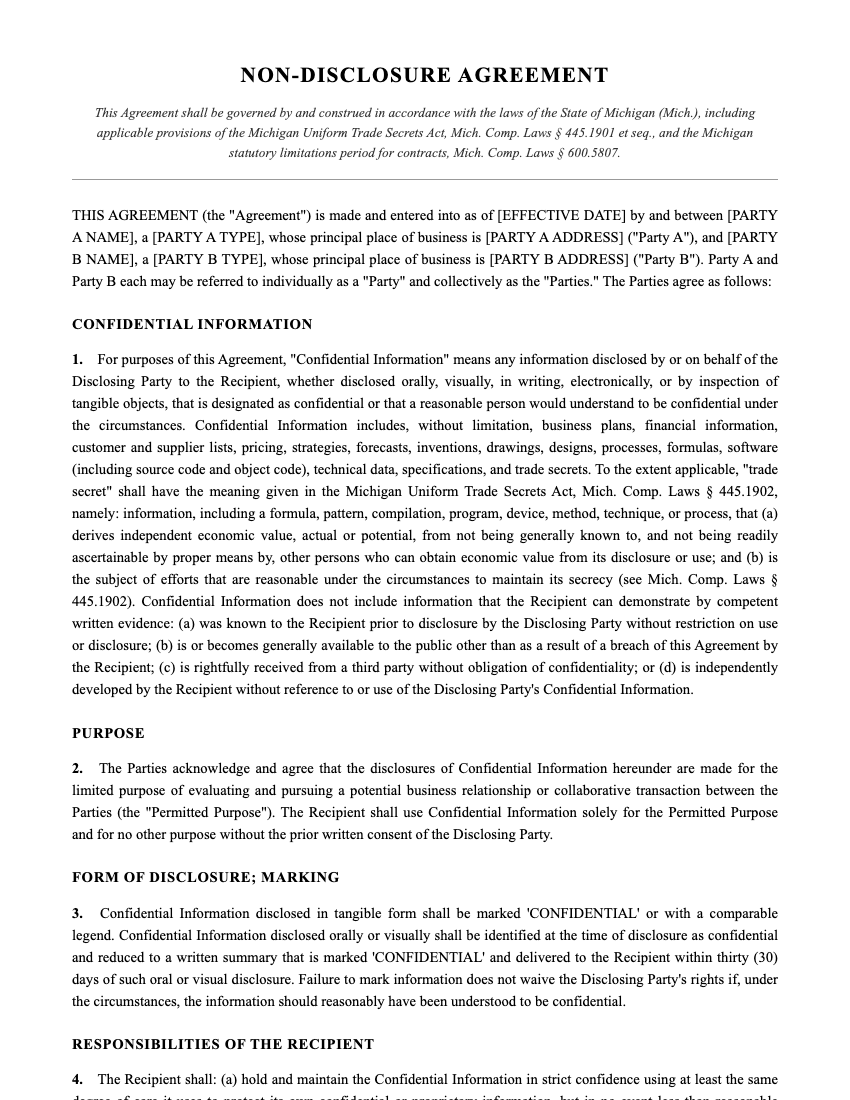
A Michigan Non-Disclosure Agreement (NDA) is a contract used to protect confidential business information and trade secrets consistent with Michigan law. In Michigan, trade secrets and remedies are governed by the Michigan Uniform Trade Secrets Act (MUTSA), codified at MCL 445.1901 et seq. A properly drafted NDA distinguishes between ordinary confidential information (time-limited protection) and trade secrets (protected so long as they remain secret).
Unlike some states that categorically ban non-competes, Michigan generally enforces restrictive covenants if they are reasonable in scope, geography, and duration. That means NDAs in Michigan must be careful about drafting clauses that could be read as overbroad restraints on trade—but you do not have to strip out reasonable restrictive covenants as you would in California.
Why "Generic" NDAs Are Dangerous in Michigan
Using a one-size-fits-all NDA—especially a template built for another state—creates three practical traps under Michigan law.
- The "consideration" trap for post-hire covenants
For a complete guide to NDA terms, duration, and standard exclusions, see our NDA Agreement Guide.
Michigan enforces non-competes and related restraints only when there is adequate consideration. If an employer asks an existing employee to sign a new restrictive covenant after employment begins, the agreement may be unenforceable unless the employer provides additional consideration (promotions, bonuses, stock or other material benefits). Don’t assume a signed NDA given mid-employment automatically sustains a post-employment non-compete.
- Overbroad scope and the reasonableness test
Michigan courts evaluate restrictive covenants on a reasonableness standard—balancing employer interest in protection against employee freedom to work. Clauses that permanently bar an employee from a broad field or large territory are frequently struck down. Templates that use absolute prohibitions ("Receiving Party shall not work in the same industry anywhere in the U.S.") invite judicial invalidation of the restraint and may jeopardize related confidentiality provisions.
- Missing DTSA whistleblower notice (federal trap)
If you ever pursue trade secret misappropriation in federal court under the Defend Trade Secrets Act (DTSA), 18 U.S.C. § 1833(b) requires that the defendant receive notice in any contract that they may disclose trade secrets to government officials when reporting suspected wrongdoing. Without this notice in your NDA, you can still sue, but you may be barred from recovering exemplary damages and attorneys’ fees under the DTSA. Most generic templates omit this protective sentence.
Paradigm-Shifting Insight for Michigan: The "Consideration + Narrowness" Double-Check
Michigan’s unique practical trap is the intersection of (1) the court’s willingness to enforce reasonable restraints, and (2) the requirement for adequate consideration for covenants signed after employment begins. Employers often think simply inserting a restrictive clause into an NDA will lock down ex-employees. Instead, the enforceability hinges on both the narrow tailoring of the restriction and whether the employee received new consideration when signing. Drafting must therefore check both boxes: narrowly limited protections PLUS documented consideration if the covenant is post-hire.
Real-world development: Michigan’s caselaw over the last decade has repeatedly confirmed that courts will refuse to enforce restraints that are broader than necessary to protect a legitimate business interest. For practical guidance, Michigan employers increasingly include severability and alternative-restriction clauses (shortening duration or reducing territory if a court finds the primary clause unreasonable) to preserve enforceability.
Case Study (Practical Illustration)
A Michigan employer attempted to enforce a perpetual prohibition contained in an NDA against a former regional sales director who moved to a competitor. The court declined to enforce the blanket restraint because it covered the entire U.S. and had been presented as a post-hire addendum without additional consideration. The employer recovered on the narrow theory of trade secret misuse for a limited set of documents, but the sweeping employment restriction was voided. This outcome underscores the two-part insight above: narrow, supported restraints survive; broad, unsupported ones do not.
What’s Included in This Template? (Key Clauses)
- Definitions: Clear separation between "Confidential Information" and "Trade Secrets" using MUTSA language (MCL 445.1901 et seq.).
- Purpose limitation: Permitted uses narrowly written to the transaction (e.g., "for evaluation of X project").
- Duration: Two-tier protections — typical confidential information (customizable 1–5 years) and trade secrets (indefinite protection while secret).
- Non-use and non-disclosure obligations with enumerated carve-outs (prior knowledge, public domain, independently developed, compelled disclosure).
- DTSA whistleblower notice language to preserve federal remedy eligibility (18 U.S.C. § 1833(b)).
- Consideration acknowledgement and, where relevant, an express statement of new consideration for post-hire covenants.
- Remedies and injunctive relief clause; reference to statute of limitations for contract claims (MCL 600.5807) where helpful.
- Severability and reformation: fallback restrictions if a court deems primary restraint unreasonable.
Who Needs This Document?
| User Persona | Usage Scenario | Key Michigan Benefit |
|---|---|---|
| Automotive suppliers | Sharing drawings with contract manufacturers | Protects trade secrets while allowing limited geography for enforcement |
| Tech startups (Detroit/Ann Arbor) | Investor pitches and engineering NDAs | DTSA-compliant notice preserves federal remedies for misappropriation |
| Health-care vendors | Sharing patient-protected processes (HIPAA implications) | Carves out legally compelled disclosures and coordinates with privacy obligations |
| Employers | Asking staff to sign confidentiality / restrictive-covenant addenda | Includes consideration checklist for post-hire covenants to improve enforceability |
How to Execute a Valid Michigan NDA
- Choose the correct form (One-way vs Mutual) and tailor the Purpose narrowly.
- If adding a restrictive covenant post-hire, provide and document new consideration (bonus, promotion, equity, paid training, or severance).
- Mark documents and demonstrate "reasonable secrecy efforts" (access controls, labeled files) to support trade secret status under MUTSA.
- Include the DTSA whistleblower notice sentence to preserve federal enhanced remedies if you ever litigate in federal court.
Receiving NDAs? What to Watch For
Before signing other people’s NDAs, check for overbroad non-compete-style language, absence of a consideration clause for post-hire restraints, or demands that waive statutory remedies (you cannot waive fundamental statutory protections). If you need help, an AI contract review tool can flag risky clauses and compare terms against Michigan law instantly.
Related NDA Templates
Get the Template
Sign up for our newsletter to receive the template.
Frequently Asked Questions

About Designer Content
Designer Content creates practical legal document resources for landlords, contractors, and small business owners. We simplify complex legal concepts into actionable guidance. Connect with us on LinkedIn.