
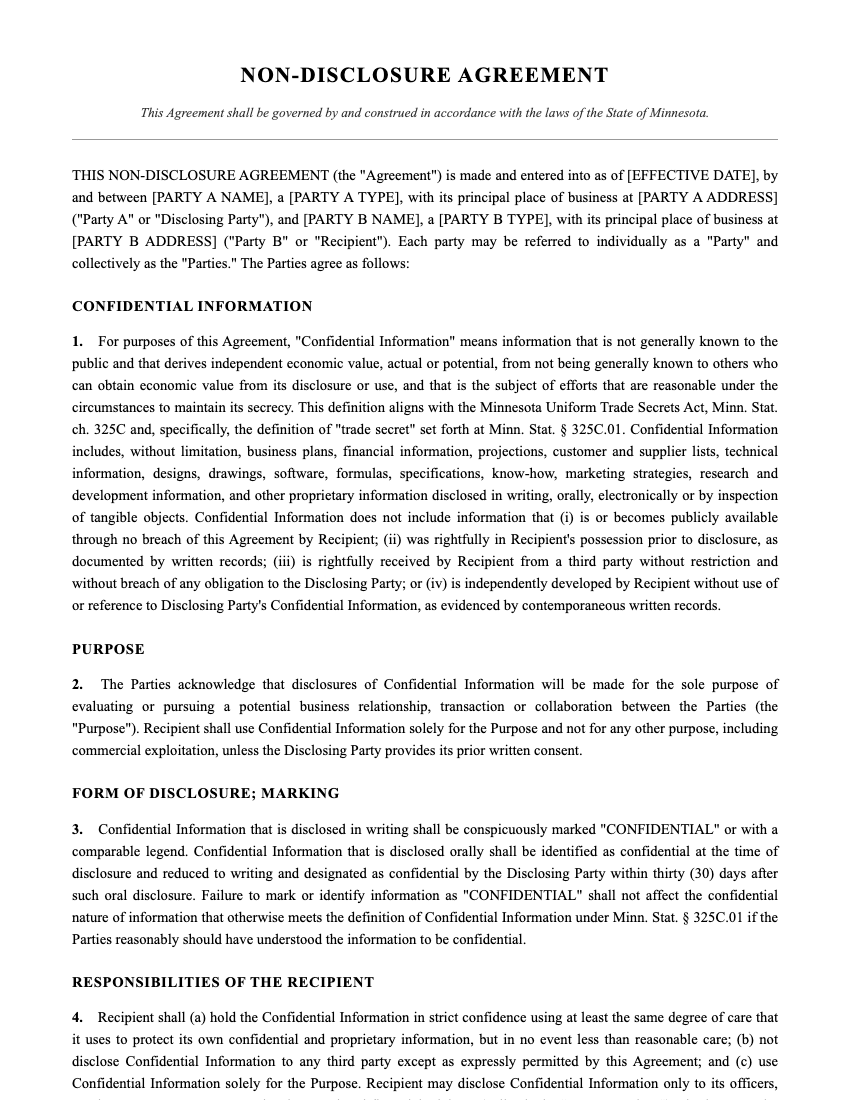
A Minnesota Non-Disclosure Agreement (NDA) is a contract that protects confidential business information and trade secrets while reflecting Minnesota's statutory ban on non-compete clauses. This template is drafted to avoid unlawful restraints on post-employment activity (Minn. Stat. § 181.988), to define trade secrets under the Minnesota Uniform Trade Secrets Act (Minn. Stat. ch. 325C), and to preserve remedies available under federal law (18 U.S.C. § 1833(b)).
What is a Minnesota NDA?
Definition: A Minnesota NDA is a written contract by which a party (the Receiving Party) agrees to keep specified information confidential and to use it only for a defined business purpose. Unlike generic templates that sometimes sneak in employment restraints, a Minnesota NDA must not include language that functions as a non-compete or otherwise restrains a worker’s right to choose employment (Minn. Stat. § 181.988).
Minnesota law now prohibits non-compete agreements that restrict an employee or independent contractor from working in their chosen field if the agreement was first entered into on or after July 1, 2023. Agreements signed before that date may still be enforceable, so it is important to date and preserve originals for historical enforceability analysis.
For a complete guide to NDA terms, duration, and standard exclusions, see our NDA Agreement Guide.
Why generic NDAs are dangerous in Minnesota
Many off-the-shelf NDAs were written for states that allow reasonable post-employment restraints. Putting those clauses into an NDA used in Minnesota risks three problems:
- Backdoor non-competes. Phrases such as “Receiving Party will not compete with Disclosing Party” or broad prohibitions on “use of Confidential Information that would result in competitive advantage” may be treated as prohibited restraints under Minn. Stat. § 181.988. That can void parts of a contract and provoke regulatory attention.
- Losing federal remedies. If you intend to rely on the federal Defend Trade Secrets Act (DTSA), you must include a whistleblower immunity notice (18 U.S.C. § 1833(b)). Without it, a plaintiff cannot recover exemplary damages and attorney’s fees in a federal DTSA case.
- Overbroad definitions. Calling every document a “trade secret” is risky. Minnesota courts enforce trade-secret protection only where information: (a) derives independent economic value from not being generally known, and (b) is subject to reasonable secrecy efforts (Minn. Stat. ch. 325C). Overreaching language can lead a court to refuse injunctive relief.
Paradigm-shifting insight for Minnesota: the non-compete ban is absolute for post‑July 1, 2023 agreements, but employers frequently attempt to achieve the same ends through NDAs, IP assignment clauses, or broad “non-use” provisions. Minnesota law treats those indirect restraints skeptically. In practice, the safest route is to draft narrow, purpose-limited confidentiality and non‑use clauses that protect trade secrets without restricting a person’s ability to work.
Recent legal development (what changed)
Effective July 1, 2023, Minn. Stat. § 181.988 bans new non-compete agreements for most workers. That statutory change is the central development affecting NDAs: where a clause functions to restrict employment, it risks invalidation and penalties. Because pre-2023 agreements may remain enforceable, any dispute often turns on execution dates and the actual language used.
Key clauses adapted for Minnesota
- Purpose/Limited Use: Define a narrow, concrete purpose (e.g., "evaluating a proposed software licensing agreement for Product X"). Overbroad purposes increase the risk of being construed as an employment restraint.
- Definition: Distinguish "Confidential Information" (time-limited, e.g., 2–5 years) from "Trade Secrets" (protected indefinitely so long as secrecy is maintained). Tie trade-secret protection to Minn. Stat. ch. 325C criteria.
- Non-Use and Non-Disclosure (narrow): Prohibit use or disclosure of Confidential Information in ways that cause actual competitive harm—avoid blanket language that purports to stop competition or employment.
- DTSA Whistleblower Notice: Include the notice required by 18 U.S.C. § 1833(b) that a person may disclose trade secrets to government officials or in a court filing under certain conditions without liability for exemplary damages.
- Exclusions: Standard carve-outs for information that is public, previously known, independently developed, or compelled by law.
- Remedies & Limitations: Specify injunctive relief and the six‑year statute of limitations for contracts where applicable (see Minn. Stat. § 541.05). Reserve the right to seek damages for misappropriation under Minn. Stat. ch. 325C and federal DTSA remedies when available.
- Electronic Signatures: Minnesota recognizes electronic signatures under its UETA adoption—use a clear executed copy to prove agreement (see Minn. Stat. § 325L.01 et seq.).
Who needs this document?
| User Persona | Usage Scenario | Key Minnesota Benefit |
|---|---|---|
| Startups (MN) | Pitching to local VCs or partners | Protects pitch decks while avoiding unlawful employment restraints |
| Employers | Onboarding contractors or consultants | Preserves trade-secret protection without creating a banned non-compete |
| Sellers (M&A) | Local due diligence | Allows disclosure of sensitive financials during sale negotiations |
| Manufacturers | Sharing prototypes with vendors | Limits misuse of designs while permitting normal vendor operations |
How to execute a valid Minnesota NDA
- Choose the correct type. Use One‑Way when only you disclose, Mutual when both sides will exchange information.
- Define the purpose specifically. "Evaluating a proposal to license Disclosing Party’s inventory management software" is better than "business discussions."
- Label and secure documents. Mark physical and electronic files CONFIDENTIAL; maintain access logs and restricted storage to show reasonable secrecy measures under Minn. Stat. ch. 325C.
- Sign before sharing. Ensure the fully executed agreement — dated and signed — exists before you send trade secrets. Use an e-sign provider and retain the signed copy; Minnesota’s UETA validates electronic signatures.
If you receive an NDA: watch for hidden restraints (broad non‑use language, employee non-solicitation disguised as confidentiality) and for missing DTSA notice language if federal trade-secret claims are a possibility.
an AI contract review tool can automatically flag backdoor non-compete language, missing DTSA notices, and overbroad definitions against Minnesota statutory standards—saving time and risk.
Related NDA Templates
Get the Template
Sign up for our newsletter to receive the template.
Frequently Asked Questions

About Designer Content
Designer Content creates practical legal document resources for landlords, contractors, and small business owners. We simplify complex legal concepts into actionable guidance. Connect with us on LinkedIn.