
A Mississippi Non-Disclosure Agreement (NDA) is a contract that creates enforceable duties of secrecy over proprietary information, structured to work with Mississippi's trade secret law (the Mississippi Uniform Trade Secrets Act—MUTSA) and common-law contract principles. Unlike some states that void or narrowly construe restraints on post-employment work, Mississippi generally enforces reasonable restraints and protects legitimate business interests—so NDAs must be drafted with precision to avoid creating unintended covenants not to compete or unfair consumer-facing restrictions.
What Is a Mississippi NDA?
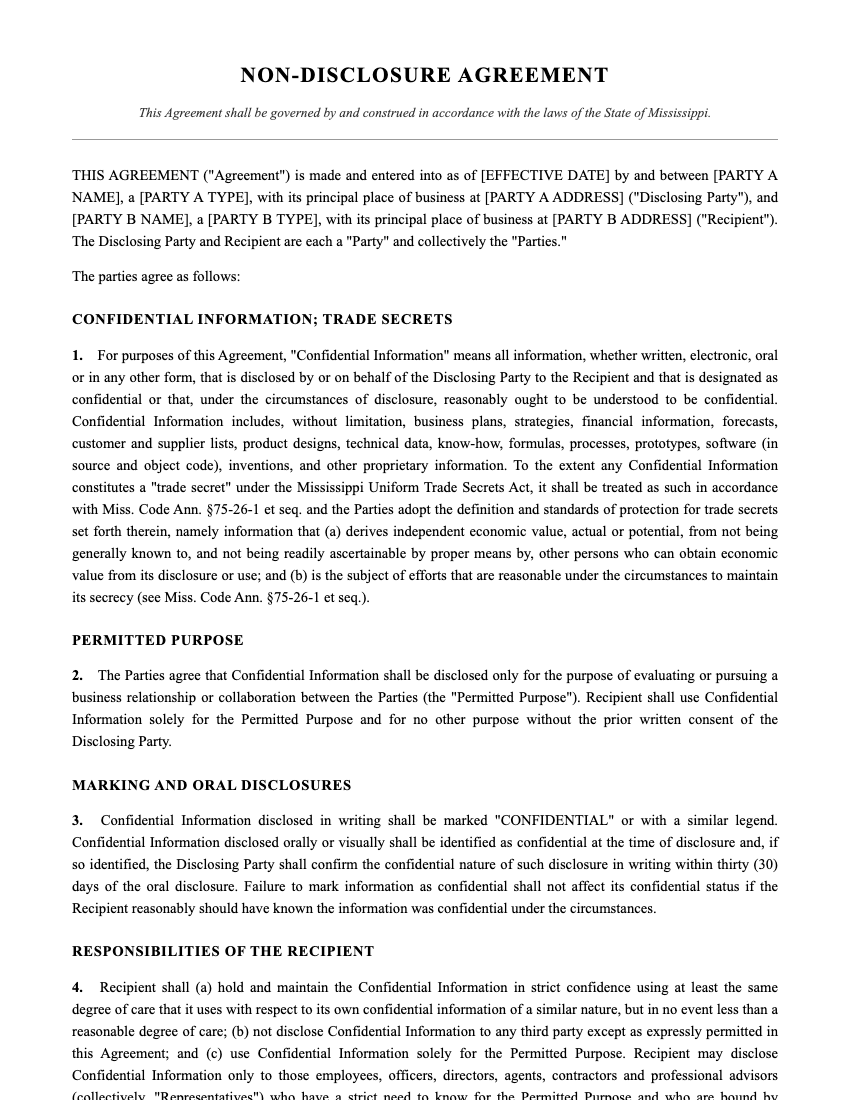
Definition: A Mississippi NDA is a written agreement under which one or both parties agree to (1) keep certain information confidential, (2) use it only for a stated purpose, and (3) return or destroy it on request. For true trade secret protection, an NDA should reflect requirements of the Mississippi Uniform Trade Secrets Act (MUTSA), codified at Miss. Code Ann. §75-26-1 et seq., which defines misappropriation, permissible disclosures, and remedies.
Key legal context you need to know: Mississippi follows common-law contract freedom and judicial reasonableness when it comes to restraints on business. While Mississippi courts will enforce non-competes and other restraints when reasonable and supported by legitimate business interests, an overbroad clause in an NDA can operate as an enforceable restriction against competition—so the risk is the opposite of states that ban non-competes.
For a complete guide to NDA terms, duration, and standard exclusions, see our NDA Agreement Guide.
Why Generic NDAs Are Dangerous in Mississippi
Most online NDA templates assume a one-size-fits-all approach. In Mississippi, that creates three local risks.
- Backdoor non-competes can be enforceable
Clauses like “Recipient shall not use Confidential Information to compete with Disclosing Party” or overly broad “no solicitation/use” language can be read as restrictive covenants. Mississippi courts evaluate covenants for reasonableness—scope, duration, geography, and legitimate business interest. If your NDA unintentionally creates a restraint that is reasonable, a court could enforce it as a non-compete or issue an injunction. That can escalate routine confidentiality disputes into high-stakes litigation.
Paradigm-shifting insight (Mississippi): Unlike California, where backdoor non-competes may be void, in Mississippi a poorly drafted NDA can become a binding restraint on future work. Employers often and unexpectedly win injunctive relief where NDAs include broad “no use” or “no solicitation” clauses tied to trade secrets or client relationships. The key is draft defensibly: limit the prohibited use to specific trade secrets, narrow the time window, and avoid blanket career restraints.
- Trade secret qualification matters under MUTSA
MUTSA requires that a trade secret derive independent economic value from not being generally known and be subject to reasonable efforts to maintain secrecy. Calling everything a “trade secret” won’t work—courts will parse the actual facts. Your NDA should distinguish true trade secrets (subject to indefinite protection so long as secrecy is maintained) from ordinary confidential business information (time-limited, e.g., 2–5 years).
- Federal DTSA notice and remediation
If you plan to rely on federal remedies under the Defend Trade Secrets Act (DTSA), include the statutorily required whistleblower notice (18 U.S.C. § 1833(b)) to preserve eligibility for exemplary damages and attorney's fees. Like other states, Mississippi employers who omit this notice may still sue under DTSA, but they limit available enhanced remedies.
Real-world development to watch
The DTSA (2016) changed the national landscape and impacts Mississippi litigants: federal courts sitting in Mississippi have applied DTSA alongside MUTSA, meaning NDAs must serve dual compliance. Also remember the six-year statute of limitations for written contracts in Mississippi—Miss. Code Ann. § 15-1-29—which can govern breach-of-contract claims arising from NDAs.
What’s Included in This Template? (Key Clauses)
- Mutual vs. Unilateral Templates: One-way for disclosures to vendors/contractors/investors; mutual where both sides exchange proprietary info.
- Precise Trade Secret Definition: Conforms to Miss. Code Ann. §75-26-1 et seq., distinguishing trade secrets from general confidential information.
- Narrow “Use” Restriction: Limits use to the stated Purpose (e.g., evaluating a partnership) rather than broad non-compete language.
- Duration Table: Two-tier protection—ordinary confidential info (customizable 1–5 years) vs. trade secrets (indefinite while secret).
- Residuals Language (Optional): Carefully drafted to avoid being read as a career bar; permits unaided memory while protecting against misappropriation of tangible materials and specific processes.
- Carve-Outs: Pre-existing knowledge, public domain, independently developed, and compelled disclosure (with notice to owner).
- DTSA Whistleblower Notice: Statutorily recommended language to preserve federal remedies (18 U.S.C. §1833(b)).
Who Needs This Document?
| User Persona | Usage Scenario | Key Mississippi Benefit |
|---|---|---|
| Manufacturers (MS) | Outsourcing production to another state | Protects drawings, BOMs, and supplier lists while avoiding overbroad employment restraints |
| Tech Startups (Jackson, MS) | Pitching to investors or sharing alpha code | Preserves MUTSA trade secret protection and includes DTSA notice for federal claims |
| Employers | Hiring senior salespeople | Limits solicitation and ensures reasonable, enforceable protection tied to legitimate customer relationships |
| Small Businesses | M&A due diligence | Allows buyers to review sensitive financials while keeping confidentiality and contract remedies intact |
How to Execute a Valid Mississippi NDA
Step 1: Choose the right type (One-way vs. Mutual).
Step 2: Define the Purpose precisely—“evaluate potential acquisition of Company X’s poultry feed formulation” rather than broad business discussions.
Step 3: Demonstrate reasonable secrecy efforts—access controls, marked documents, policies, and limited distribution. These facts matter under MUTSA.
Step 4: Get signatures and consider consideration language for employee agreements. For new hires, continued employment is typically adequate consideration; for existing employees, provide additional consideration (bonus, promotion, new stock rights) to avoid challenges.
Receiving an NDA? Read for these Mississippi red flags
If a counterparty’s NDA contains sweeping “no use” clauses, blanket non-solicit language, or indefinite career restraints, negotiate to limit scope, duration, and purpose. In Mississippi, overbroad wording can be enforced—don’t assume courts will void it.
an AI contract review tool (link) can automatically flag clauses that create hidden covenants not to compete, identify missing DTSA notice, and compare your NDA against Mississippi case law patterns—saving hours of manual review.
Related NDA Templates
Get the Template
Sign up for our newsletter to receive the template.
Frequently Asked Questions

About Designer Content
Designer Content creates practical legal document resources for landlords, contractors, and small business owners. We simplify complex legal concepts into actionable guidance. Connect with us on LinkedIn.