
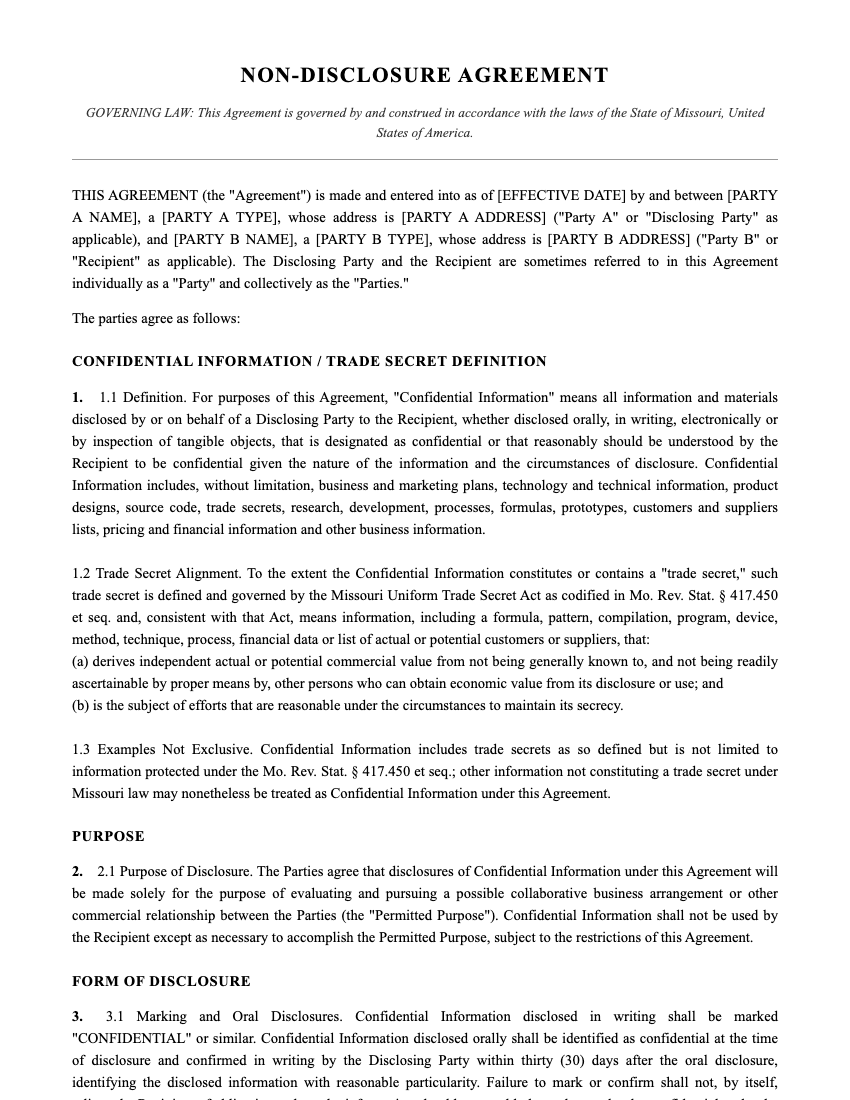
A Missouri Non-Disclosure Agreement (NDA) is a contract that protects confidential business information and trade secrets while navigating Missouri’s common-law approach to restraints and statutory protections. This template is tailored to Missouri law: it aligns with the Missouri Uniform Trade Secrets Act (RSMo Chapter 417), avoids common traps under the Missouri Merchandising Practices Act (RSMo Chapter 407), and accounts for the 10-year statute of limitations for written contracts (RSMo 516.110).
What Is a Missouri NDA?
Definition: A Missouri NDA is a written agreement where a party (the Receiving Party) promises to keep certain disclosed information confidential and to use it only for an expressly defined Purpose. In Missouri, trade-secret protection is governed by the state’s adoption of the Uniform Trade Secrets Act (see RSMo Chapter 417), and restraint-of-trade issues—such as non-compete or overbroad non-use terms—are judged under a reasonableness standard by Missouri courts.
Unlike states that categorically bar non-competes, Missouri enforces reasonable restraints. That means NDAs must be carefully drafted: overbroad duration, geographic scope, or use restrictions risk being treated like an unlawful or unenforceable restraint.
For a complete guide to NDA terms, duration, and standard exclusions, see our NDA Agreement Guide.
Why Generic NDAs Are Dangerous in Missouri
Most free NDA forms are drafted for jurisdictions with different doctrines. Using a generic template in Missouri can create four specific legal risks:
- Enforcement exposure under the 10-year written-contract statute of limitations (RSMo 516.110). A broadly worded written NDA can leave parties vulnerable to long-tail claims—plan accordingly when choosing duration and remedies.
- Treating confidentiality clauses as de facto non-competes. Missouri courts enforce restraints that are reasonable, so a confidentiality provision that functionally prevents someone from working in their field risks judicial scrutiny and possible narrowing or invalidation.
- Missouri Merchandising Practices Act (RSMo Chapter 407) risk. Using an NDA to conceal fraud or to silence consumers/employees reporting illegal conduct may trigger MMPA claims for unfair or deceptive practices.
- Losing enhanced remedies in federal trade secret litigation if the NDA omits DTSA notice. Under the federal Defend Trade Secrets Act (18 U.S.C. § 1833(b)), plaintiffs seeking exemplary damages or attorneys’ fees must show their confidentiality agreements included notice that reporting to government officials or in some instances making protected disclosures is permitted.
Paradigm-shifting insight (Missouri): Missouri’s combination of a permissive enforcement stance for reasonable restraints and a long statute of limitations for written contracts means NDAs can carry enforceable obligations for many years—but only if drafted with precise, reasonable scope. Put another way: Missouri will enforce restraint-like confidentiality if it is reasonable; but an overreaching NDA can be recharacterized as an unreasonable restraint and partially or wholly invalidated, while still exposing parties to decade-long contractual liability if it survives initial challenges.
Real development: Missouri codified trade-secret remedies through RSMo Chapter 417 (Missouri’s adoption of the Uniform Trade Secrets Act); litigants in Missouri now routinely balance UTSA protections against the state’s MMPA and common-law reasonableness tests when disputes arise.
Key Clauses in the Missouri Template
- Purpose clause: narrowly define the legitimate commercial purpose. Missouri courts favor specific, limited purposes.
- Definition: split Confidential Information vs. Trade Secrets. Follow RSMo Chapter 417 standards: trade secrets require economic value from secrecy and reasonable efforts to maintain secrecy.
- Duration: use a two-tier approach. Non-essential business information: 2–5 years. Trade secrets: indefinite protection while secrecy is maintained. Remember the 10-year limitation on written contract claims (RSMo 516.110) when drafting long-term remedies.
- Use restriction (not a non-compete): prohibit use of disclosed information for purposes outside the defined Purpose, but avoid language that bars employment entirely in a field—frame restrictions around specific data, clients, or technology.
- Return/destruction and certification: require prompt return or certified destruction of materials upon request or termination.
- Carve-outs: information already publicly known, independently developed, or legally compelled to be disclosed. Include a compelled disclosure procedure that preserves privilege when possible.
- DTSA whistleblower notice: include the federal DTSA notice (18 U.S.C. § 1833(b)) so you retain eligibility for enhanced federal remedies.
- Remedies and limitation: specify injunctive relief and liquidated damages carefully—Missouri courts scrutinize penalties; avoid unconscionable or punitive language that could conflict with RSMo Chapter 407.
Who Needs This Document?
| User Persona | Usage Scenario | Why This Template Helps in Missouri |
|---|---|---|
| Midwest tech startup | Pitching to investors or sharing prototypes | Protects source code and protocols while limiting duration to what Missouri courts consider reasonable |
| Manufacturers | Sharing supplier specs with contractors | Carves out trade-secret protections and return obligations for physical prototypes |
| Professional services firms | Sharing client lists with M&A advisors | Enables narrow, purpose-limited protection to reduce non-compete exposure |
| Employers | Onboarding employees with access to IP | Balances confidentiality with Missouri’s reasonableness test to avoid unlawful restraints |
How to Execute a Valid Missouri NDA
Step 1: Pick the right form
Decide between One‑Way (unilateral) for disclosures coming only from you, or Mutual when both sides exchange information. Missouri courts assess the bargain’s context; pick the version that reflects reality.
Step 2: Tailor the Purpose and Scope
Be precise. A narrow Purpose reduces the risk a court will treat the NDA as an unlawful restraint. Define categories of Confidential Information and flag which items are asserted trade secrets under RSMo Chapter 417.
Step 3: Mark documents and show secrecy efforts
Label files, limit access, and maintain access logs. Missouri’s UTSA adoption requires “reasonable efforts” to maintain secrecy; labeling and internal controls are evidence of that.
Step 4: Sign before sharing; use enforceable signatures
Get the NDA signed before disclosure. Missouri recognizes electronic execution under UETA/ESIGN principles—use robust audit trails (dated signatures, IP addresses, certificate logs) for enforceability in later litigation.
Receiving an NDA from a Client?
Before signing, confirm the agreement’s duration, remedy clauses, non-use language, and any employment restraints. If it reads like a non-compete in disguise—or attempts to bar whistleblowing—negotiate a narrower Purpose clause and insist on DTSA notice.
an AI contract review tool can quickly flag Missouri-specific risks, compare terms to RSMo Chapter 417 and Chapter 407 concerns, and recommend edits, saving hours of manual review.
Related NDA Templates
Get the Template
Sign up for our newsletter to receive the template.
Frequently Asked Questions

About Designer Content
Designer Content creates practical legal document resources for landlords, contractors, and small business owners. We simplify complex legal concepts into actionable guidance. Connect with us on LinkedIn.