
Opening
A Master Services Agreement (MSA) in Monaco is a B2B framework agreement that sets, once and for all, the legal rules (payment, liability, confidentiality, intellectual property, disputes) applicable to all your future engagements via Statements of Work (SOW) signed over the course of projects. For an agency, a consultant, or a freelancer, this format reduces negotiation time and secures the commercial relationship. In Monaco, it must also reflect the Monegasque Civil Code and local data protection requirements.
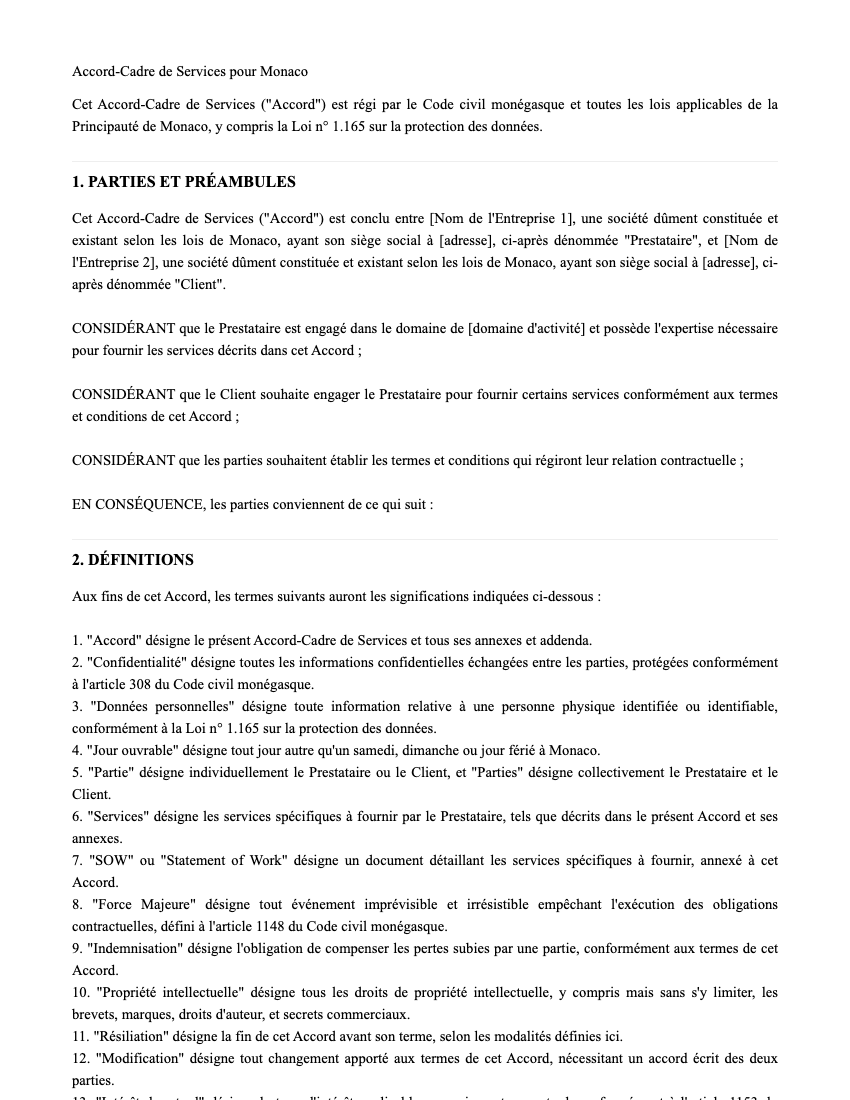
For a comprehensive guide to structuring MSAs and SOWs that protect your business, see our Freelancer Contracts Guide.
Definition Box
Definition: A Monegasque MSA (master services framework agreement) is a main contract entered into between a service provider and a client that defines the general terms governing their successive services in Monaco. Rather than renegotiating for each engagement, the parties then sign SOWs (purchase orders/engagement letters) describing the scope, deadlines, deliverables, and price, while referring back to the clauses of the MSA. A good MSA for Monaco addresses in particular confidentiality (Monegasque Civil Code, art. 308), force majeure (art. 1148), late-payment interest (art. 1153), and personal data (Law No. 1.165, art. 17).
Why You Cannot Use a Generic MSA in Monaco
A “standard” template (often inspired by Anglo-Saxon law) may work in some countries, but it creates gray areas in Monaco: unsuitable terminology, unenforceable clauses, and reclassification risks. Here are three areas where a Monegasque MSA must be designed “locally”.
Worker Classification Rules
Monaco does not operate with an “ABC test” like some U.S. states. The key question is instead: does your relationship, in practice, resemble an employment contract (relationship of subordination) or an independent service? The Monegasque Labour Code governs the employment contract and, in practice, the administration and courts examine concrete indicators: managerial authority, control of working hours, integration into the client’s team, exclusivity, and economic dependence. If your MSA/SOW looks like a staff secondment (imposed hours, daily reporting, equipment provided, hierarchical approval), the risk is reclassification.
Possible consequences: back pay/benefits, regularization of social security contributions with the competent bodies, and employment litigation (Tribunal du travail). Even without a single scale, the total cost is often higher than the “gain” from a poorly structured contract. A Monegasque MSA should therefore document independence: autonomy of performance, no exclusivity by default, deliverables-based invoicing, and the right to use subcontractors (if compatible).
Non-Compete Enforceability
Unlike California, non-compete clauses can be accepted in the Monegasque environment, but they must remain proportionate. A generic template that prohibits “any competing activity worldwide for 5 years” is a red flag for imbalance and can become difficult to defend. In practice, a reasonable limitation is sought (duration, geographic area, targeted activity) and a justification based on the client’s legitimate interest (protection of sensitive information, stability of a portfolio, product strategy).
Rather than copying “blocking” clauses, an MSA in Monaco favors more robust alternatives: (1) confidentiality and trade secret protection with a precise definition of Confidential Information (Monegasque Civil Code, art. 308), (2) targeted non-solicitation (identified clients/contacts; short period), and (3) clauses requiring return/destruction of data at the end of the engagement. For freelancers and agencies, these mechanisms protect the client without preventing you from working. If in doubt, the clause should be calibrated project by project in the SOW.
IP/Work-for-Hire Considerations
Anglo-Saxon templates often use “work made for hire”, a concept that does not export cleanly into civil law. In Monaco, best practice is to provide for a clear assignment of rights (or a license): which deliverables, which rights (reproduction, representation, adaptation), which territory, which term, and at what price. Without this, you can deliver a website, code, or visuals while retaining (or losing) rights in an uncertain way. The MSA must also tie the assignment to payment (e.g., transfer upon full payment) to prevent the client from exploiting an unpaid deliverable.
What's Included in This Template
Flexible SOW Structure
The template separates the legal (MSA) from the operational (SOW). The MSA sets the stable rules; each SOW describes the engagement: scope, milestones, acceptance criteria, rates, expenses, and points of contact. This reduces “scope creep” and speeds up signatures.
Monaco-Specific Indemnification
The indemnification clause is drafted for B2B use: liability for fault, usual exclusions (indirects), caps, and a claim notification/management mechanism. It can be combined with a settlement/waiver where relevant (Monegasque Civil Code, art. 2044) to secure an amicable resolution.
Dispute Resolution and Venue
The template provides for governing law and jurisdiction consistent with Monaco (Monegasque courts), and an amicable resolution step before litigation. It also includes an adapted force majeure clause (Monegasque Civil Code, art. 1148), useful for delays linked to unforeseeable events.
Other included clauses (with references): confidentiality (Monegasque Civil Code, art. 308); late-payment interest (Monegasque Civil Code, art. 1153); data protection and security/purpose limitation obligations (Law No. 1.165, art. 17); termination terms and reversibility; subcontracting; insurance; acceptance of deliverables.
Who Needs This Document?
| User Type | Relationship | Key Benefit |
|---|---|---|
| Agencies (marketing, design) | Recurring engagements with Monegasque companies | Fast SOWs + clarified intellectual property |
| Consultants (finance, ops) | Long-term advisory | Framing of scope and deliverables |
| Developers / IT | Phased projects (MVP, maintenance) | IP transfer tied to payment + structured support |
| Event service providers | Multi-date services | Cancellation, force majeure, and expenses framed |
How to Use This MSA Template
Step 1: Identify the Parties
Indicate the exact corporate name, legal form, and address (registered office) of the client and the service provider. Check consistency with registration documents and invoicing.
Step 2: Set the Term and Termination
Choose a term (e.g., 12 months) or an automatic renewal, then specify termination (notice, termination for breach, effect on ongoing SOWs).
Step 3: Attach the First SOW
Describe precisely the scope, deliverables, schedule, acceptance criteria, and price. Add the contact person and the approval process.
Step 4: Sign and Operate
Sign the MSA once, then sign an SOW for each engagement. Centralize communications (emails, tickets) because they serve as evidence in the event of a dispute.
Already Receiving Contracts from Clients?
Even if you send your own MSA, you will often receive a client’s “in-house” MSA. In Monaco, review as a priority: overly broad non-compete clauses, automatic IP assignment not conditioned on payment, penalties and liability caps, and personal data obligations (Law No. 1.165). Before signing, compare the risks with your operational practices and your insurance. For a quick triage of points to negotiate, use an AI contract review tool.
Download Options
Free PDF Version: ideal for reading, internal validation, and sharing with the client.
Editable Word/Google Docs Version: editable version with fields to complete, clause variants (IP, liability, confidentiality) and a ready-to-use SOW template for your next engagements.
Disclaimer
Informational template for B2B relationships in Monaco. Does not constitute legal advice. Consult a Monegasque lawyer for complex or regulated situations.
Related MSA Templates
Get the Template
Sign up for our newsletter to receive the template.
Frequently Asked Questions

About Designer Content
Designer Content creates practical legal document resources for landlords, contractors, and small business owners. We simplify complex legal concepts into actionable guidance. Connect with us on LinkedIn.