
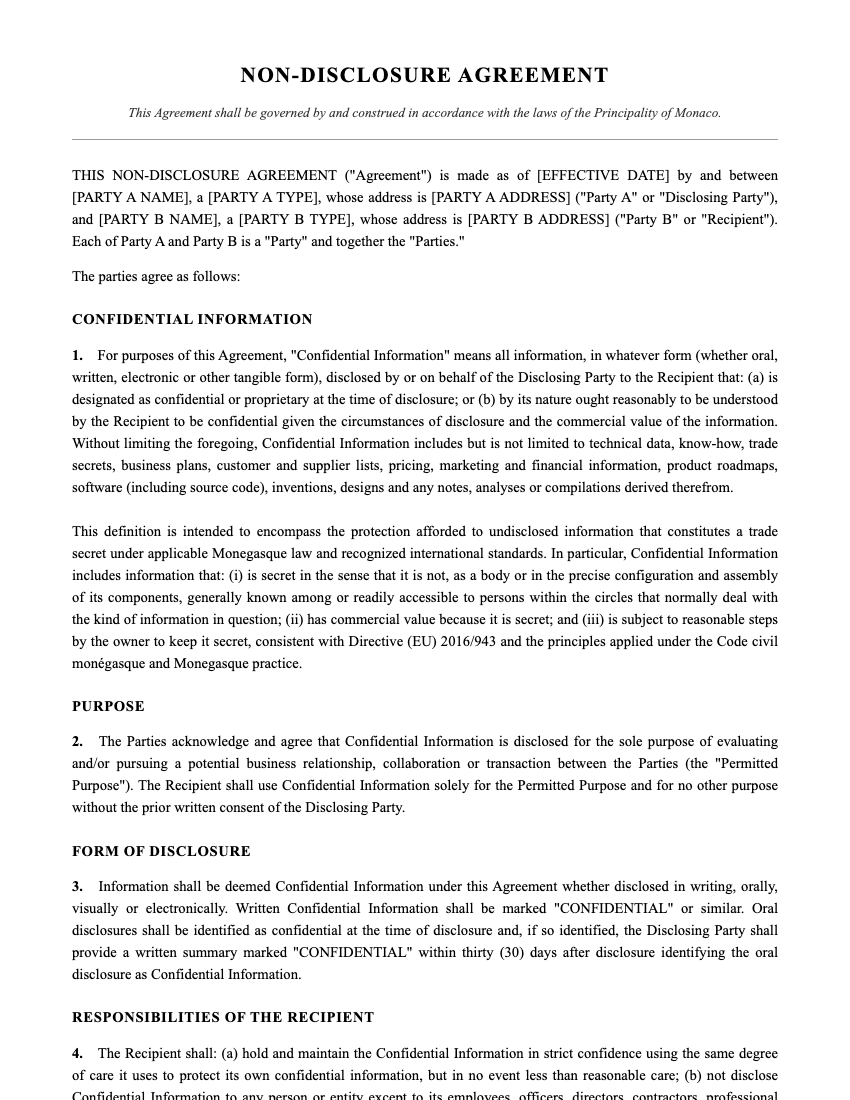
A Monaco Non-Disclosure Agreement (NDA) is a written contract that creates binding obligations of confidentiality under Monaco’s civil-law framework (Code civil monégasque) and must be tailored to local requirements—especially Monaco’s data protection statute (Loi n° 1.165) and the jurisdiction’s long prescription period (30 years for common-law obligations).
What Is a Monaco NDA?
Definition: A Monaco NDA is a contractual instrument, grounded in the Code civil monégasque, by which one party (Disclosing Party) provides Confidential Information to another (Receiving Party) under enforceable duties to keep that information secret and to use it only for a stated Purpose.
Unlike common-law templates drafted for jurisdictions like the United States, Monaco NDAs operate in a civil-law environment where form, specificity, and proportionality matter. Clauses must show a clear legal basis for obligations (contractual consent and legitimate interest), respect Monaco’s data-protection regime (Loi n° 1.165 on processing of personal data), and account for local labour-law practice when the counterparty is an employee or contractor.
For a complete guide to NDA terms, duration, and standard exclusions, see our NDA Agreement Guide.
Why Generic NDAs Are Dangerous in Monaco
Many free online templates assume a flexible common-law approach to restrictive covenants and punitive remedies. That creates three Monaco-specific risks:
- Formality and clarity traps
Monaco courts and authorities expect clear, written commitments with identifiable Parties, Purpose, scope, and duration. Vague, omnibus “confidentiality” wording is at high risk of being partially or fully recharacterized or held unenforceable.
- Employment and restraint issues (the paradigm-shifting insight)
Monaco follows civil-law employment principles similar to French practice: post‑termination restraints (non-compete or overbroad restrictive language) can be enforceable only if they meet strict criteria—limited in time and territory, necessary to protect legitimate business interests, and typically coupled with financial compensation for the employee. In a small, tightly-networked market like Monaco, overbroad NDA language that effectively restrains an employee’s post‑employment activity will likely be treated as a disguised non-compete and either struck down or converted into a limited restraint with compensation. The insight: in Monaco, an overreaching NDA can be recharacterized by a tribunal as an employment restraint, with attendant requirements (compensation and proportional limits) rather than simply being void as in some U.S. jurisdictions.
- Data protection and transfer obligations
If the Confidential Information includes personal data, the NDA must respect Loi n° 1.165 and any guidance from Monaco’s supervisory authority (Commission de Contrôle des Informations Nominatives — CCIN). That means clear legal bases for processing, limits on onward transfers, and specific instructions for data retention and deletion. Failure to include these elements risks administrative sanctions and undermines contractual remedies.
Real Development to Watch
Monaco has actively modernized data and confidentiality regulation in recent years to align with international standards. Practitioners now routinely reference Loi n° 1.165 for processing requirements and the CCIN’s guidance for cross-border transfers. Because Monaco’s courts apply civil‑law formalism, a written NDA drafted with the Code civil monégasque and Loi n° 1.165 in mind is significantly more likely to be upheld than an off‑the‑shelf common‑law template.
What’s Included in This Template? (Key Clauses)
- Purpose clause: precise, limited description of the permitted use of Confidential Information (mandatory in Monaco).
- Definition of Confidential Information: two-tier approach separating personal data, trade secrets, and general commercial information.
- Duration and territorial scope: set specific time limits for non‑trade‑secret information (e.g., 2–5 years) and indefinite protection for bona fide trade secrets so long as secrecy is preserved.
- Employment carve-out & restraint hygiene: explicit language confirming the NDA is not intended as a non‑compete; where applicable, a separate, compensatory non‑compete must comply with local labour rules.
- Data protection obligations: clauses addressing processing bases, security measures, notification duties, and lawful international transfers in line with Loi n° 1.165.
- Remedies and governing law: civil remedies, injunctive relief, and choice of Monaco courts; note prescription (statute of limitations) of 30 years for common-law obligations.
- Electronic signature and formality clause: acceptance of electronic signatures where parties agree, while recommending originals for high‑value disclosures.
Mutual vs. Unilateral Options
- One‑Way (Unilateral): Use when only one party discloses sensitive information (investor pitches, vendor proposals).
- Mutual (Two‑Way): Use when both parties exchange information in due diligence, partnership talks, or collaborative development.
Choose the narrower option that matches the exchange—Monaco courts dislike catch‑all mutual language that creates ambiguous obligations.
Who Needs This Document?
| User Persona | Usage Scenario | Key Monaco Benefit |
|---|---|---|
| High‑net‑worth service providers | Private wealth management introductions | Protect client lists and financial workflows while complying with Loi n° 1.165 |
| Tech vendors & SaaS providers | Deploying software to Monegasque customers | Ensure data processing clauses meet local law and contractual security expectations |
| Employers & HR teams | Confidentiality with employees and contractors | Avoid disguised post‑termination restraints; include compensation language or separate non‑compete if appropriate |
| Manufacturers & designers | Protecting luxury goods designs | Protect trade secrets while documenting secrecy measures required under civil law |
How to Execute a Valid Monaco NDA
Step 1: Choose and tailor the type
Decide One‑Way or Mutual and tailor definitions and Purpose to the actual exchange. Monaco judges will look for precision.
Step 2: Check for personal data
If any Confidential Information contains personal data, add specific processing instructions, legal basis, retention periods, and transfer protections to comply with Loi n° 1.165 and CCIN guidance.
Step 3: Mark and secure materials
Label confidential files, keep restricted access logs, and document technical and organisational security measures—these steps support claims that information qualified as a trade secret under civil‑law standards.
Step 4: Sign before sharing (formalize delivery)
Obtain written (or mutually agreed electronic) signatures before any disclosure. For high‑value relationships, exchange counterparts and retain originals in case of future proceedings.
Receiving NDAs from Counterparties
When asked to sign a third‑party NDA, watch for disguised restraints that limit your post‑employment activity or create obligations incompatible with Code civil principles. Request narrowing of scope, time, and territory and confirm any employee restraints include appropriate compensation under local practice.
an AI contract review tool can help spot overbroad clauses, recharacterization risk (restraints vs. confidentiality), and data‑protection gaps—saving you negotiation time.
Related NDA Templates
Get the Template
Sign up for our newsletter to receive the template.
Frequently Asked Questions

About Designer Content
Designer Content creates practical legal document resources for landlords, contractors, and small business owners. We simplify complex legal concepts into actionable guidance. Connect with us on LinkedIn.