
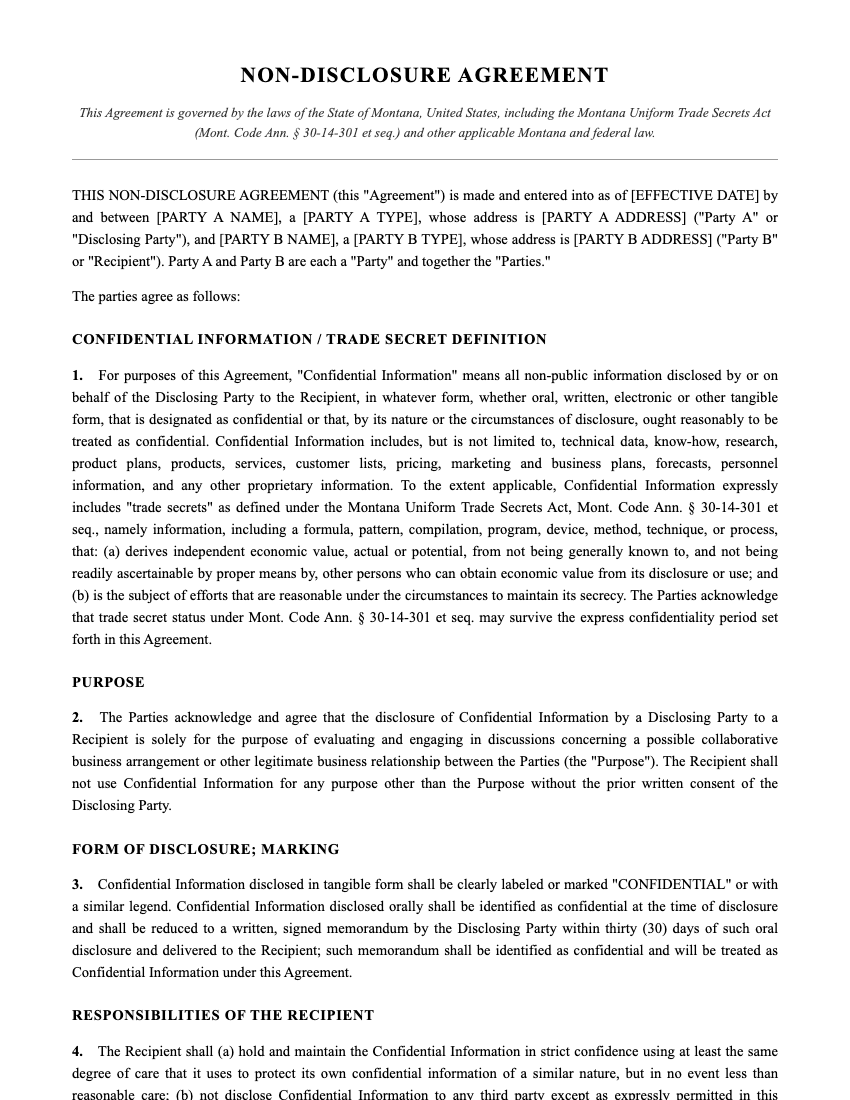
A Montana Non-Disclosure Agreement (NDA) is a contractual tool to protect proprietary information, trade secrets, and confidential business processes while aligning with Montana law — including the state’s trade-secret framework, the 8-year statute of limitations for written contracts (MCA 27-2-202), and Montana’s strong constitutional right to privacy. Unlike one-size-fits-all templates, a Montana NDA needs to reflect how local courts treat enforceability, reasonableness, and public-policy limits.
What Is a Montana NDA?
Definition: A Montana NDA is a contract by which a party (the Receiving Party) agrees not to disclose or misuse information provided by another party (the Disclosing Party). In Montana, enforceability depends on the agreement’s specificity, the nature of the information (ordinary confidential information vs. trade secret), and compliance with federal rules that affect remedies (e.g., Defend Trade Secrets Act (DTSA) notice requirements for whistleblowers).
Montana does not follow California’s blanket ban on non-competes. Montana courts generally enforce restrictive covenants (including confidentiality provisions that have a spillover effect on competition) if they are reasonable in scope, duration, and geography and supported by adequate consideration. But Montana’s constitutional right to privacy (Article II of the Montana Constitution) and consumer-protection laws can create unique limits on overbroad secrecy provisions.
For a complete guide to NDA terms, duration, and standard exclusions, see our NDA Agreement Guide.
Why “Generic” NDAs Are Dangerous in Montana
Many online NDA forms assume either a no‑noncompete jurisdiction or a broad-contract approach. In Montana, that creates three risks:
- Unenforceable overbreadth. Courts will refuse to enforce provisions that are vague or exceed what’s necessary to protect legitimate business interests. A clause forbidding “any use” of received information forever invites a judge to narrow or strike the clause.
- Privacy and public‑interest conflicts. Montana’s constitutional right to privacy and public‑policy protections can make NDAs risky if they try to silence disclosures about illegal conduct, workplace safety, or matters of public concern. A Montana court may decline to enforce confidentiality that would otherwise conceal consumer harms or criminal activity.
- Lost federal remedies without DTSA notice. If you plan to sue in federal court under the federal DTSA, you lose certain enhanced remedies (exemplary damages and attorneys’ fees) unless your agreement includes the DTSA whistleblower notice that tells employees they may disclose trade secrets to government officials or in certain legal filings.
Paradigm-shifting insight: In Montana, the interplay between an individual’s constitutional privacy right and contract freedom makes NDAs a unique drafting challenge. NDAs that are too broad not only fail on traditional reasonableness grounds but can also be attacked under the state constitution and consumer-protection statutes if they chill speech on matters of public interest or hide unlawful practices.
Real development to watch: Montana’s statutes include an 8-year limitations period for written contracts (MCA 27-2-202). That affects how long you should expect to pursue contractual claims connected to an NDA. For trade-secret claims, separate statutory provisions (state trade-secret law and DTSA) determine remedies and potentially different statutes of limitations.
Key Clauses — Montana Adaptations
- Definition of Confidential Information vs. Trade Secrets: Distinguish ordinary confidential business information (time-limited protection, e.g., 2–5 years) from trade secrets (protected indefinitely while secret and valuable). The Montana approach rewards this precision.
- Purpose and Use Limitation: Narrowly define the “Permitted Purpose” for disclosure. Courts expect specificity: "to evaluate X partnership for Project Y" beats "for business purposes."
- Residuals Clause (optional): Montana courts accept residuals clauses if drafted carefully. If you allow unaided-memory use of general skills, limit it so it doesn’t function as a de facto non-compete.
- DTSA Whistleblower Notice: Include express language informing recipients they may disclose trade secrets to government officials or in confidence to an attorney and that such disclosures are protected. This preserves DTSA enhanced remedies if you later litigate in federal court.
- Exclusions & Carve-Outs: Standard carve-outs (public domain, prior knowledge, independently developed, compelled by law) are essential in Montana to avoid overbreadth and to respect privacy/public-interest exceptions.
- Remedies and Limitations: Specify injunctive relief and the right to seek both state and federal remedies, but avoid liquidated damages that resemble punitive sanctions for whistleblowing—Montana public policy may frown on clauses that chill protected disclosures.
Who Needs This Document?
| User Persona | Usage Scenario | Key Montana Benefit |
|---|---|---|
| Tech startups | Pitching to investors or contractors | Protects source code and algorithms while respecting privacy and whistleblower carve-outs |
| Employers | Hiring key personnel | Preserves confidential HR processes, customer lists, and trade secrets without creating unenforceable overbroad restraints |
| Manufacturers | Sharing designs with vendors | Clear trade-secret language keeps designs protected under Montana trade-secret law |
| Small businesses | M&A or due diligence | Enables disclosure during diligence while limiting future disputes under MCA contract rules |
| Service providers | Consultants and freelancers | Allows one-way NDAs that avoid implying a non-compete |
How to Execute a Valid Montana NDA
Step 1: Choose the type. Decide One‑Way (unilateral) if only you disclose, or Mutual if both sides will exchange information.
Step 2: Define the purpose narrowly. Limit the permitted use to a specific project or evaluation.
Step 3: Document secrecy efforts. In Montana, a trade-secret protection claim improves if you can show concrete steps (labels, restricted access, internal policies) that evidence reasonable efforts to keep information secret.
Step 4: Sign before sharing. Execute the NDA before sending sensitive information. Electronic signatures are generally enforceable for contracts, but preserve execution evidence (timestamps, signature logs).
Reviewing NDAs You Receive
If a client or vendor sends you an NDA, check for overbroad duration, sweeping non-disclosure of lawful reporting (privacy or public-safety issues), missing DTSA notice (if DTSA remedies matter), and ambiguous permitted uses. Use an AI contract review tool to flag risky clauses against Montana benchmarks and save negotiation time.
Related NDA Templates
Get the Template
Sign up for our newsletter to receive the template.
Frequently Asked Questions

About Designer Content
Designer Content creates practical legal document resources for landlords, contractors, and small business owners. We simplify complex legal concepts into actionable guidance. Connect with us on LinkedIn.