
A Mozambique Master Services Agreement (MSA) is a master contract that defines, in a reusable way, the rules for the provision of services between a supplier and a client in Mozambique. Instead of renegotiating everything for each project, the parties sign an MSA once and execute “Statements of Work” (SOWs) for each specific job, with scope, deadlines, and pricing. For freelancers, consultants, and agencies, this reduces delays, avoids “scope creep,” and provides predictability for invoicing, confidentiality, intellectual property, and dispute resolution.
Definition: A Master Services Agreement (MSA) in Mozambique is a framework agreement of a contractual nature that establishes the general conditions applicable to multiple future service engagements between the same parties, leaving the details of each project to attached SOWs. The MSA typically covers: the method of engagement and change of scope, prices and taxes, late-payment default interest, confidentiality and data protection, intellectual property, limits of liability, warranties and indemnities, termination and effects of termination. As Mozambique follows a civil law system, clear clauses compatible with the Civil Code and the Commercial Code (including rules on contractual freedom and interest) reduce discussions and disputes.
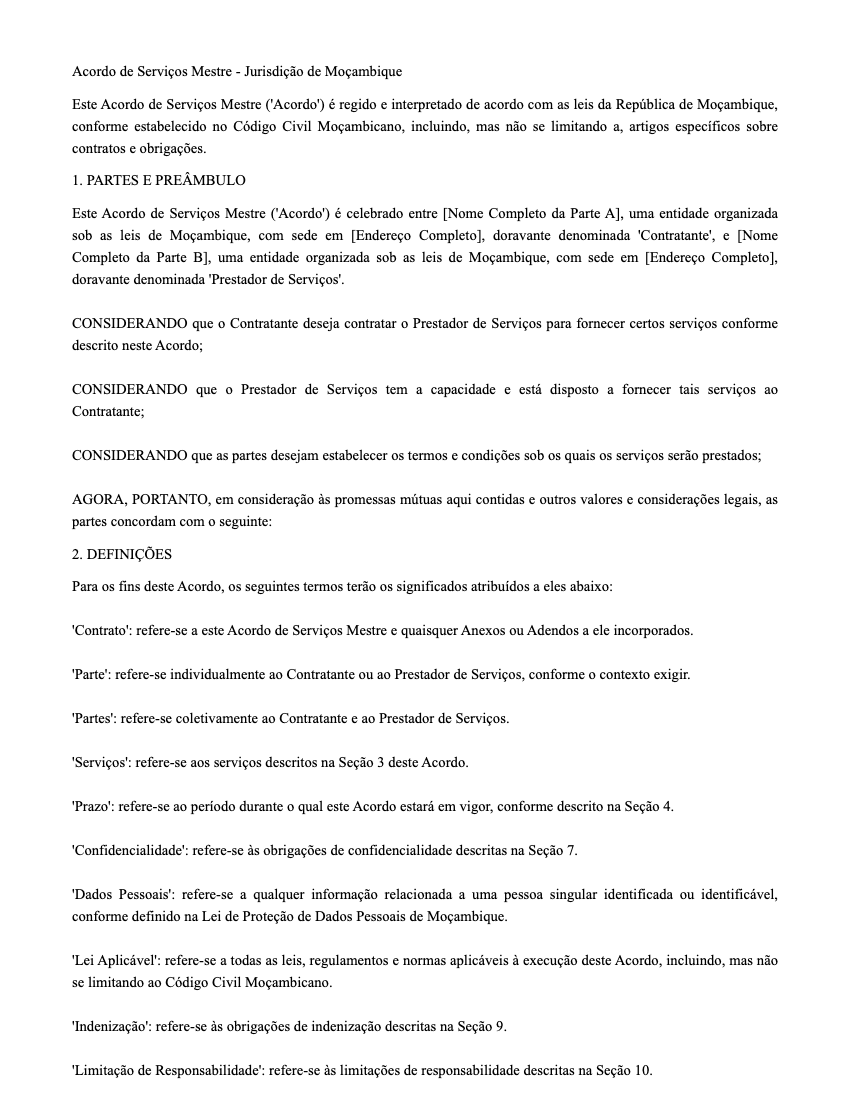
Why You Cannot Use a Generic MSA in Mozambique
Generic templates (for example, an “international MSA” copied from a US/UK contract) often fail in three critical areas in Mozambique: (i) correct framing of the employment relationship versus provision of services; (ii) validity and limits of restrictive clauses such as non-compete; and (iii) ownership and transfer of intellectual property rights and handling of personal data. In B2B contracts, the risk is not only an “invalid clause”: it is the practical cost of difficult collection, regulatory fines (when there is data), and employment reclassification with retroactive payment.
3a. Worker Classification Rules
In Mozambique, the relevant distinction is not an “ABC test” as in some US states; it is the separation between an employment contract (with legal subordination) and a services agreement (autonomy). In practice, authorities and courts tend to look at factors such as: control of working hours, integration into the client’s organization, exclusivity, provision of tools, and continuous technical direction. If reality indicates subordination, the label “independent contractor” may not hold up.
For a comprehensive guide to structuring MSAs and SOWs that protect your business, see our Freelancer Contracts Guide.
To mitigate this, a Mozambican MSA should: (1) state the provider’s autonomy (no obligation of fixed hours, except meeting windows); (2) allow subcontracting when appropriate; (3) define deliverables by SOW (result, not means); and (4) clarify that the provider manages their own taxes/social security, when applicable. The basis for contractual validity and freedom of stipulation is grounded in the Mozambican Civil Code, Art. 405 (private autonomy/contractual freedom). Misclassification risk can result in retroactive labor obligations (wages, vacation, contributions, and sanctions), in addition to disputes and project blockage.
3b. Non-Compete Enforceability
Non-compete clauses in Mozambique are not automatically prohibited, but they must be drafted carefully so they do not become abusive or invalid due to excess. In a civil-law environment, the practical rule is: post-contractual restrictions tend to be defensible only when (i) they protect a legitimate interest (trade secrets, customer base, know-how), (ii) they are proportionate in duration and territory, and (iii) they do not unduly prevent the provider’s professional activity.
A common trap in generic templates is imposing a broad non-compete (“any similar service, in any country, for 2–5 years”) without compensation or without defining what “competition” is. This increases the risk of the provider challenging it and the clause being struck down for disproportionality, creating uncertainty precisely when the client is trying to protect sensitive information.
A more solid approach in Mozambique is to combine: (a) a robust confidentiality clause (applicable during and after the contract); (b) a non-solicitation of clients/employees for a short period; and (c) if there is a non-compete, limit it to a set of specific services and clients, for a reasonable term. To reinforce predictability, the MSA may include a waiver clause for future unknown/unexpected allegations when a final settlement is reached regarding accounts and responsibilities, aligning with the Mozambican Civil Code, Art. 344 (waiver of unknown claims), provided it is drafted clearly and knowingly.
3c. IP/Work-for-Hire Considerations
Generic templates assume “work made for hire” as a universal solution, but that does not always fit civil-law systems. In Mozambique, the essential point is to document the assignment/license of intellectual property rights created in the project and tie the transfer to payment. A well-drafted MSA separates: (1) the provider’s pre-existing IP (tools, libraries, methods); (2) SOW-specific deliverables; and (3) moral/copyright rights where applicable. It should also specify what happens to source code, materials, and documentation if the client terminates before paying.
What's Included in This Template
Flexible SOW Structure
The MSA works as an “umbrella,” and each SOW defines deliverables, acceptance criteria, dates, price (fixed, hourly, retainer) and responsible persons. This speeds up contracting: a new project becomes a 1–2 page SOW, without reopening the entire contract.
Mozambique-Specific Indemnification
The indemnity is designed to balance risk: the provider is responsible for third-party IP infringement caused by their work and for breaches of confidentiality; the client is responsible for materials supplied by them and for unlawful instructions. The MSA also addresses late-payment default interest under the Mozambican Commercial Code, Art. 102 (rate/default interest in a commercial context), to avoid discussions when payments are late.
Dispute Resolution and Venue
For commercial disputes, this template prioritizes an arbitration clause in Maputo, using the rules of an arbitration center affiliated with the Chamber of Commerce of Mozambique, when the parties opt for arbitration. When it is not arbitration, the MSA defines venue and Mozambican governing law to avoid litigation in distant jurisdictions.
Additional provisions (with legal basis):
- Electronic signatures and communications with validity requirements: Electronic Transactions Law, Art. 12.
- Personal data compliance (legal basis, purpose, security): Personal Data Protection Law, Art. 5º.
- Contractual freedom and interpretation clause: Civil Code, Art. 405.
- Waiver/closing of accounts in final agreements: Civil Code, Art. 344.
Who Needs This Document?
| User Type | Relationship | Key Benefit |
|---|---|---|
| Agencies (marketing/branding) | Retainers and campaigns with companies | Fast SOWs and protection of confidentiality and customer base |
| Consultants (management/finance) | Recurring advisory per project | Clear rules against “scope creep” and invoicing extra hours |
| Software developers | Milestone-based projects and maintenance | IP transfer conditioned on payment and limits of liability |
| Companies hiring providers | Multiple vendors and external teams | Standardization, payment terms, and personal data clauses |
How to Use This MSA Template
Step 1: Identify the parties correctly
Use the full legal name, NUIT (if applicable), address, and authorized representatives. Clarity avoids nullities and collection difficulties.
Step 2: Define term, renewal, and termination
Choose a fixed term (e.g., 12 months) or automatic renewal. Include how to terminate, notice periods, and effects: amounts due, return of materials, and ongoing confidentiality.
Step 3: Attach the first SOW with measurable scope
In the SOW, describe deliverables, acceptance criteria, client dependencies, and schedule. Set the price, currency, taxes, and the invoicing trigger (advance, milestones, retainer).
Step 4: Sign and operate via SOWs
After signing the MSA, each new project is added via an SOW. If there are changes, use an addendum to the SOW (not “loose messages”), maintaining an audit trail.
Related MSA Templates
Get the Template
Sign up for our newsletter to receive the template.
Frequently Asked Questions

About Designer Content
Designer Content creates practical legal document resources for landlords, contractors, and small business owners. We simplify complex legal concepts into actionable guidance. Connect with us on LinkedIn.