
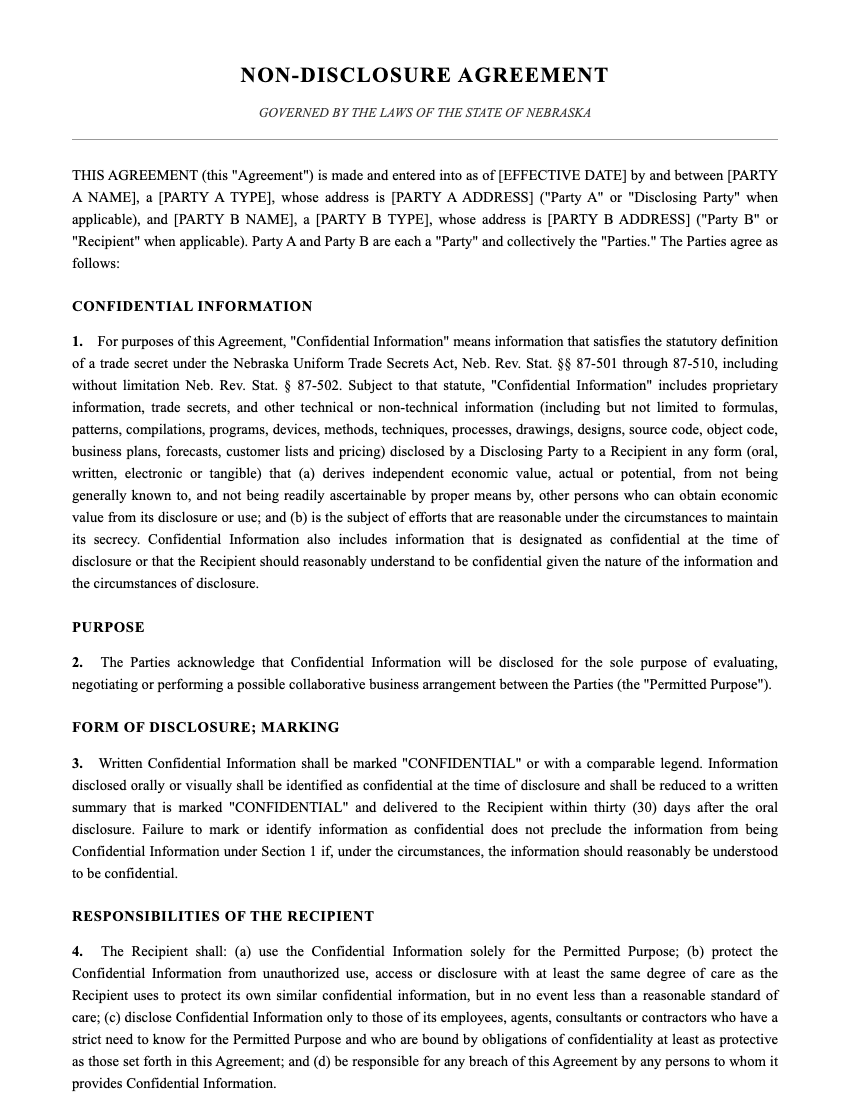
A Nebraska Non-Disclosure Agreement (NDA) is a contract designed to protect confidential business information and trade secrets under Nebraska law while preserving remedies and enforceability in Nebraska courts. This template is written to align with the Nebraska Uniform Trade Secrets Act (Neb. Rev. Stat. § 87-501 et seq.), Federal trade secret enforcement paths, and Nebraska’s contract statute of limitations (Neb. Rev. Stat. § 25-205).
What is a Nebraska NDA?
Definition: A Nebraska Non-Disclosure Agreement is a written contract in which one or more parties (the Disclosing Party) agree to share proprietary information with another (the Receiving Party) for a limited purpose while obligating the Receiving Party to keep that information confidential. Trade secret claims are governed by the Nebraska Uniform Trade Secrets Act (Neb. Rev. Stat. § 87-501 et seq.), which defines a trade secret in terms of economic value and reasonable secrecy measures.
Nebraska courts generally allow parties freedom of contract, and unlike jurisdictions that automatically void non-competes, Nebraska enforces restrictive covenants if they are reasonable and necessary to protect legitimate business interests. That means NDAs must be drafted carefully so confidentiality provisions don’t inadvertently operate as overbroad restraints on trade.
For a complete guide to NDA terms, duration, and standard exclusions, see our NDA Agreement Guide.
Why “Generic” NDAs Are Dangerous in Nebraska
Using a generic template drafted for another state risks three Nebraska-specific
traps:
- Overbroad restrictive language. Nebraska enforces non-compete and restraint clauses if reasonable, so careless NDA language that broadly prohibits competitive activity can be enforced in ways you didn’t intend. Conversely, an overly broad NDA may provoke a court to refuse injunctive relief or to limit damages.
- Statute of limitations oversight. Claims for breach of a written contract (including written NDAs seeking damages) are subject to Nebraska’s five-year limitations period under Neb. Rev. Stat. § 25-205. If you wait too long to assert a claim for damages, you may be barred—though equitable relief like temporary injunctions can still be available. Your NDA should preserve the right to prompt injunctive relief and include notice provisions to avoid forfeiting remedies.
- Missing DTSA whistleblower notice. If you plan to rely on federal remedies under the Defend Trade Secrets Act (DTSA) (for example, if infringement reaches across state lines or you want federal remedies), federal law requires a notice about whistleblower immunity to secure certain enhanced remedies. Many templates omit this, reducing recoverable damages in a federal case.
Paradigm-shifting insight for Nebraska: Because Nebraska will enforce reasonable restraints, the real drafting trap is not “how do I make it enforceable?” but “how do I ensure it doesn’t become a hidden, enforceable non-compete?” In Nebraska, that hidden trap can cause a court to award injunctive relief you never intended. Draft NDAs narrowly—define the confidential materials, the limited purpose, and carve out legitimate employment activities while preserving trade-secret protection.
Real legal development to watch
Nebraska codified the Uniform Trade Secrets Act at Neb. Rev. Stat. § 87-501 et seq., giving clearer statutory guidance on what qualifies as a trade secret and how remedies are awarded. Separately, Nebraska’s five-year statute of limitations for written contracts (Neb. Rev. Stat. § 25-205) shapes how and when you must bring a claim for breach of an NDA. Combine these two statutory realities when planning enforcement strategy.
Key Clauses in this Template (Nebraska-focused)
- Trade Secret Definition: Matches Neb. Rev. Stat. § 87-501’s factors—economic value from secrecy and reasonable efforts to maintain secrecy.
- Purpose and Narrow Scope: Strictly limits use to a defined purpose (e.g., evaluating a supplier relationship for Project X).
- Time Limits: Two-tier approach—general confidential information protected for a defined period (commonly 2–5 years), true trade secrets protected so long as they remain secret.
- Injunctive Relief & Remedies: Express provision reserving equitable relief (injunction) in Nebraska courts plus damages; states the parties understand that damages may be inadequate.
- Statute of Limitations Notice: Alerts parties that written-contract remedies may be subject to Neb. Rev. Stat. § 25-205 (5 years).
- DTSA Whistleblower Immunity Clause: Explicit notice that a person may disclose a trade secret to government official or in confidence to an attorney and still retain immunity for such disclosures under federal law—vital if you may bring a DTSA action.
- Confidentiality Carve-Outs: Standard exceptions for information already public, previously known by the recipient, independently developed, or compelled by law.
- Choice of Law & Venue: Option to select Nebraska law and a Nebraska forum, which controls enforcement predictability.
Mutual vs. Unilateral Options
- One-Way (Unilateral): Use when only you disclose—investor pitches, contractor onboarding, supplier quotations.
- Mutual (Two-Way): Use for collaborations, M&A due diligence, or joint development where both sides exchange sensitive material.
Choosing the wrong type can either expose your proprietary information or unduly constrain the other party.
Who Needs This Document?
| User Persona | Usage Scenario | Key Nebraska Benefit |
|---|---|---|
| Ag Tech Startups | Sharing prototypes with Nebraska manufacturers | Protects trade secrets while permitting employees to seek work locally if not given proprietary knowledge |
| Service Firms (HR/payroll) | Onboarding contractors | Clarifies confidential payroll data handling and state-law remedies |
| Family Businesses | Selling business assets | Keeps financials confidential during NE-based due diligence |
| Inventors & Manufacturers | Sharing designs with Midwestern suppliers | Preserves UTSA remedies and preserves right to quick injunctive relief in Nebraska courts |
How to Execute a Valid Nebraska NDA
- Pick the right template (One-Way vs. Mutual).
- Describe the purpose tightly—avoid catch-all phrases like “business purposes.”
- Mark materials CONFIDENTIAL and document your secrecy efforts—this supports Nebraska UTSA claims.
- Sign before sharing; include electronic-signature language consistent with the federal E-SIGN Act (15 U.S.C. § 7001) so email or DocuSign execution is persuasive.
Already Receiving NDAs from Clients?
When a client sends you an NDA, review it for overbroad use restrictions that could function as a non-compete, ambiguous definitions of “confidential,” missing DTSA notices, or clauses that waive Nebraska statutory rights (like consumer-protection concerns under the Nebraska Consumer Protection Act, Neb. Rev. Stat. § 59-1601 et seq.). If in doubt, negotiate narrower language or ask for specific carve-outs for pre-existing knowledge and general skills.
an AI contract review tool can instantly flag risky clauses, compare terms against Nebraska law, and suggest negotiable edits—saving time and avoiding hidden enforcement traps.
Related NDA Templates
Get the Template
Sign up for our newsletter to receive the template.
Frequently Asked Questions

About Designer Content
Designer Content creates practical legal document resources for landlords, contractors, and small business owners. We simplify complex legal concepts into actionable guidance. Connect with us on LinkedIn.