
Opening
A Netherlands Master Services Agreement (MSA) is a framework agreement under Dutch law that sets the baseline terms for multiple future engagements between the client and the service provider. Rather than negotiating a new contract for each project, you sign one MSA and work per project with a Statement of Work (SOW) in which scope, schedule, and price are set. For Dutch B2B collaborations, this is particularly useful due to rules on statute of limitations, statutory interest, and privacy (AVG/UAVG).
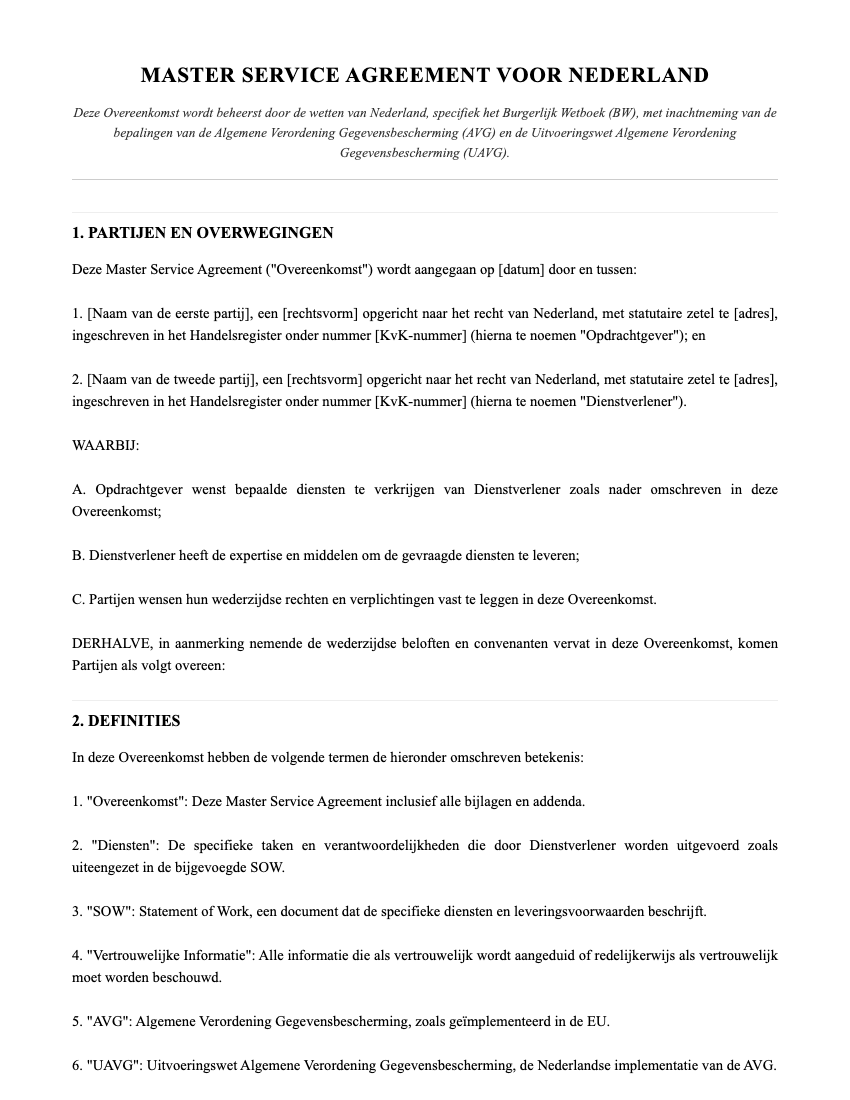
For a comprehensive guide to structuring MSAs and SOWs that protect your business, see our Freelancer Contracts Guide.
Definition Box
Definition: A Netherlands Master Services Agreement (MSA) is an overarching services agreement in which two parties (usually business entities) agree on which standard terms apply to all current and future work. Think payment terms, liability limits, intellectual property, confidentiality, insurance, and dispute resolution. The concrete project arrangements are then set per engagement in a Statement of Work (SOW). In the Netherlands, a good MSA is typically aligned with the Burgerlijk Wetboek, with, among other things, provisions on statute of limitations (e.g., art. 3:307 BW) and interest for late payment (art. 6:119 BW), plus AVG/UAVG obligations.
"Why You Cannot Use a Generic MSA in Netherlands"
A generic MSA (for example from the US or the UK) often does not work well in the Netherlands, because Dutch contracts lean heavily on the Civil Code and specific mandatory rules. Additionally, Dutch privacy requirements and the practice around employment relationships differ from those in common law countries. A template without Dutch anchors can lead to unenforceable provisions, incorrect risk allocation, and unexpected claims.
Worker Classification Rules
In the Netherlands there is no American “ABC test.” The core question is whether the collaboration in reality constitutes an employment contract. The legal definition is in art. 7:610 BW: work, wages, and direction. For long-term use of freelancers/consultants you want to explicitly state in your MSA and SOW that the service provider operates independently, bears its own business risk, and does not accept an employer–employee relationship.
Since 2024, art. 7:610a BW (rebuttable presumption of an employment contract) is also relevant: with structured work for payment, a court may more quickly assume an employment contract exists, depending on the facts. Misclassification can lead to wage and holiday pay claims, continued wage payments during sickness, and premiums/penalties from the tax side. A Netherlands-specific MSA helps by contractually structuring the engagement (deliverable-based, freedom in execution, substitution/engagement of support personnel, own tools) so that the actual execution better aligns with an independent contractor relationship.
Non-Compete Enforceability
Unlike California, non-competes in the Netherlands are not “per se” prohibited, but they are indeed tightly regulated—and especially relevant for employees. A concurrentiebeding in an employment agreement is governed by art. 7:653 BW and is generally only valid if it is in writing and agreed with an adult employee. For a temporary contract, additional requirements apply: the employer must justify the clause in writing with compelling business or service interests.
For a true B2B relationship (MSA between two enterprises), a non-compete is not automatically invalid, but unreasonably broad restrictions can be struck down under general contract law, for example via reasonableness and fairness (art. 6:248 BW) or the voidability of unreasonably burdensome clauses in certain contexts. Therefore a Dutch MSA template should include alternatives that hold up better: strong confidentiality, protection of trade secrets, and a reasonable non-solicit (customers/employees) with clear duration and geographic/sectoral boundaries.
IP/Work-for-Hire Considerations
The “work made for hire” concept is not a standard category like in the US. Under Dutch copyright law, the default is that the author is the rights holder, unless there is employer’s copyright (in case of an employment contract) or a valid transfer. For transfer of copyright, a written deed is typically required (practically: ensure your MSA/SOW explicitly provides “transfer upon payment” and delivery/acceptance arrangements). For software and other creations, you also want to arrange whether the client receives an exclusive license or full transfer, and when (e.g., only after full payment).
"What's Included in This Template"
Flexible SOW Structure
The template uses an “umbrella + SOW” model: the MSA contains fixed legal rules, while each SOW describes the concrete deliverables, milestones, rates, and acceptance criteria. This helps prevent scope creep and means you don’t have to renegotiate the entire contract for every project.
Netherlands-Specific Indemnification
The indemnification/liability provisions are aligned with Dutch standards: clear carve-outs for intentional wrongdoing and willful recklessness and a realistic liability cap per event, tied to mandatory insurances. The template also includes a requirement for €1,000,000 coverage per event, suitable for many B2B engagements.
Dispute Resolution and Venue
The template specifies that disputes are resolved by the competent court in the Netherlands and that Dutch law applies. This prevents foreign forum or choice-of-law provisions from forcing you to litigate abroad.
Additionally, the template includes, among other things:
- Statute of limitations clause and claim periods in line with art. 3:307 BW (5 years for actions for performance).
- Statutory interest for late payment in line with art. 6:119 BW.
- AVG/UAVG security and data breach processes with reference to AVG art. 32 and UAVG art. 7.
"Who Needs This Document?"
| User Type | Relationship | Key Benefit |
|---|---|---|
| IT and software agencies | Ongoing development & support | SOWs per sprint with tailored IP and acceptance criteria |
| Marketing and design studios | Retainers and campaigns | Scope delineation, reusable rates and licenses |
| Consultants (finance/HR/ops) | Long-term advisory | Clear deliverables and liability limitation |
| Managed service providers | SLA-like services | Incident definitions, response times, and payment security |
"How to Use This MSA Template"
Step 1: Enter party details correctly
Use the statutory name, KvK registration details, and signing authority for both parties. This prevents disputes about who is bound and who may sign.
Step 2: Choose the IP and usage rights model
Determine per type of engagement whether you will use assignment (upon payment) or an (exclusive) license. Also specify which pre-existing tools or libraries of the supplier remain with them.
Step 3: Make your first SOW concrete
Set the deliverables, deadlines, acceptance criteria, rates, and the change-order procedure in the SOW. Tie payments to milestones to balance cash flow and delivery risk.
Step 4: Sign once, repeat with new SOWs
The MSA remains in place; each new engagement is a new SOW under the same terms. That speeds up sales and reduces legal friction.
"Already Receiving Contracts from Clients?"
Many freelancers and agencies do not send their own MSA, but receive an MSA from the client. Then there is a risk that you agree to overly broad liability, unfavorable IP terms, or foreign forum selection. Specifically check: late payment interest, statute of limitations/claim periods, AVG roles (processor/controller) and insurance obligations. With an AI contract review tool you can have received contracts screened faster for Dutch “red flags” before you sign.
"Download Options"
Free PDF Version: suitable for internal review and to discuss with your client.
Editable Word/Google Docs Version: the same MSA + fill-in SOW template, so you can quickly capture scope, price, and acceptance for each engagement. Ideal if you run projects regularly and want to contract consistently.
Disclaimer
This article and template provide general information and are not legal advice. For complex matters, have a Dutch lawyer review your situation.
Related MSA Templates
Get the Template
Sign up for our newsletter to receive the template.
Frequently Asked Questions

About Designer Content
Designer Content creates practical legal document resources for landlords, contractors, and small business owners. We simplify complex legal concepts into actionable guidance. Connect with us on LinkedIn.