
What Is a Netherlands NDA?
Definition: A Netherlands Non-Disclosure Agreement (NDA) is a contract that limits disclosure and use of confidential information, tailored to Dutch civil-law rules (Burgerlijk Wetboek, BW) and the Dutch Trade Secrets Act (Wet bescherming bedrijfsgeheimen - Wbb). It must also respect privacy laws (AVG and the Dutch UAVG) and public-interest exceptions.
In the Netherlands, trade secret protection is governed by the Wet bescherming bedrijfsgeheimen (Wbb), the national implementation of the EU Trade Secrets Directive. The Wbb gives rightsholders civil remedies for misappropriation, and Dutch courts can impose swift protective measures while balancing free expression and employees' rights.
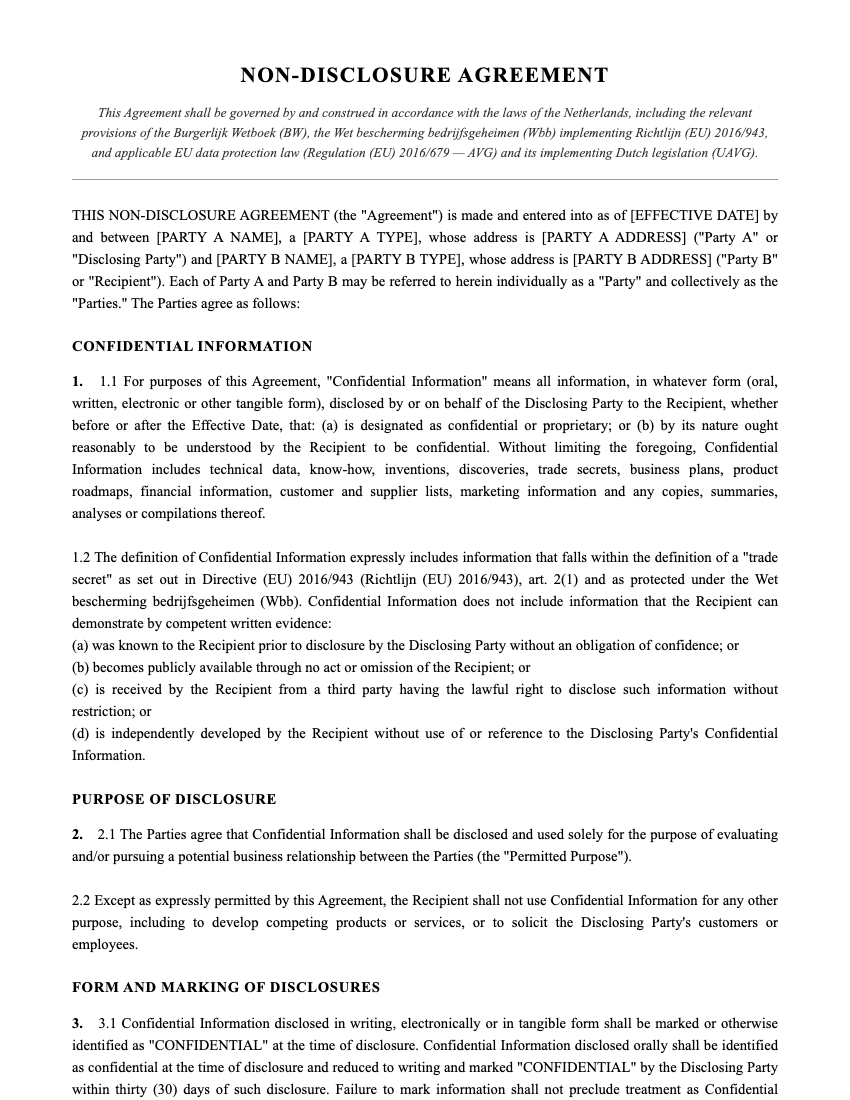
This template distinguishes between regular confidential information (time-limited contractual protection) and trade secrets under the Wbb (potentially protected indefinitely so long as secrecy is maintained and reasonable measures were taken). It also aligns NDA wording with Dutch privacy and employment law limits.
Why "Generic" NDAs Are Dangerous in the Netherlands
Using a one-size-fits-all NDA written for another legal system creates several Dutch-specific traps:
- Procedural remedies under the Wbb vs. overbroad secrecy clauses
For a complete guide to NDA terms, duration, and standard exclusions, see our NDA Agreement Guide.
- The Wbb makes it easier to seek injunctive relief and confidential handling of evidence, but Dutch courts expect a concrete showing that information is a trade secret and that reasonable secrecy measures were taken. Vague, blanket "trade secret" labels can backfire.
- GDPR/UAVG limits on employee data and whistleblowing
- NDAs that attempt to prohibit employees from reporting misconduct (to regulators or law enforcement) conflict with public interest protections and data-subject rights under the AVG and UAVG. Silence requirements must carve out lawful disclosures and whistleblowing to authorities. - Employment and non-compete interaction
- Unlike some jurisdictions with absolute non-compete bans, Dutch employment law allows post-employment restraints if expressly agreed (see BW). However, there is active legislative and political pressure to limit non-competes for flexible workers; the practical insight: don’t hide a restrictive post-employment covenant inside a confidentiality clause. Make separate, reasonable, and signed restraints if needed.
Paradigm-shifting insight (Netherlands): The Wbb strengthened procedural tools (injunctions, seizure under protective conditions, in-camera hearings) but also increased scrutiny: courts require documented reasonable secrecy measures and proportionality. In practice, an NDA that both overreaches (barring lawful reporting or broadly restricting work) and lacks demonstrable secrecy steps may cost you injunctive relief and judicial sympathy.
Real legal development: The Netherlands implemented the Trade Secrets Directive through the Wbb (see Rijksoverheid guidance). Since implementation, Dutch courts and practitioners emphasize procedural protection (quick interim measures) but demand a clear, documented secrecy regime before granting extreme remedies. Separately, Dutch government debates since 2021 about limiting non-competes for flexible workers mean employers should avoid bundling restraints into NDAs (see DutchNews analysis).
Key Clauses — Netherlands Version
- Clear definitions: "Confidential Information" vs. "Trade Secret (bedrijfgeheim)" with Wbb criteria: economic value from secrecy and reasonable secrecy measures.
- Purpose limitation: precise use restrictions (e.g., "for evaluation of a potential software licensing agreement for Product X").
- Duration: tiered protections — limited-term protection for ordinary confidential business information (commonly 2–5 years) and indefinite protection for trade secrets so long as secrecy is maintained and measures are documented.
- Data privacy clause: permitted processing under AVG/UAVG, lawful bases, retention limits, and Data Protection Officer (DPO) contact if applicable.
- Whistleblowing/public authority exception: explicit carve-outs for disclosures required or permitted by law or reporting to regulators (Autoriteit Persoonsgegevens, OM, AFM), preserving recoverable remedies under Wbb where possible.
- Remedies and interim measures: statement that parties can seek injunctive relief under Wbb, and agreement on confidential treatment of court filings where available.
- Electronic signature and execution: reference to eIDAS for electronic signatures and confirmation they are acceptable for execution.
- Residuals and permitted use: optional residuals clause about unaided memory, carefully limited to avoid undermining trade-secret claims.
- Assignment and choice of law: Dutch law (Nederlandse wet) recommended for enforceability in Dutch courts. Forum and language clauses should be explicit.
Who Needs This Document?
- Tech Scaleups (Amsterdam, Eindhoven): Protect source code, algorithms, and supplier connections during partner talks.
- Law Firms & Consultants: Maintain client confidentiality while complying with legal reporting duties.
- Manufacturers & Designers: Protect prototypes and production methods under Wbb; secure injunctive remedies if misappropriation occurs.
- HR / In-House Counsel: Use narrow NDAs when sharing sensitive personnel data or disciplinary details—align with AVG obligations.
How to Execute a Valid Netherlands NDA (4 Steps)
- Choose the right form: One-way (unilateral) if only you disclose; mutual when both parties share. Keep employment restraints separate and signed where necessary.
- Define the purpose and the information: Be specific—list categories (technical drawings, customer lists) and mark materials " vertrouwelijk / confidential ".
- Document security measures: keep logs of who accessed documents, use access controls, watermark PDFs, and record confidentiality trainings—this shows "reasonable secrecy measures" under Wbb.
- Sign properly: execute under Dutch choice-of-law; electronic signatures under eIDAS are valid. Keep executed copies and exchange confirmation emails before sharing confidential files.
Getting NDAs from Clients? Read Carefully
When a client sends an NDA, watch for hidden restraints, overly broad assignment of IP, or clauses that try to prevent lawful reporting. Use this template to counter-sign with protective carve-outs and data processing language aligned with AVG/UAVG.
an AI contract review tool still helps: it flags Dutch-specific red flags (overbroad scope, missing Wbb alignment, GDPR conflicts) and compares contract language to Netherlands statutory requirements—saving review time.
Related NDA Templates
Get the Template
Sign up for our newsletter to receive the template.
Frequently Asked Questions

About Designer Content
Designer Content creates practical legal document resources for landlords, contractors, and small business owners. We simplify complex legal concepts into actionable guidance. Connect with us on LinkedIn.