
A Nevada Non-Disclosure Agreement (NDA) is a contract that protects confidential business information and trade secrets under Nevada law while fitting into Nevada’s business-friendly enforcement landscape. Unlike California’s near-total ban on non-competes, Nevada generally enforces reasonable restraints and provides robust injunctive remedies—so NDAs drafted poorly can operate as de facto non-competes or trigger long-term liability.
What is a Nevada NDA?
Definition: A Nevada NDA is a written agreement in which one or both parties agree to keep certain information confidential and to use it only for a limited purpose. Trade secrets in Nevada are protected under the state’s adoption of the Uniform Trade Secrets Act (see NRS Chapter 600A) and by the federal Defend Trade Secrets Act (DTSA), 18 U.S.C. § 1836. Written contracts are subject to a six-year statute of limitations in Nevada (NRS 11.190).
Practical effect: Nevada courts apply ordinary contract principles and a reasonableness standard when evaluating restrictive terms. NDAs that are narrow in scope, geographically and temporally limited, and tied to a legitimate business interest are typically enforced; overbroad restraints risk reformation, denial of injunctive relief, or damages reductions.
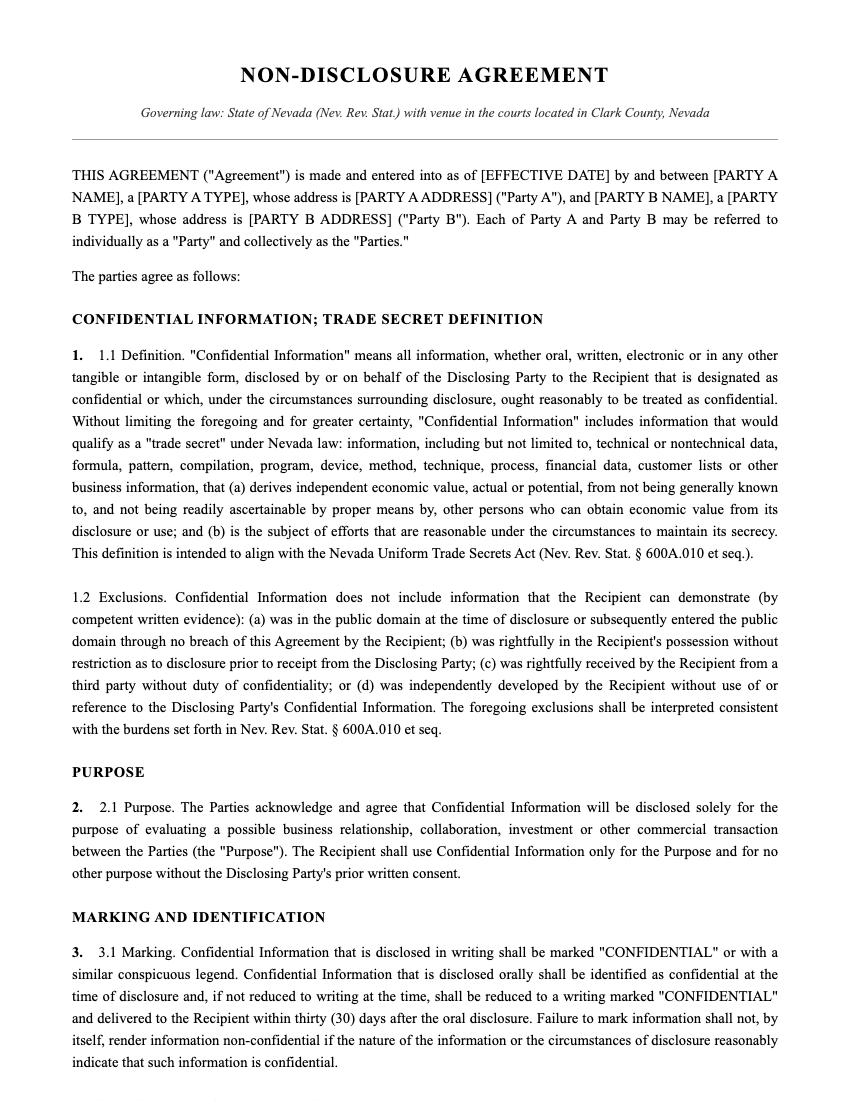
For a complete guide to NDA terms, duration, and standard exclusions, see our NDA Agreement Guide.
Why “Generic” NDAs Are Dangerous in Nevada
Many off-the-shelf NDA templates come from jurisdictions with different approaches
to post-employment restraints. Using them in Nevada creates three local risks.
- Overbroad NDAs can function as implicit non-competes
Nevada enforces non-competes and injunctive relief when protections are reasonable and necessary to protect legitimate business interests. Courts in Nevada and federal courts applying Nevada law have recognized doctrines such as “inevitable disclosure” (see PepsiCo, Inc. v. Redmond, 54 F.3d 1262 (7th Cir. 1995), persuasive authority used in many jurisdictions). In practice, a broadly written NDA that forbids using "any information" may be used to seek injunctions preventing someone from working if the employer can show a real risk of misappropriation. The paradigm-shifting insight for Nevada: NDAs that try to be over-inclusive can actually give you stronger temporary injunctive power—but at a cost. They may be construed as unreasonable restraint and reformed by courts, or provoke expensive litigation because Nevada courts will examine whether the restraint is narrowly tailored to a protectable interest.
- Remedies and liquidated damages are scrutinized but often upheld
Nevada is business-friendly about allowing contractual remedies, including liquidated damages and equitable relief, so long as the terms are not punitive or unconscionable. A poorly drafted damages provision may be struck or reduced, but Nevada judges will not automatically void commercially reasonable contractual protections.
- Federal DTSA notice requirement
If you want access to DTSA's enhanced remedies in federal court (exemplary damages and attorneys’ fees), your NDA should include the DTSA whistleblower immunity notice (18 U.S.C. § 1833(b)). Without it, you can still sue under state law, but you may forfeit those federal enhancements.
Real case study / development
Nevada’s courts have not adopted a blanket rule like California’s § 16600. Instead, Nevada opinions and district court practice show a willingness to grant preliminary injunctions based on the risk of disclosure where the employer demonstrates trade secret status and a narrowly tailored restraint. Parties should be mindful of persuasive federal authorities (e.g., PepsiCo v. Redmond) and federal DTSA practice in the District of Nevada when contemplating injunctive relief.
Key Clauses (what this template includes)
- Purpose/Scope: Precise, limited purpose language. Avoid blanket prohibitions that block future employment.
- Definitions: Separate "Trade Secrets" (NRS Chapter 600A criteria) from "Confidential Information" (time-limited protection). Trade secrets remain protected as long as secrecy is maintained.
- Duration: Two-tier duration—shorter (e.g., 1–3 years) for general confidential info, indefinite for properly defined trade secrets.
- Use and Non-Disclosure Obligations: Limit to the Purpose; prohibit direct use or disclosure for competitive advantage.
- Residuals Clause (optional): A narrowly drafted residuals clause that permits unaided-memory use of general skills and experience but protects specific trade secrets.
- Exclusions: Public domain, prior knowledge, independently developed, compelled disclosure.
- Remedies: Injunctive relief, damages, and DTSA notice to preserve federal remedies; liquidated damages option with reasonableness guardrails.
- Choice of Law & Forum: Nevada choice-of-law and forum-selection clauses (recommended where appropriate) with attention to enforceability.
Who needs this document?
| User Persona | Use Case | Why Nevada-specific matters |
|---|---|---|
| Tech founder in Reno/Las Vegas | Hiring developers or sharing code with contractors | Protects source code and trade secrets while avoiding overbroad employment restraints |
| Manufacturing company | Sharing designs with suppliers | Nevada’s willingness to grant injunctions makes prompt NDAs valuable to stop misappropriation |
| Small business selling to buyers | M&A due diligence | Two-way NDA with strict purpose limitation protects both parties during negotiations |
| Recruiters / Staffing agencies | Sharing candidate data with clients | Ensures compliance with Nevada consumer/deceptive trade practice statutes (NRS Chapter 598) when handling third-party data |
How to execute a valid Nevada NDA (practical steps)
- Choose the right form: One-way (discloser only) or mutual (both share). Use one-way for pitches or contractor work.
- Define the purpose narrowly: Tie disclosure to a specific project or transaction to help courts find reasonableness.
- Mark and protect: Reasonable secrecy steps (access controls, confidentiality legends, limited distribution) support trade secret status under NRS Chapter 600A.
- Sign before sharing: Use Nevada-recognized electronic signatures (federal E-SIGN and Nevada’s UETA in NRS Chapter 719) or wet signatures. Date the execution and record who received which documents.
Cross-sell: If you often receive third-party NDAs, use [an AI contract review tool] to flag overbroad provisions, identify implied restraints that act like non-competes, and highlight missing DTSA notice language—saving time and litigation risk.
Related NDA Templates
Get the Template
Sign up for our newsletter to receive the template.
Frequently Asked Questions

About Designer Content
Designer Content creates practical legal document resources for landlords, contractors, and small business owners. We simplify complex legal concepts into actionable guidance. Connect with us on LinkedIn.