
A New Hampshire Non-Disclosure Agreement (NDA) is a contractual tool to protect confidential business information and trade secrets while fitting within New Hampshire’s common-law approach to contractual freedom and the state’s procedural limits.
What Is a New Hampshire NDA?
Definition: In New Hampshire, an NDA is a contract by which parties agree how disclosed information may be used and who may access it. New Hampshire does not have a standalone state codification of the Uniform Trade Secrets Act; trade secrets are protected under federal law (the Defend Trade Secrets Act, 18 U.S.C. §1836), New Hampshire common-law principles, and related contract remedies. Contract claims are subject to New Hampshire’s statute of limitations for contracts (RSA 508:4). The New Hampshire Consumer Protection Act (RSA 358-A) can also affect NDAs used with consumers or to conceal deceptive practices.
This matters because New Hampshire courts generally enforce non-competes and confidentiality provisions so long as they are reasonable in scope, duration, and geography. But NDAs that are effectively functioning as overbroad restraints on trade or that mask unlawful conduct can be set aside on public-policy grounds.
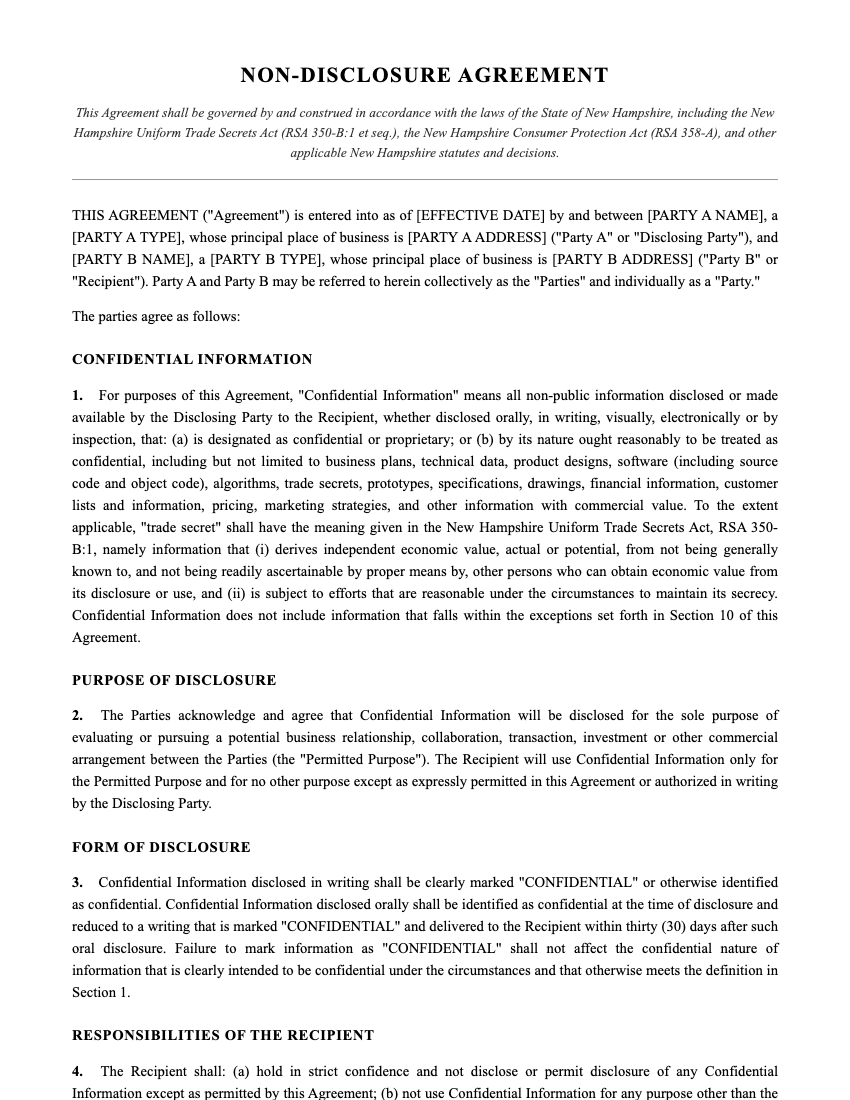
For a complete guide to NDA terms, duration, and standard exclusions, see our NDA Agreement Guide.
Why Generic NDAs Are Dangerous in New Hampshire
Using an out-of-state or generic template can create three traps in New Hampshire:
- The "Restraint-as-Confidentiality" Trap — In NH, parties often enforce non-competition covenants when they are reasonable. A poorly drafted NDA that prohibits a recipient from "using" information in ways that actually prevent normal competition may be viewed as an unenforceable restraint or recharacterized as a covenant not to compete. Courts will look at substance over labels.
- The Statute-of-Limitations Trap — Contract claims in New Hampshire are governed by RSA 508:4 (three-year limitations period for certain contract actions). If you treat every confidentiality breach solely as a contract claim, you risk losing remedies after three years. By contrast, federal DTSA claims have their own timetables and remedies (see 18 U.S.C. §1836). Drafting the NDA to preserve injunctive relief and to enable trade-secret causes of action can prevent avoidable procedural bars.
- The Consumer-Protection/Public-Policy Trap — NDAs used in consumer settings or those that attempt to hide fraud, deceptive acts, or certain statutory rights may violate RSA 358-A or public policy. New Hampshire treats consumer protection seriously; NDAs cannot lawfully be used to conceal illegal activity.
Paradigm-shifting insight for New Hampshire: think in two axes — (A) substance vs label (will a confidentiality clause operate like a covenant not to compete?), and (B) remedy timing (will your claim be contract-limited under RSA 508:4?). Good NDAs in NH are drafted both to avoid recharacterization as a restraint on trade and to preserve timely access to injunctive and statutory trade-secret remedies.
Recent development worth noting: while New Hampshire courts have not adopted sweeping limits on covenants not to compete, federal-level activity—like the FTC’s 2023 rulemaking to restrict non-competes and continuing litigation over that rule—affects contract drafting nationwide and informs how NH courts view the balance between worker mobility and employer protection. Employers and counsel in NH are watching these developments when drafting NDAs or companion restrictive covenants.
Key Clauses (New Hampshire-focused)
- Purpose/Use Limitation: Be precise about the business purpose (e.g., "evaluating a development services agreement for Project X"). A narrow purpose reduces the risk that a court will treat restrictions as overbroad.
- Definition of Confidential Information vs Trade Secrets: Distinguish general confidential business information (time-limited protection) from trade secrets (protected so long as secrecy is maintained and actionable under DTSA or common law). This distinction matters for remedies and for statute-of-limitations strategy.
- Exclusions: Carve out information that is public, previously known, independently developed, or disclosed under legal compulsion. Also explicitly permit whistleblowing consistent with 18 U.S.C. §1833(b) (DTSA whistleblower immunity) so you do not forfeit enhanced federal remedies.
- Injunctive Relief & Remedies: Because contract claims may be time-barred under RSA 508:4, include language preserving equitable relief (injunctions) and expressly reserving statutory trade-secret claims. Consider adding a savings clause that allows the disclosing party to seek immediate injunctive relief without first exhausting contract remedies.
- Residuals / Memory Clause: Optional in tech deals; if used, draft narrowly to avoid implying a broad ban on future competing work.
- Choice of Law & Forum: New Hampshire courts will enforce reasonable choice-of-law clauses, but a forum-selection clause that attempts to deprive a party of statutory protections (e.g., consumer protections) may be challenged.
- Electronic Signatures: NDAs signed electronically are generally enforceable under the federal ESIGN Act (15 U.S.C. §7001). Preserve evidence of execution and timestamps.
Who Needs This Document?
| User Persona | Usage Scenario | Key NH Benefit |
|---|---|---|
| Small manufacturers | Sharing blueprints with a local vendor | Protects designs while preserving ability to enforce in NH courts |
| Tech consultants | Pitching code or algorithms to an enterprise client | Differentiates trade secrets from general know-how to avoid overreach |
| Startups | Due diligence for fundraising | Allows safe disclosure to investors while preserving injunctive remedies and federal DTSA protections |
| Employers | Hiring senior employees | Use together with narrowly tailored non-compete (if necessary) and clear confidentiality expectations |
How to Execute a Valid New Hampshire NDA
Step 1: Choose the right form — unilateral for disclosures from one side; mutual when both sides trade confidential information.
Step 2: Define the purpose and confidential categories precisely — that reduces recharacterization risk.
Step 3: Mark materials as confidential and adopt reasonable secrecy measures — courts look for objective steps showing confidentiality was protected.
Step 4: Sign before sharing — get a signed agreement (electronic signature under ESIGN is fine) before disclosing sensitive materials.
Already Receiving NDAs from Clients?
If a counterparty sends you an NDA, review it for hidden covenants not to compete, overly broad use restrictions, choice-of-law that strips statutory protections, and missing whistleblower/DTSA-language. an AI contract review tool flags these risks and compares terms to New Hampshire statutory timing (RSA 508:4) and federal trade-secret requirements—saving negotiation time.
Related NDA Templates
Get the Template
Sign up for our newsletter to receive the template.
Frequently Asked Questions

About Designer Content
Designer Content creates practical legal document resources for landlords, contractors, and small business owners. We simplify complex legal concepts into actionable guidance. Connect with us on LinkedIn.