
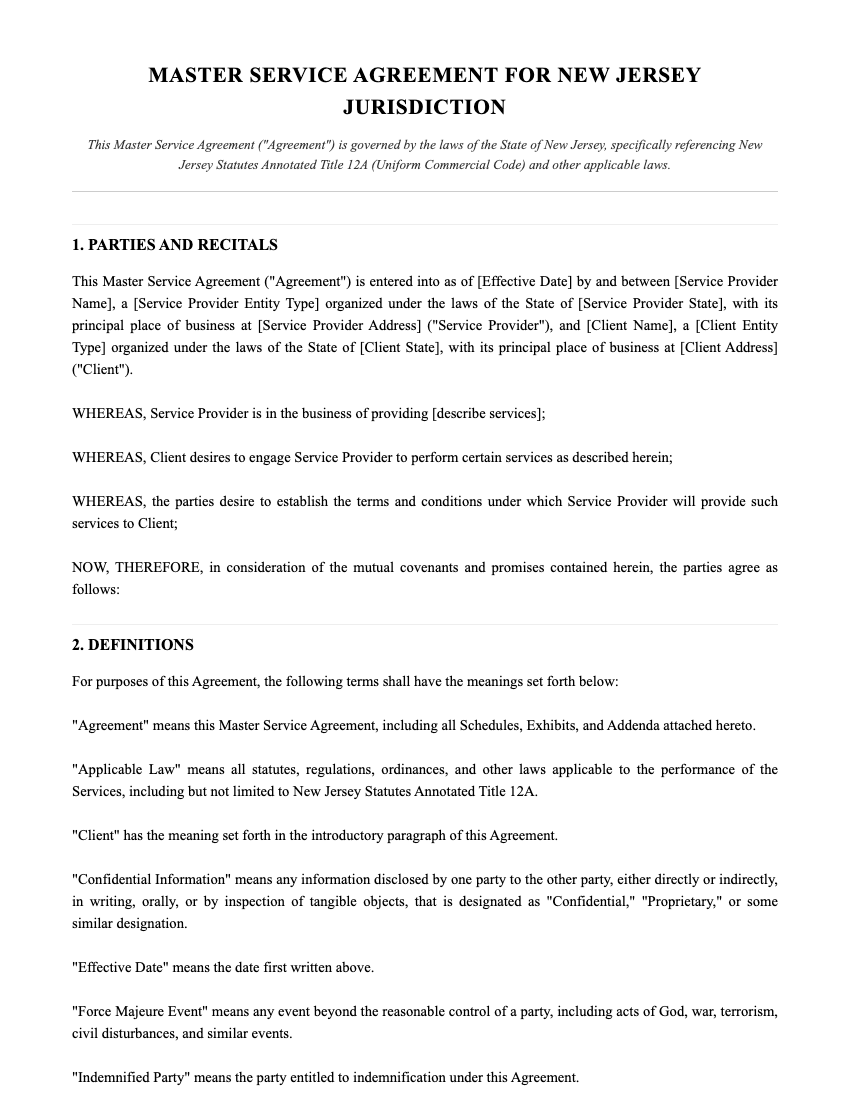
A New Jersey Master Services Agreement (MSA) is a reusable contract that sets the legal “ground rules” for ongoing services between a provider and a client in New Jersey. Instead of renegotiating legal terms for every project, you sign one MSA and then attach Statements of Work (SOWs) that describe each job’s scope, fees, and timeline. For New Jersey SMBs, consultants, and agencies, a NJ-tailored MSA helps manage payment timing, worker status, IP ownership, and where disputes must be filed.
Definition: A New Jersey Master Services Agreement is a governing contract for a business-to-business services relationship where New Jersey law (or New Jersey venue) is intended to control. It sets baseline terms—billing and late fees, confidentiality, intellectual property ownership, limits of liability, insurance, and dispute resolution—that apply automatically to each future Statement of Work. The practical benefit is speed: once the MSA is signed, each new project can be launched with a short SOW rather than a brand-new contract. A New Jersey-specific template also helps you align key clauses with state rules on worker classification, enforceable restrictive covenants, and state statutes governing contract claims.
Why You Cannot Use a Generic MSA in New Jersey
A generic “50-state” MSA is risky in New Jersey because the state has its own legal pressure points that show up precisely in service relationships: (1) worker classification is aggressively enforced using an “ABC” framework for wage/hour purposes; (2) non-compete clauses can be enforceable, but only if drafted narrowly and reasonably; and (3) intellectual property ownership depends on correct authorship/assignment language rather than vague “you own everything” statements. The result is that a generic template may look professional yet still create expensive exposure—back wages, tax issues, unenforceable restrictions, or confusion over who owns deliverables.
3a. Worker Classification Rules
New Jersey applies an ABC test for many wage-and-hour and unemployment contexts, and it is often unforgiving when a template accidentally reads like an employment agreement. For wage payment and wage/hour laws, the independent contractor standard is tied to the “ABC” test under N.J.S.A. 34:11-56a4 (used in the Wage and Hour Law). In plain terms, the hiring business generally must show: (A) the worker is free from control; (B) the service is outside the usual course (or performed outside all the places of business); and (C) the worker is customarily engaged in an independently established trade or business.
For a comprehensive guide to structuring MSAs and SOWs that protect your business, see our Freelancer Contracts Guide.
Why this matters in an MSA: if your contract sets rigid hours, requires daily supervision, prohibits other clients, or otherwise reads like a manager/employee relationship, you are building evidence against “independent contractor” status. Misclassification can trigger claims for unpaid wages and overtime, plus statutory remedies under the New Jersey Wage Payment Law (N.J.S.A. 34:11-4.10 et seq.) and related enforcement regimes. Even if you intended a B2B relationship, an overly controlling MSA can become an exhibit in a dispute.
3b. Non-Compete Enforceability
Unlike states that broadly ban non-competes, New Jersey can enforce non-compete agreements in business and employment settings, but only if they are reasonable and protect legitimate interests. New Jersey’s enforceability standard is primarily judge-made law, not a single “non-compete statute.” Courts commonly apply the reasonableness framework from Solari Industries, Inc. v. Malady, 55 N.J. 571 (1970) and later refinements such as Community Hosp. Group, Inc. v. More, 183 N.J. 36 (2005): a restriction must protect a legitimate business interest (like trade secrets, confidential information, or customer relationships), must not impose undue hardship on the restricted party, and must not harm the public.
What this means for an MSA template in New Jersey: a broad “no competition anywhere in the U.S. for two years” clause is a negotiation and litigation magnet. If you need protection, the better practice is to narrow the clause to (1) specific services that compete, (2) a limited geographic area tied to where business is actually done, and (3) a limited duration that fits the engagement. Many service providers choose alternatives that are more reliably enforceable, such as confidentiality and trade-secret clauses, a no-use/no-disclosure covenant, and narrowly drafted non-solicitation provisions—especially when the “provider” is a freelancer or small agency who must keep working.
3c. IP/Work-for-Hire Considerations
New Jersey contracts regularly stumble on intellectual property because parties assume “work made for hire” automatically transfers ownership. In reality, copyright “work made for hire” is governed by federal law (17 U.S.C. § 101), and many contractor deliverables do not qualify unless they fit a statutory category and are memorialized correctly. A New Jersey MSA should therefore include a clear IP assignment clause (transfer of rights upon payment or upon creation), plus a license-back if the provider needs to reuse pre-existing tools. It should also separate “background IP” (what the provider already owns) from “project IP” (what is created in the SOW).
What’s Included in This Template
Flexible SOW Structure. The MSA acts as the umbrella agreement, while each SOW specifies scope, deliverables, milestones, acceptance criteria, and fees. This setup helps prevent “scope creep,” because anything not listed in the SOW can be handled through change orders or a new SOW rather than informal emails.
New Jersey-Specific Indemnification. The indemnity language is designed for typical NJ B2B service engagements: third-party claims allocation, mutual indemnities where appropriate, and carve-outs for gross negligence and willful misconduct. It also pairs indemnity with practical insurance expectations so risk is aligned with what small businesses can actually obtain.
Dispute Resolution and Venue. This template defaults disputes to the Superior Court of New Jersey (unless the SOW says otherwise), avoiding the common problem where a generic template forces you into an out-of-state forum. It also clarifies notice, cure periods, and attorneys’ fees language so enforcement is predictable.
Additional New Jersey-specific provisions included:
- Contract limitations period awareness: six-year limitations period for contract actions (N.J.S.A. 2A:14-1).
- Late-payment interest option: allows interest for late payments up to 18% per annum in appropriate commercial contexts, tied to N.J.S.A. 2A:15-5.9 and N.J.S.A. 2A:15-5.10.
- Consumer-law caution language: avoids sales/marketing representations that can trigger N.J.S.A. 56:8-1 et seq. (NJ Consumer Fraud Act) when a transaction is consumer-facing.
- Data breach/privacy alignment: adds data-security and incident notice cooperation clauses referencing N.J.S.A. 56:8-161 et seq. (New Jersey Identity Theft Prevention Act).
Who Needs This Document?
| User Type | Relationship | Key Benefit |
|---|---|---|
| Marketing & creative agencies | Retainers and ongoing campaigns | Faster project launches with SOWs while keeping payment and IP rules consistent |
| IT managed service providers | Monthly services + change requests | Clarifies scope, SLAs in SOWs, and limits liability for outages |
| Consultants (ops/finance/HR) | Advisory plus periodic deliverables | Defines ownership of work product and prevents unpaid “extra” work |
| Software/dev shops | Milestones and feature builds | Protects background code, assigns project IP, and ties acceptance to payment |
How to Use This MSA Template
Step 1: Identify the Parties
Use the exact legal names and entity types (LLC, corporation, sole proprietor). If you’re contracting through a business entity, list the entity and add the signer’s title so authority is clear.
Step 2: Set the Term and Termination
Choose an initial term (e.g., 12 months) with auto-renewal or a month-to-month setup. Include how either side terminates, what happens to in-progress SOWs, and what fees are still owed.
Step 3: Attach the First SOW
Put deliverables, dates, and pricing in the SOW—not the MSA. A tight SOW should list acceptance criteria, revision rounds, and what counts as an out-of-scope change.
Step 4: Sign and Run Future Projects via SOWs
Once the MSA is signed, every new project becomes a short SOW. This reduces negotiation time and keeps your legal protections consistent across all engagements.
Related MSA Templates
Get the Template
Sign up for our newsletter to receive the template.
Frequently Asked Questions

About Designer Content
Designer Content creates practical legal document resources for landlords, contractors, and small business owners. We simplify complex legal concepts into actionable guidance. Connect with us on LinkedIn.