
A New Jersey Non-Disclosure Agreement (NDA) is a contract that lets parties share sensitive business information while limiting use and disclosure. Unlike some states that categorically restrict post-employment restraints, New Jersey enforces reasonable restrictive covenants. That enforcement-friendly posture creates two distinct legal traps for NDAs: (1) accidental or overbroad non-compete language embedded in confidentiality clauses can be upheld, and (2) NDAs that try to silence reporting of illegal or consumer-harmful conduct can trigger statutory remedies under state whistleblower and consumer-protection laws.
What Is a New Jersey NDA?
Definition: In New Jersey, an NDA is a written agreement where one or both parties agree to keep specified Confidential Information secret and use it only for specified purposes. Trade secrets receive statutory protection under the New Jersey Trade Secrets Act (N.J.S.A. 56:15-1 et seq.). Contract claims are subject to New Jersey’s general statute of limitations for written agreements (six years; N.J.S.A. 2A:14-1).
NDAs in New Jersey should clearly distinguish between: (a) ordinary confidential business information (time-limited protection, e.g., 2–5 years), and (b) trade secrets protected under N.J.S.A. 56:15-1 et seq., which can be protected indefinitely so long as secrecy is maintained.
For a complete guide to NDA terms, duration, and standard exclusions, see our NDA Agreement Guide.
Why "Generic" NDAs Are Dangerous in New Jersey
Most online NDA generators produce templates written for jurisdictions that either (1) bar non-competes (California) or (2) apply a different reasonableness standard. New Jersey’s approach sits in between: courts will enforce post-employment restrictions and other protective covenants if reasonable as to scope, geography, and duration. That means careless language in an NDA can be read as an enforceable restraint.
Three local traps to watch for:
- Backdoor non-competes are enforceable. If your NDA says the Receiving Party "shall not use Confidential Information to compete" without a narrow, functional limit, NJ courts may treat that as a valid restraint rather than strike it down. Draft narrowly: limit prohibited uses to misappropriation of trade secrets or misuse of specifically identified customer lists.
- Whistleblowing and CEPA. The Conscientious Employee Protection Act (CEPA, N.J.S.A. 34:19-1 et seq.) protects employees who report illegal activity. NDAs that purport to bar reporting of criminal activity, regulatory violations, or workplace safety issues are unenforceable to the extent they conflict with CEPA. Worse, trying to use an NDA to silence a whistleblower can produce punitive litigation risk.
- Consumer Fraud Act risk. New Jersey’s Consumer Fraud Act (N.J.S.A. 56:8-1) gives a powerful private right of action where corporate practices are deceptive or unconscionable. Using NDAs to conceal ongoing consumer-facing wrongdoing (e.g., hiding defects or deceptive practices) can draw CFA liability and treble damages.
Paradigm-shifting insight: In New Jersey the bigger legal risk is not that NDAs will be void as overbroad (as in California)—it is that an ambiguous NDA can become an enforceable covenant that drastically limits a person’s work options, while a different class of NDAs that try to silence legally protected disclosures (CEPA, consumer complaints) can invite statutory penalties. Drafters must therefore calibrate both enforceability and compliance with public-policy exceptions.
Real Legal Development (Federal + State Interaction)
Federal law also matters. The Defend Trade Secrets Act (DTSA) (18 U.S.C. §1836) gives civil remedies for trade secret theft, but to recover enhanced damages and attorney’s fees in federal court a trade-secrets plaintiff must include DTSA’s whistleblower notice (18 U.S.C. §1833(b)) in employee agreements. New Jersey litigants commonly pursue both DTSA claims in federal court and state claims under the NJ Trade Secrets Act; missing the DTSA notice can reduce remedies in federal filings.
What’s Included in This Template? (Key Clauses)
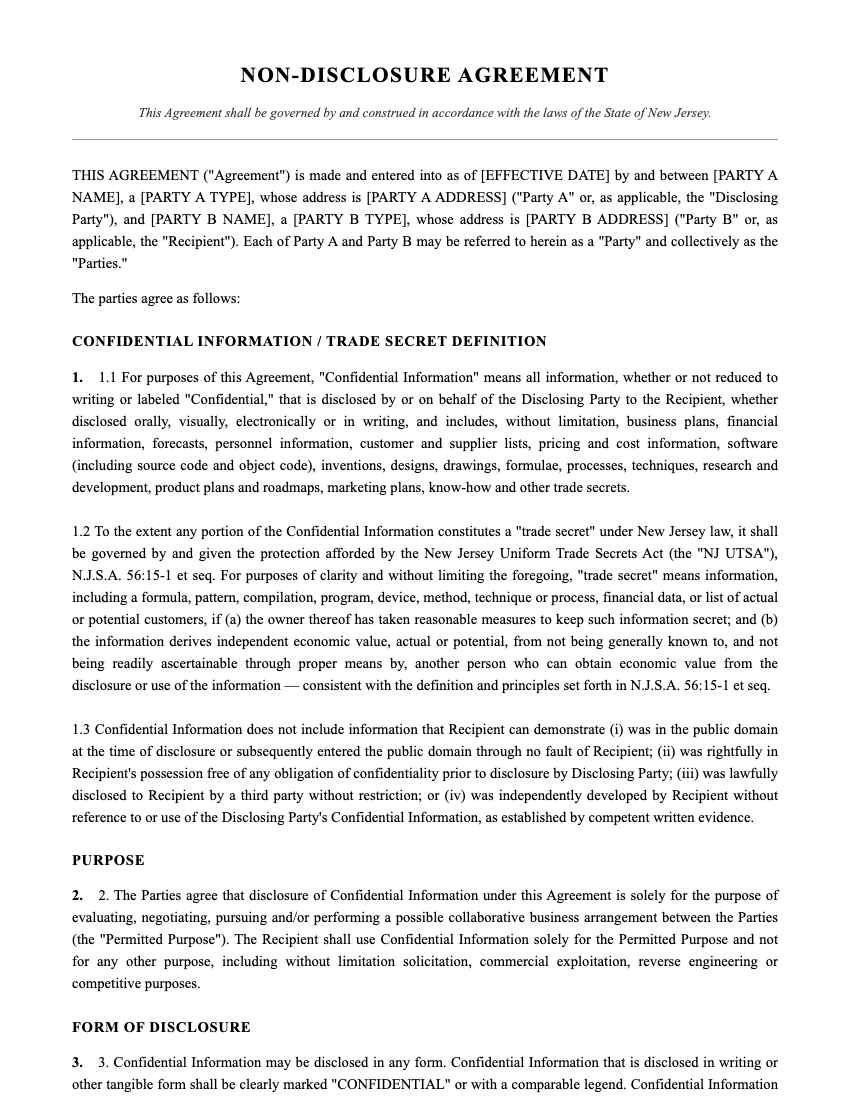
- Purpose clause: narrowly defines why information is shared and limits permitted use.
- Detailed definition of “Confidential Information” vs. “Trade Secrets” with reference to N.J.S.A. 56:15-1 et seq.
- Exclusions: public domain, prior knowledge, independent development, compelled disclosure.
- Use and non-disclosure obligations: tailored to prohibit misappropriation and disclosure, not lawful competition.
- Residuals clause (optional): permits use of information retained in unaided memory—draft carefully where employees will move between employers.
- DTSA whistleblower notice: compliant language required for federal enhanced remedies (18 U.S.C. §1833(b)).
- CEPA and public-policy carve-outs: language confirming the agreement does not prevent reporting illegal activity to government authorities or filing protected whistleblower claims.
- Remedies and injunctive relief: injunctive relief is commonly sought for trade secret misappropriation; specify governing law (New Jersey) and plaintiff’s right to seek equitable relief.
Who Needs This Document?
- Tech startups (NJ/Newark/Princeton): Protect code, algorithms, and investor pitches while avoiding overbroad non-compete wording.
- Professional services (law firms, consultants): Limit client-list misuse while recognizing reasonableness standards for post-engagement restraints.
- Manufacturers and life sciences firms: Protect formulas, processes, and supplier relationships as trade secrets.
- Small businesses and merchants: Use NDAs carefully—misuse to hide consumer issues can trigger the NJ Consumer Fraud Act.
How to Execute a Valid New Jersey NDA
Step 1: Choose One-Way or Mutual
Decide whether only one party will disclose confidential information (use One-Way) or both will (use Mutual). Overly mutual forms can create unnecessary liability.
Step 2: Define Purpose and Scope Precisely
Specificity matters in NJ courts. State the project, products, or transaction that justifies disclosure. Narrow purpose limits make enforcement and injunctive relief more predictable.
Step 3: Label and Protect Your Materials
Mark paper and electronic files as "CONFIDENTIAL," implement access controls, and document secrecy measures—key evidence for trade-secret status under N.J.S.A. 56:15-1.
Step 4: Sign Before Sharing; Use Compliant Notice Language
Get the agreement executed before disclosure. Include the DTSA whistleblower notice (for federal remedies) and a CEPA carve-out. Electronic signatures are generally enforceable under the federal E-SIGN Act (15 U.S.C. §7001) and accepted in New Jersey courts.
Getting NDAs From Clients
If a client sends you an NDA, review it for hidden non-compete language, overly broad definitions that could be enforced in New Jersey, and provisions that might improperly bar whistleblowing or consumer complaints. Our an AI contract review tool tool flags such risks, compares clauses against New Jersey statutes and case law, and recommends negotiated language.
Related NDA Templates
Get the Template
Sign up for our newsletter to receive the template.
Frequently Asked Questions

About Designer Content
Designer Content creates practical legal document resources for landlords, contractors, and small business owners. We simplify complex legal concepts into actionable guidance. Connect with us on LinkedIn.