
A New Mexico Master Services Agreement (MSA) is a standing contract that sets the legal rules for an ongoing service relationship in New Mexico, with project details handled through separate Statements of Work (SOWs). Instead of renegotiating payment, ownership, confidentiality, and dispute terms every time you start a new project, you sign the MSA once and then attach short SOWs for each engagement. For New Mexico SMB owners, consultants, agencies, and freelancers, a state-specific MSA helps align payment terms, consumer-protection risk, and data-handling duties with New Mexico statutes.
Definition: A New Mexico Master Services Agreement is a written umbrella contract between a service provider and a client that governs multiple current and future service projects performed in or connected to New Mexico. The MSA establishes baseline legal terms—scope framework, pricing mechanics, invoicing, confidentiality, intellectual property (IP) ownership, warranties, limitations of liability, and dispute resolution—while each project’s exact deliverables and timeline live in an attached Statement of Work (SOW). This structure reduces drafting costs, speeds approvals, and creates consistent risk allocation across projects, while still allowing each SOW to override the MSA when explicitly stated.
Why You Cannot Use a Generic MSA in New Mexico
A generic MSA often “works” only until something goes wrong—an invoice is late, a contractor classification is challenged, a client claims deceptive sales practices, or a laptop with customer data is lost. New Mexico has several legal pressure points that should be reflected in your template so your contract is enforceable and operational in the real world.
First, limitations periods and payment interest are not mere boilerplate. New Mexico allows six years to sue on written contracts under NMSA 1978, § 37-1-3. If your template assumes a shorter period or borrows another state’s limitations language, you can create confusion about record retention and claim timing. Similarly, if you want late-payment interest, New Mexico provides a commonly cited rate of 15% per annum in NMSA 1978, § 56-8-3 when parties have not contracted for a different lawful rate. A New Mexico-forward MSA should (a) clearly set when invoices are due, (b) define when interest begins to accrue, and (c) state whether interest is “the maximum allowed by law” to avoid an unenforceable overcharge.
For a comprehensive guide to structuring MSAs and SOWs that protect your business, see our Freelancer Contracts Guide.
Second, New Mexico’s Unfair Practices Act (UPA) can turn sloppy marketing promises into expensive disputes. The UPA prohibits unfair or deceptive trade practices and includes remedies that may include attorney fees in certain situations (see NMSA 1978, § 57-12-1 et seq.). Even in B2B contexts, you should draft accurate scopes, exclude “guaranteed results” claims unless you truly mean them, and include a clean process for change orders. A generic MSA that overpromises outcomes (for example, “Provider guarantees compliance” or “guarantees sales increases”) increases the risk that a dissatisfied customer frames the issue as deception instead of a simple contract dispute.
Third, data incidents are not only an IT problem; they’re a contract problem. Under the New Mexico Data Breach Notification Act, businesses that own or license certain personal identifying information must provide notice following a security breach, with required content elements and timing obligations (see NMSA 1978, § 57-12C-1 et seq.). If you handle customer lists, login credentials, or HR files, your MSA should allocate responsibilities: who secures systems, who investigates, who provides notices, and who pays.
3a. Worker Classification Rules
New Mexico does not use a single “ABC test” statute for all purposes; instead, worker status is commonly evaluated using right-to-control/common-law factors, and New Mexico’s unemployment insurance law provides a statutory framework for when services are “employment.” Under the New Mexico Unemployment Compensation Law, “employment” is defined broadly and then limited by specific inclusions/exclusions (see NMSA 1978, Chapter 51, Article 1, including definitions around “employment” in § 51-1-42). In practice, state agencies look at whether the hiring business controls how the work is performed, whether the worker is independently established, and whether the worker bears entrepreneurial risk.
Why it matters in your MSA: classification language alone does not decide status, but it can support the facts. Your New Mexico template should include (1) an independent contractor clause stating the provider controls the manner and means of performing services, (2) a requirement that the provider pays their own taxes and carries insurance, and (3) a ban on client policies that look like employment (set hours, mandatory trainings unrelated to safety, supervision of methods). Misclassification can trigger assessments for unpaid unemployment contributions and related penalties/interest under agency enforcement, and it can create wage-and-hour exposure if the relationship is treated as employment in substance.
3b. Non-Compete Enforceability
Unlike states with broad bans, New Mexico can enforce non-compete agreements in many commercial settings if they are reasonable and protect legitimate business interests. However, New Mexico has a major carveout: non-compete clauses for certain healthcare practitioners are restricted. The Health Care Practitioner Non-Compete Act limits non-competes for health care practitioners, reflecting a strong public policy in that sector (see NMSA 1978, §§ 24-1I-1 through 24-1I-2).
For non-healthcare service providers (marketing agencies, IT consultants, fractional CFOs), the safer approach is not to copy a broad “no competition anywhere for two years” clause from an out-of-state template. Courts generally scrutinize non-competes for reasonableness in time, geographic scope, and activity restrictions, and overbroad restraints risk being narrowed or rejected. In an MSA template, consider whether you even need a classic non-compete. Often, you can get most of the protection with enforceable alternatives: (1) a robust confidentiality/trade secret clause, (2) a narrow non-solicitation clause focused on active customers or employees, and (3) clear IP ownership terms that prevent the client from using your proprietary tools without permission. If you do use a non-compete, tailor it to the specific role, geography where the business actually operates, and a short duration tied to legitimate interests.
3c. IP/Work-for-Hire Considerations
New Mexico does not have a special “New Mexico-only” IP ownership statute for standard commercial services; IP ownership is mainly governed by federal copyright law and your contract. Generic templates often misuse “work made for hire” language. Under federal law, work-for-hire applies only in limited circumstances (employee scope of employment or certain commissioned works with a signed agreement), so your template should include a present assignment of IP (“hereby assigns”) upon payment, plus a license back if the provider needs reusable know-how. For UCC-governed deliverables (for example, software plus hardware or other mixed transactions), New Mexico’s adoption of the UCC in NMSA 1978, Chapter 55 may affect warranties and remedies, so define deliverables and acceptance criteria in each SOW.
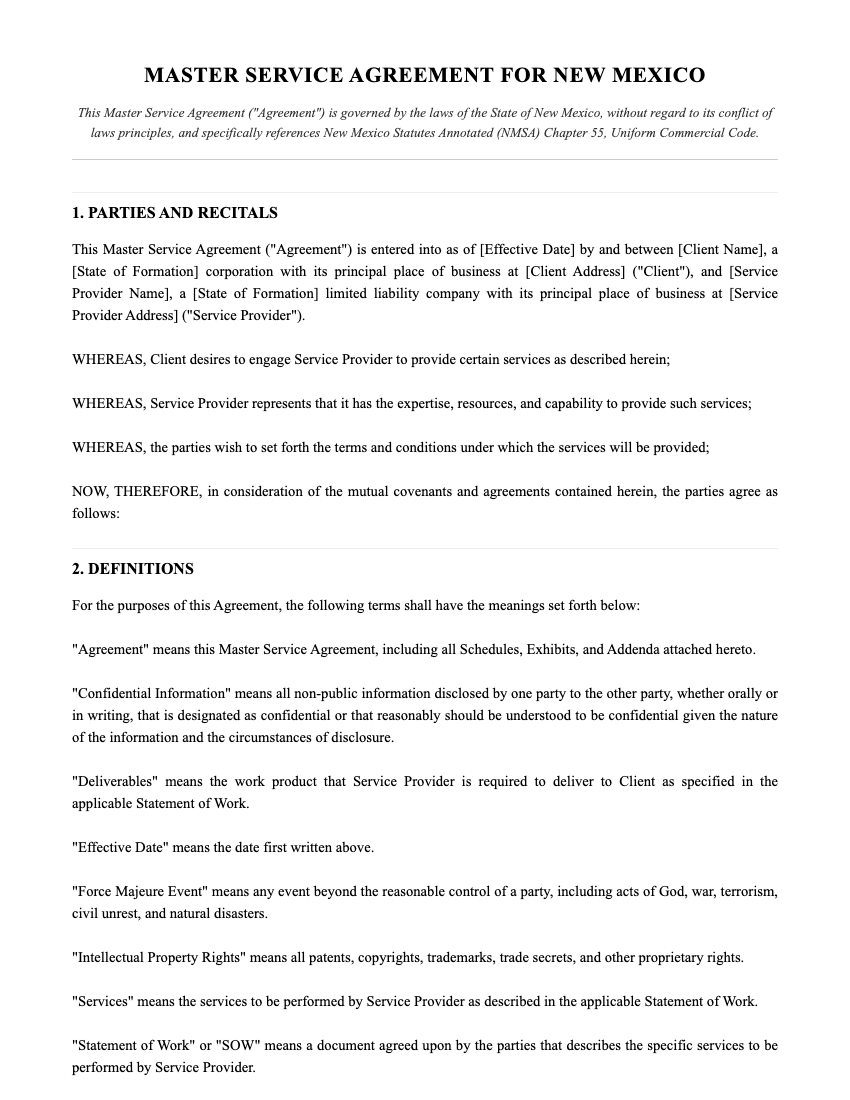
What’s Included in This Template
Flexible SOW Structure. The template treats the MSA as the umbrella and each SOW as the project “instruction sheet.” It includes a priority clause so you can specify when an SOW overrides the MSA. This prevents scope creep by making changes require a written change order.
New Mexico-Specific Indemnification. The indemnity language is written for typical B2B services and includes carve-outs for the other party’s negligence and for unauthorized modifications. If you contract with New Mexico public entities, the template flags that governmental liability can be limited under the New Mexico Tort Claims Act (NMSA 1978, § 41-4-1 et seq.).
Dispute Resolution and Venue. The template pre-sets governing law and venue in New Mexico to avoid being dragged into a distant forum. It also includes an escalation process (business negotiation before litigation) and can be paired with arbitration if both parties prefer it. Written-contract timing is aligned to NMSA 1978, § 37-1-3.
Additional provisions included (with New Mexico citations):
- Late-payment interest clause referencing NMSA 1978, § 56-8-3 (15% per annum unless otherwise agreed/lawful).
- Contract limitations/reliance language aligned to NMSA 1978, § 37-1-3 (six-year period for written contracts).
- UPA compliance and “no deceptive promises” framing referencing NMSA 1978, § 57-12-1 et seq.
- Data breach cooperation and notification allocations referencing NMSA 1978, § 57-12C-1 et seq.
- Public-entity risk note referencing NMSA 1978, § 41-4-1 et seq.
Who Needs This Document?
| User Type | Relationship | Key Benefit |
|---|---|---|
| Marketing or Creative Agency | Retainers + multiple campaigns | Reuses the same payment/IP terms while SOWs define each campaign |
| IT Managed Services Provider | Monthly services + special projects | Clear service levels, security duties, and change-order pricing |
| Business Consultant / Fractional Exec | Ongoing advisory | Defines decision authority, reliance limits, and confidentiality |
| Construction/Field Services Subcontractor | Repeated work orders | Standardizes insurance, indemnity, and acceptance across sites |
How to Use This MSA Template
Step 1: Identify the parties correctly
Use each party’s legal name and entity type (LLC, corporation, sole proprietor). If you’re registered in New Mexico, match the name on your Secretary of State filings to avoid enforceability and invoicing problems.
Step 2: Set the commercial terms that repeat
Fill in invoicing timing, late-fee/interest language, and the baseline rate card or pricing method. Reference NMSA 56-8-3 in the late-interest clause so your finance team has a consistent rule.
Step 3: Attach your first SOW
Put deliverables, milestones, and acceptance criteria in the SOW—not the MSA. If the project touches personal data, include security requirements and breach cooperation aligned to NMSA 57-12C-1 et seq.
Step 4: Sign once, then run on SOWs
Execute the MSA once and sign new SOWs as needed. Keep every SOW with its exhibits so you can prove the final scope and pricing if a dispute arises within the six-year window in NMSA 37-1-3.
Related MSA Templates
Get the Template
Sign up for our newsletter to receive the template.
Frequently Asked Questions

About Designer Content
Designer Content creates practical legal document resources for landlords, contractors, and small business owners. We simplify complex legal concepts into actionable guidance. Connect with us on LinkedIn.