
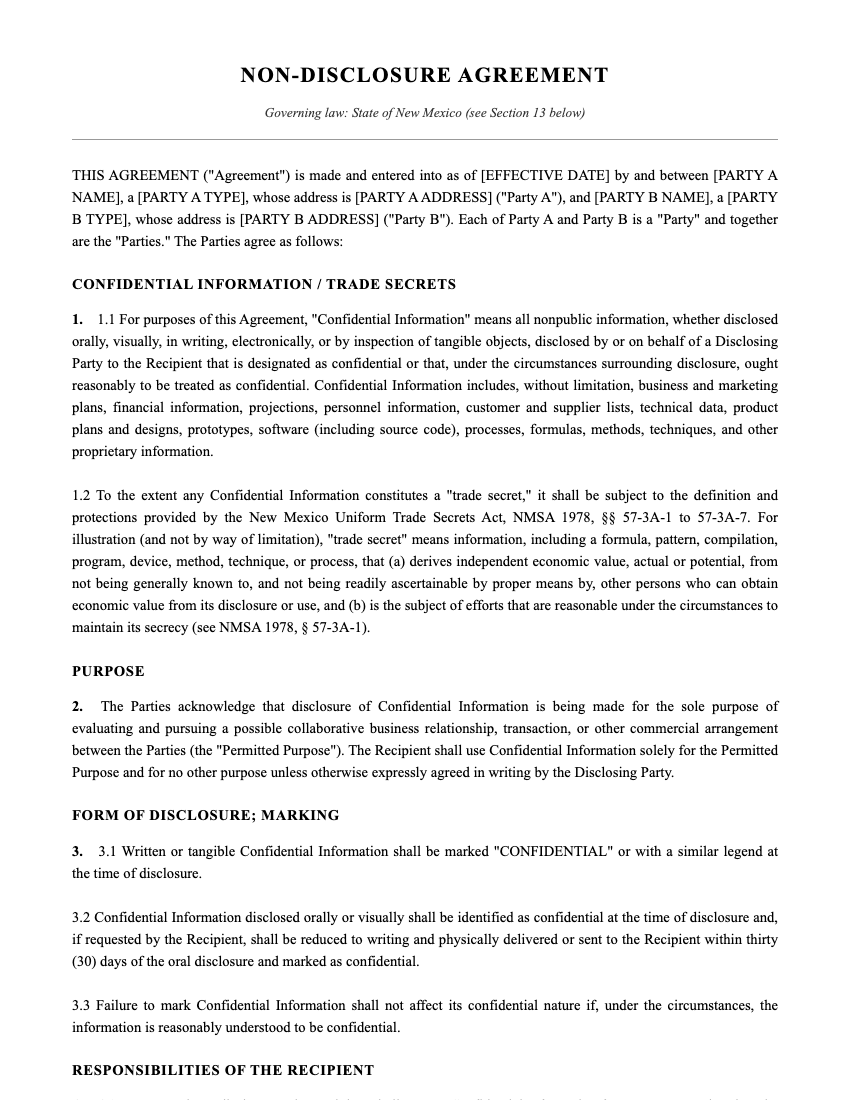
A New Mexico Non-Disclosure Agreement (NDA) is a contract that protects confidential business information, trade secrets, and proprietary materials while aligning with New Mexico statutory and case-law practice. Unlike some states that categorically invalidate restraints on employment, New Mexico courts generally enforce non-competes and confidentiality commitments so long as they are reasonable in scope, duration, and geographic reach.
What is a New Mexico NDA?
Definition: In New Mexico, an NDA is a contractual promise that limits use and disclosure of confidential information exchanged for a defined purpose. Trade-secret claims are governed by the New Mexico Uniform Trade Secrets Act (NMSA 57-3A-1 et seq.), while contract claims are governed by general contract law (with written-contract claims often subject to a 6-year statute of limitations under NMSA 37-1-3).
Practically, this means two things matter: (1) your NDA must describe what qualifies as confidential or a trade secret with enough particularity to be actionable under the UTSA; and (2) how you characterize a dispute (breach of contract vs. trade-secret misappropriation) affects remedies and timing.
For a complete guide to NDA terms, duration, and standard exclusions, see our NDA Agreement Guide.
Why “Generic” NDAs Are Dangerous in New Mexico
Many free templates were drafted for states with different law. Using them in New Mexico can create three traps you might not see at first glance.
- The statute-of-limitations trap (the paradigm-shifting insight)
- New Mexico’s written-contract statute of limitations is 6 years (NMSA 37-1-3). By contrast, trade-secret claims under the Uniform Trade Secrets Act are often time-sensitive and commonly treated by courts as having shorter accrual periods. If you only plead a UTSA claim, you may lose the ability to rely on the longer contract limitations period. The practical takeaway: draft NDAs to preserve both contract and statutory trade-secret claims and prepare to plead in the alternative so you don’t unintentionally shorten your window to sue.
- Overbroad definitions and enforceability
- New Mexico enforces non-compete and restrictive covenants under a reasonableness standard. While non-competes are not automatically void, courts will strike or narrow overly broad terms. Generic NDAs that sweep in an employee’s general skills or unaided memory can be rewritten by a court or partially invalidated.
- Missing federal DTSA notice
- If you may ever litigate in federal court under the Defend Trade Secrets Act (DTSA, 18 U.S.C. § 1836), your NDA should include the DTSA whistleblower/authorization notice. Without it, you may be limited as to enhanced damages and fee-shifting available under federal law.
Real development to watch
New Mexico has adopted the Uniform Trade Secrets Act (codified at NMSA 57-3A-1 et seq.), and courts in the district and state system routinely consider whether misappropriation claims are pleaded as contract breaches or statutory torts. Practitioners should watch how federal and state decisions treat accrual and tolling for trade-secret claims in New Mexico — the choice of pleading can be case-dispositive on limitations and damages.
What’s Included in This Template? (Key Clauses)
- Clear definitions: Separates "Confidential Information" (time-limited, non-secret data) and "Trade Secrets" (information that derives independent economic value from not being generally known and for which the owner made reasonable efforts to maintain secrecy), consistent with NMSA 57-3A-1 et seq.
- Mutual vs. unilateral options: One-way (useful for disclosures to contractors, vendors, or investors) and mutual (for joint ventures, M&A due diligence).
- Purpose clause: Narrowly limits permitted use (e.g., "for evaluating a potential software license agreement for Product X"). Narrow purposes help courts enforce NDAs while avoiding boilerplate overreach.
- Non-use and non-disclosure obligations: Standard prohibitions on using or disclosing confidential information, with carve-outs for information already public, independently developed, or required to be disclosed by law.
- Residuals / memory carve-out (optional): Carefully worded option that allows the receiving party to retain general ideas or skills learned, while still prohibiting use of trade secrets or client-specific confidential materials.
- DTSA whistleblower clause: Permits disclosure to government officials or attorneys and informs the receiving party of whistleblower protections under the DTSA to preserve federal remedies.
- Remedies and choice of law: Allows injunctive relief and specifies New Mexico law and venue for disputes; also preserves contract causes of action to take advantage of longer limitations periods where appropriate.
Who Needs This Document?
| User Persona | Usage Scenario | Key Benefit in New Mexico |
|---|---|---|
| Software Startups | Pitching to investors or hiring contractors | Protects source code and roadmaps while preserving longer contract remedies |
| Employers | Hiring managers and key hires | Reasonable confidentiality can be enforced alongside narrow non-competes where needed |
| Small Business Sellers | M&A due diligence | Allows secure exchange of seller financials while preserving injunctive relief options |
| Manufacturers | Sharing tooling/specs with vendors | Protects trade secrets and expressly permits limited disclosures required by regulators |
How to Execute a Valid New Mexico NDA
- Choose the right type: One-way vs. mutual depending on who shares information.
- Define the purpose: Narrow the use to a specific business evaluation or project.
- Mark materials: Label files "CONFIDENTIAL" and document reasonable steps you took to maintain secrecy — this strengthens both UTSA and contract claims.
- Sign before sharing: New Mexico recognizes electronic signatures under the Uniform Electronic Transactions Act (UETA). Still, always execute the NDA before sending sensitive materials.
Practical note: because the written-contract statute of limitations (NMSA 37-1-3) is 6 years, preserve a breach-of-contract claim in your form so you don't foreclose longer recovery windows by pleading only statutory misappropriation.
Getting NDAs from Clients?
If someone sends you an NDA to sign, review it for: overly broad confidentiality definitions, scope that reads like a non-compete, missing DTSA notice if federal remedy is important, and limitations language that could shorten your ability to sue. Our an AI contract review tool tool flags these issues and compares clauses to New Mexico law in seconds.
Related NDA Templates
Get the Template
Sign up for our newsletter to receive the template.
Frequently Asked Questions

About Designer Content
Designer Content creates practical legal document resources for landlords, contractors, and small business owners. We simplify complex legal concepts into actionable guidance. Connect with us on LinkedIn.