
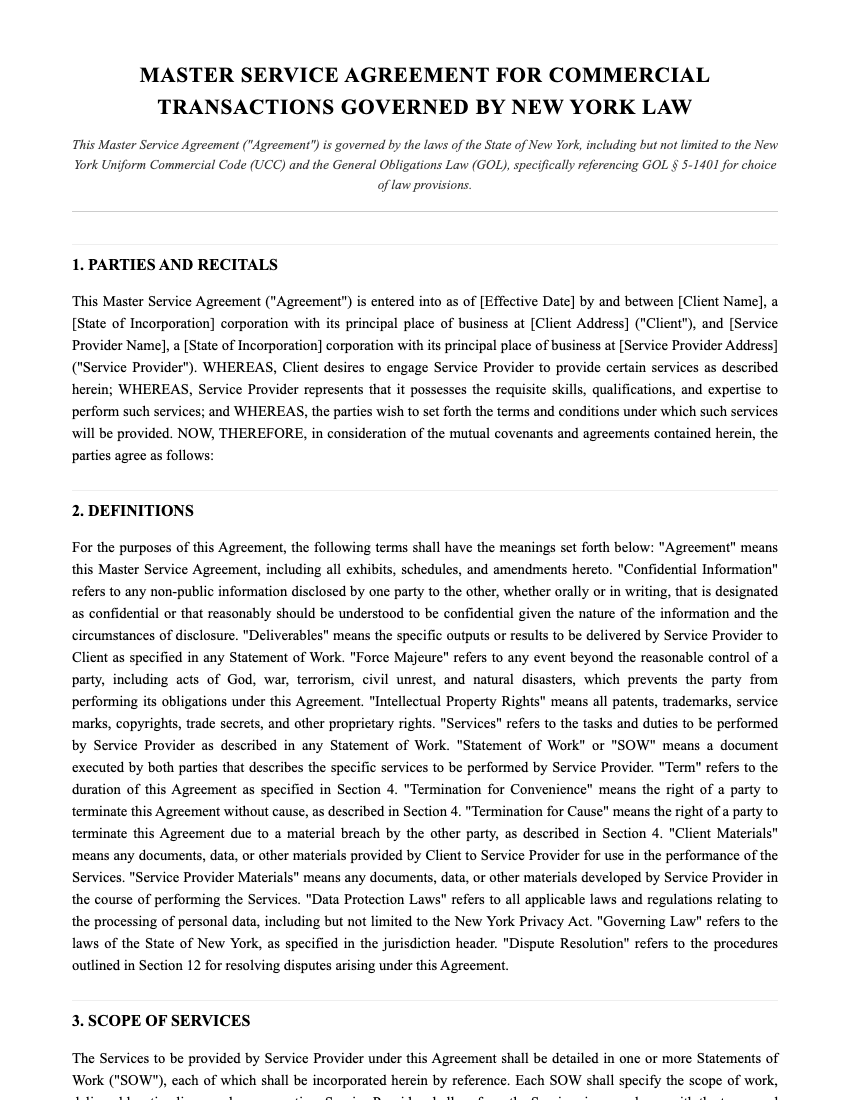
A New York Master Services Agreement (MSA) is a reusable contract that sets the “baseline” legal terms for an ongoing services relationship, while individual projects are handled through short Statements of Work (SOWs). If you are a New York-based consultant, agency, or SaaS implementation provider (or you sell services into New York), an NY-focused MSA helps you avoid common disputes about scope, payment timing, ownership of deliverables, and where a lawsuit must be filed. It also lets you negotiate the hard legal terms once and move faster on each new project.
Definition: A New York Master Services Agreement is a governing contract between a service provider and a client that establishes the core terms—like payment, intellectual property ownership, confidentiality, liability limits, and dispute resolution—intended to apply to multiple future projects performed in or connected to New York. Each project is then documented in a separate Statement of Work (SOW) that specifies the deliverables, schedule, and fees. New York MSAs are commonly drafted to leverage New York’s predictable commercial law, including enforceable choice-of-law clauses under New York General Obligations Law (GOL) § 5-1401, and to address New York-specific litigation defaults such as statutory interest under CPLR § 5004.
Why You Cannot Use a Generic MSA in New York
A generic MSA (often written for “any U.S. state”) misses New York’s practical realities: New York courts apply state-specific rules for worker classification, non-compete enforcement, and drafting choices that control litigation outcomes. Two contracts can look similar on paper but behave very differently when a dispute occurs—especially if the contract picks New York law, a New York venue, or involves services performed in New York.
New York is also a popular “governing law” jurisdiction in B2B deals. If your contract uses New York law, you should draft like New York law will actually be applied. A few lines of boilerplate can decide whether you can collect late-payment interest, whether a restrictive covenant survives a termination, and how long you have to sue.
For a comprehensive guide to structuring MSAs and SOWs that protect your business, see our Freelancer Contracts Guide.
3a. Worker Classification Rules
New York does not use a single all-purpose “ABC test” for every context. For many business contracts, worker status is evaluated under a common-law “right to control” test, focusing on whether the hiring party controls the manner and means of the work (not just the outcome). In unemployment matters, New York’s Department of Labor also looks for supervision, scheduling control, required training, and whether the worker is truly in business for themselves.
Why this matters for an MSA: a “contractor” label alone is not enough. Misclassification can trigger back unemployment insurance contributions and penalties under the New York Labor Law, including civil penalties for certain pay practice violations. For example, the Wage Theft Prevention Act provisions in NY Labor Law § 198(1-b) allow statutory damages for failures to provide required wage notices to employees; if a worker is later reclassified as an employee, paperwork gaps can become leverage in a dispute. The safest New York MSA templates pair an independent-contractor clause with operational guardrails: no set hours, no day-to-day supervision, contractor-provided tools where appropriate, and clear responsibility for taxes and insurance.
3b. Non-Compete Enforceability
Unlike California, New York can enforce non-competes, but only if they are reasonable and protect legitimate business interests. New York courts generally require that a restrictive covenant be no greater than necessary to protect the employer/company, not impose undue hardship, and not harm the public. The core case often cited for the modern test is BDO Seidman v. Hirshberg, 93 N.Y.2d 382 (1999), which explains that enforcement depends on reasonableness in time and geographic scope and the presence of a legitimate protectable interest.
For service providers and SMB clients using an MSA, the takeaway is: a generic “one-size” non-compete (e.g., two years, nationwide, covering any business activity) is a litigation magnet in New York. If you include a non-compete for an independent contractor or vendor, it should be narrowly tailored—often focusing on non-solicitation of the client’s customers, protection of trade secrets, or restrictions tied to a specific named account or territory. In many B2B service relationships, New York-friendly alternatives are stronger and easier to defend: (1) a robust confidentiality clause, (2) a non-solicitation clause limited to customers the contractor actually worked with, and (3) a return/destruction of client data clause. If you want New York governing law in a high-value deal, a careful restrictive covenant is still possible, but it must be drafted with the BDO Seidman reasonableness framework in mind.
3c. IP/Work-for-Hire Considerations
New York contract practice often assumes that “we paid for it, so we own it,” but copyright law is federal and does not work that way. In an MSA, you typically need a clear IP allocation: either the provider retains pre-existing tools and grants a license, or the provider assigns specified deliverables after payment. If you use “work made for hire” language, remember it is limited under 17 U.S.C. § 101 to employees acting within scope or certain enumerated commissioned works with a written agreement. A New York MSA template should therefore include a backup present assignment (and an obligation to sign confirmatory documents) so the client can actually receive enforceable rights to deliverables.
What’s Included in This Template
Flexible SOW Structure. The MSA holds the legal framework steady, while each SOW specifies deliverables, timelines, acceptance criteria, and pricing. That separation helps prevent scope creep: when the client asks for “just one more revision,” you can point to the SOW and treat extras as change orders rather than free work.
New York-Specific Indemnification. The template uses mutual indemnity concepts but warns against overbroad provisions in certain industries. For example, construction-related agreements in New York must consider GOL § 5-322.1, which can void clauses that require one party to indemnify another for that other party’s negligence.
Dispute Resolution and Venue. The template includes New York-friendly governing law and forum language and explains when New York law can be chosen even if the parties are not located there. For qualifying commercial agreements, GOL § 5-1401 supports choosing New York law (often paired with New York venue clauses).
Additional New York provisions included (with legal hooks): late-payment interest defaults referencing CPLR § 5004 (9% simple interest unless otherwise provided by statute); statute of limitations awareness for contract actions under CPLR § 213 (commonly six years for breach of contract); choice-of-law language aligned to GOL § 5-1401; indemnity caution language referencing GOL § 5-322.1; and settlement/claims drafting awareness tied to GOL § 15-108 (effects of releases and settlements among tortfeasors).
Who Needs This Document?
| User Type | Relationship | Key Benefit |
|---|---|---|
| Marketing or creative agency | Ongoing campaigns with multiple SOWs | Controls revisions and change orders, protects portfolio and IP |
| IT managed services provider (MSP) | Recurring support + project work | Separates baseline terms from monthly scope and SLAs |
| Business consultant | Advisory retainers and periodic deliverables | Clear payment triggers, late fees/interest, and confidentiality |
| Software developer / implementation firm | Milestone-based builds | Acceptance criteria, IP assignment after payment, warranty limits |
How to Use This MSA Template
Step 1: Identify the parties correctly
Use the exact legal names (LLC/Corp) and addresses. If you contract through an LLC but sign personally, you can accidentally create personal liability.
Step 2: Set the term and termination mechanics
Choose an initial term (e.g., 12 months) and whether it auto-renews. Include a clean offboarding process: final invoices, return of data, and survival of confidentiality.
Step 3: Attach your first SOW
Keep deliverables out of the MSA. Put scope, milestones, and acceptance testing in the SOW so each project is measurable and billed consistently.
Step 4: Sign once, then reuse
After the MSA is signed, every new engagement should be a short SOW referencing the MSA. That approach reduces negotiation time and keeps your legal risk consistent.
Related MSA Templates
Get the Template
Sign up for our newsletter to receive the template.
Frequently Asked Questions

About Designer Content
Designer Content creates practical legal document resources for landlords, contractors, and small business owners. We simplify complex legal concepts into actionable guidance. Connect with us on LinkedIn.