
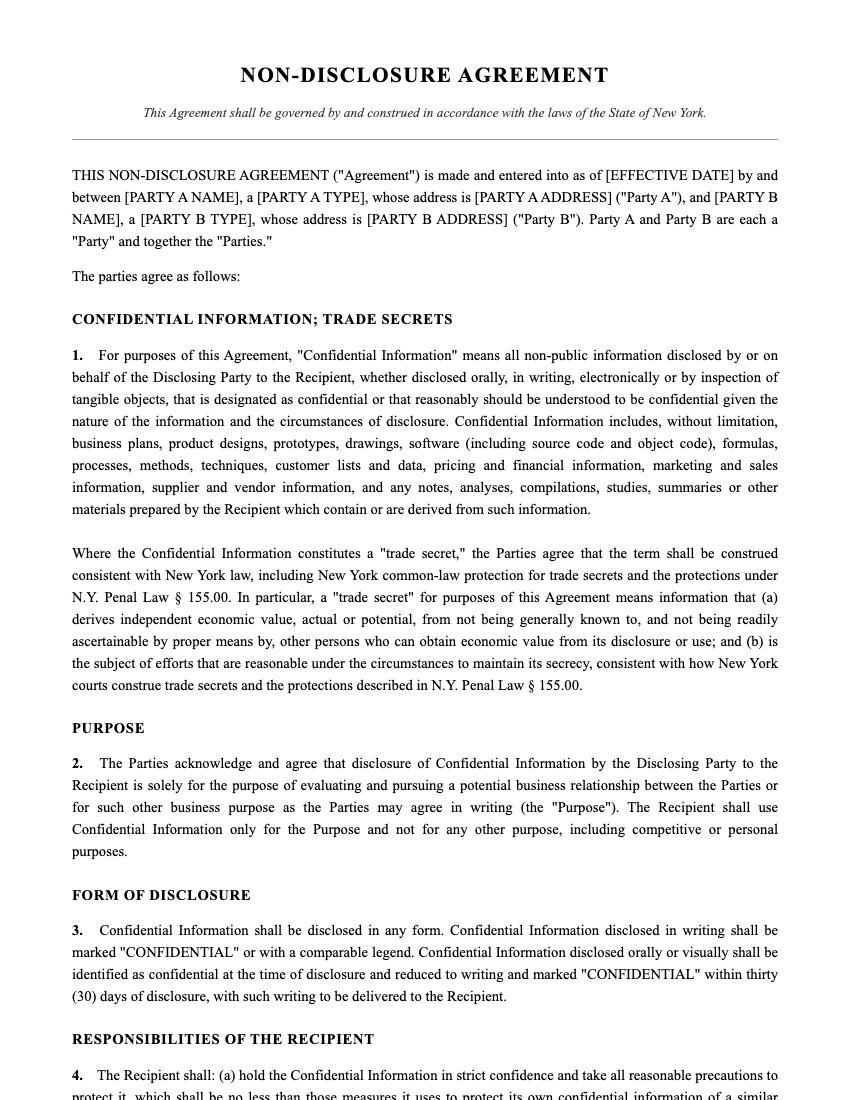
A New York Non-Disclosure Agreement (NDA) is a contract used to protect confidential business information and trade secrets while reflecting New York’s case law emphasis on reasonableness, the State’s data security duties under the SHIELD Act (N.Y. Gen. Bus. Law § 899-bb), and federal DTSA notice requirements.
What is a New York NDA?
Definition: A New York NDA is a confidentiality contract tailored to protect proprietary information, ideas, and trade secrets under both common law and statutory frameworks (including New York Penal Law § 155.00 for theft of trade secrets). New York courts generally enforce restrictive covenants—non-solicitation and confidentiality provisions—so long as they are reasonable in scope, duration, and geography.
Because New York follows a reasonableness standard (see Reed, Roberts Assocs. v. Strauman, 40 N.Y.2d 303 (1976)), drafters must narrowly tailor NDAs: overly broad language risks denial of injunctive relief or total invalidation of the clause.
For a complete guide to NDA terms, duration, and standard exclusions, see our NDA Agreement Guide.
Why 'Generic' NDAs Are Dangerous in New York
Many off-the-shelf NDAs were written for jurisdictions that either ban or more readily modify restrictive covenants. Using those templates in New York creates several local traps.
- Overbroad non-compete or anti-use language
New York enforces covenants but scrutinizes them. Clauses that effectively act as a non-compete (e.g., "Receiving Party shall not use Confidential Information in any manner that competes with Disclosing Party") can be rejected, especially when they restrict broad categories of work or lack narrow tailoring. The Reed, Roberts factors require a legitimate protectable interest and a limitation reasonable as to time and area.
- Blue‑penciling is no guarantee (paradigm-shifting insight)
New York courts historically apply a flexible "blue‑pencil" approach: they may modify or sever unreasonable provisions to preserve what’s enforceable (BDO Seidman v. Hirshberg, 93 N.Y.2d 382 (1999)). Paradigm shift: unlike some jurisdictions that strictly decline to rewrite contracts, New York judges often try to save an agreement by narrowing language instead of throwing it out—BUT this is unpredictable. Relying on a court to fix poor drafting is risky; precise, narrow drafting is the safer path.
- Data security and notification obligations
The New York SHIELD Act (N.Y. Gen. Bus. Law § 899-bb) imposes obligations on how businesses secure personal data. NDAs that contemplate shared personal or customer data should align with SHIELD requirements and internal data-security commitments. A confidentiality promise without a concrete data-security regime can expose you to regulatory scrutiny or civil liability.
- Missing DTSA whistleblower notice
If you ever bring a federal claim under the Defend Trade Secrets Act (18 U.S.C. § 1836 et seq.), federal law (18 U.S.C. § 1833(b)) requires that a complaint seeking certain enhanced damages show the NDA included notice that the recipient may disclose trade secrets to government officials or in certain reporting contexts. Omit it and you risk losing entitlement to exemplary damages and attorneys’ fees in a DTSA action.
Real case study
Reed, Roberts Assocs. v. Strauman, 40 N.Y.2d 303 (1976), remains central: the Court enforced restraints only where they were necessary to protect reasonable business interests and were reasonable in time and area. In BDO Seidman v. Hirshberg, 93 N.Y.2d 382 (1999), the Court addressed the limits of modification and underscored the court’s remedial role—illustrating both enforcement and judicial reshaping of overbroad covenants.
What’s included in this New York template (Key clauses)
- Purpose-limited definition of Confidential Information and a tiered approach: ordinary confidential business info (time-limited) vs. Trade Secrets (protected while secret).
- Narrow non-use clause (restricts use only to the Purpose); separate non-solicitation clause with clear time and geographic limits.
- DTSA Whistleblower/Reporting clause (18 U.S.C. § 1833(b)) to preserve federal remedies.
- SHIELD Act compliance rider: basic data-security commitments and notice procedures when personal data is involved (aligns with N.Y. Gen. Bus. Law § 899‑bb).
- Residuals clause (optional): carefully worded to allow use of unaided memory without permitting misuse of trade secrets.
- Standard carve-outs: information already public, previously known, independently developed, or compelled disclosure.
- Choice-of-law and forum clause option: model language that invokes New York law and Commercial Division consent where appropriate; note GOL § 5-1401 permits New York law choice for large contracts.
Who needs this document?
- Tech startups (NYC): Protect pitch decks and customer lists during investor diligence while keeping clauses narrow enough for NY courts.
- Law firms & consultants: Preserve client confidences and comply with SHIELD data duties when handling PHI/PII.
- Employers: Protect business processes and client relationships with reasonable non-solicitation terms enforceable in NY.
- Sellers and acquirers (M&A): Use mutual NDAs with strong carve-outs for mounting due-diligence disclosure.
How to execute a valid New York NDA
Step 1: Choose unilateral or mutual
Use Unilateral when only one party discloses (investor pitches, vendor proposals). Use Mutual for M&A or joint-development scenarios where both sides exchange secrets.
Step 2: Clearly define the Purpose and confidential categories
Limit the purpose to a concrete project. Use separate definitions for "Confidential Information" and "Trade Secrets" so courts can apply different protection periods.
Step 3: Mark and secure your materials
Mark documents as "CONFIDENTIAL," enforce access controls, and document reasonable steps (passwords, limited recipients, SHIELD-compliant safeguards). These efforts support trade-secret claims and align with SHIELD obligations.
Step 4: Sign (and choose governing law) before sharing
Get the NDA signed before disclosure. New York recognizes electronic signatures under the Electronic Signatures and Records Act (N.Y. Tech. Law § 301 et seq.). For large-value deals, consider a New York choice-of-law clause consistent with GOL § 5-1401.
When someone gives you their NDA
Review for overbroad non-use language that could function as a de facto non-compete, missing DTSA notice, vague trade-secret definitions, or inappropriate data-security promises under SHIELD. This template includes negotiation notes to help you push back effectively.
an AI contract review tool can instantly flag broad restrictive covenants, missing DTSA language, and SHIELD-related obligations against New York law—saving time and reducing litigation risk.
Related NDA Templates
Get the Template
Sign up for our newsletter to receive the template.
Frequently Asked Questions

About Designer Content
Designer Content creates practical legal document resources for landlords, contractors, and small business owners. We simplify complex legal concepts into actionable guidance. Connect with us on LinkedIn.