
A New Zealand Master Services Agreement (MSA) is a framework contract that sets the core legal terms for ongoing services so you can add project-specific Statements of Work (SOWs) without renegotiating every time. It is commonly used by agencies, consultants, IT providers, and specialist contractors working B2B across multiple engagements. A well-drafted New Zealand MSA helps reduce “scope creep,” speeds up procurement approvals, and clarifies risk allocation around payment, liability, confidentiality, and intellectual property. Importantly, it should reflect New Zealand’s approach to contractor classification, restraint of trade, privacy, and limitation periods.
Definition: A New Zealand Master Services Agreement (MSA) is a reusable contract between a service provider and a client that governs all current and future service engagements carried out under it. The MSA contains baseline terms—fees and invoicing rules, late-payment interest, service standards, confidentiality, intellectual property ownership, liability caps, insurance, and dispute resolution—while each individual project is documented in an attached Statement of Work (SOW) that sets the scope, deliverables, timeline, and pricing. In New Zealand, a good MSA also anticipates local compliance issues such as contractor vs employee risk, enforceable (reasonable) restraint of trade clauses, Privacy Act 2020 duties when handling personal information, and limitation/notification mechanics.
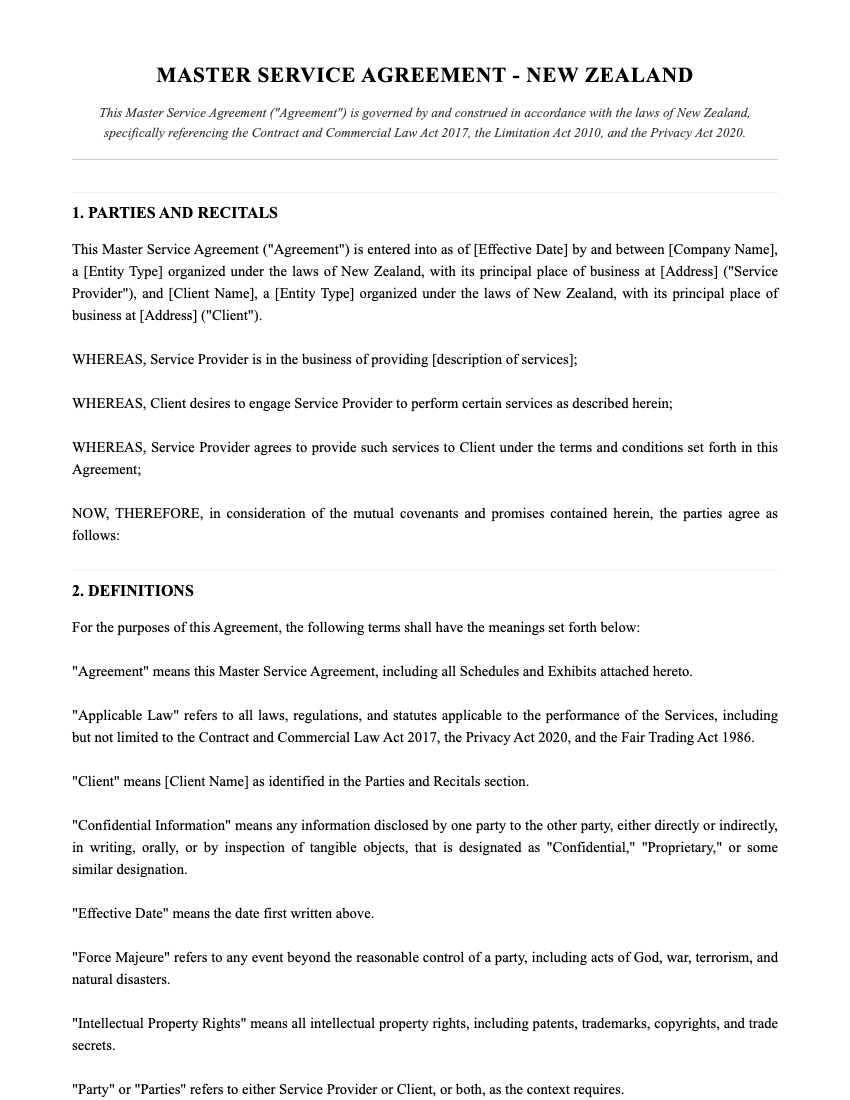
Why You Cannot Use a Generic MSA in New Zealand
A generic MSA drafted for the US, UK, or “global use” often fails in New Zealand because enforceability turns on local tests and statutes. NZ courts focus on the real substance of the relationship, not just labels, and statutory regimes affect how you can charge interest, manage personal data, and draft time-bar and waiver language. A template that ignores these issues can create disputes that are expensive to unwind—especially once work has started and deliverables, source code, or customer data is already in circulation.
3a. Worker Classification Rules
New Zealand does not use the US-style “ABC test.” Instead, whether someone is an employee or an independent contractor is assessed under the Employment Relations Act 2000 using the “real nature of the relationship” test. Section 6 of the Employment Relations Act 2000 provides that the court (or Authority) must determine the real nature of the relationship, considering all relevant matters, including the parties’ intentions, but not treating statements about status as decisive.
For a comprehensive guide to structuring MSAs and SOWs that protect your business, see our Freelancer Contracts Guide.
In practical terms, this means a generic MSA clause declaring “the Provider is an independent contractor” is not enough. Decision-makers will look at control (who directs the work), integration (is the person part of the business), independence (can they subcontract, advertise, work for others), and economic reality (who bears risk and provides tools). Misclassification can expose a client to claims for holiday pay, minimum entitlements, and other employee protections under the Holidays Act 2003 and wage laws, plus penalties orders in employment jurisdictions. Your MSA template should therefore include operational signals of independence (control over method, ability to use substitutes, own equipment, invoice-based payments) and avoid “employee-like” directions embedded in service terms.
3b. Non-Compete Enforceability
Unlike California, New Zealand can enforce non-compete and non-solicitation clauses (often called restraints of trade), but only if they are reasonable and go no further than necessary to protect a legitimate business interest (such as trade secrets, customer connections, or confidential pricing). The key legal mechanism is the Contract and Commercial Law Act 2017, which preserves and empowers the court’s ability to grant relief in restraint cases by allowing a restraint to be enforced to the extent it is reasonable (commonly referred to as “read down” or partial enforcement). Practically, an overbroad clause can still be risky: while courts may modify, you cannot rely on a court to “fix” a badly drafted restraint, and uncertainty can undermine your ability to stop a departing contractor from poaching clients.
A generic MSA often drops in a 12–24 month, nationwide non-compete covering “any business similar to the client,” which is unlikely to be defensible for most freelancers and SMB engagements. In an NZ-tailored template, restraints should be drafted narrowly: define the protected clients (e.g., clients worked with in the last 12 months), specify geography tied to real market reach (often city/region rather than “New Zealand”), and keep duration proportionate (often 3–6 months for many service relationships, depending on role and access). Where a non-compete is too hard to justify, better alternatives include (1) strong confidentiality and trade secret protections, (2) targeted non-solicitation of customers and staff, and (3) IP and return-of-materials clauses that reduce leverage for misuse.
3c. IP/Work-for-Hire Considerations
New Zealand does not use the US “work made for hire” concept as a universal shortcut. Instead, copyright ownership is governed by the Copyright Act 1994. As a default position, the author/creator generally owns copyright, subject to specific exceptions (such as certain works created in the course of employment). For contractor-created deliverables, you typically need a clear written assignment to ensure the client owns the agreed IP. A New Zealand-ready MSA template should separate (a) background IP each party brings in, (b) project IP created under an SOW, and (c) licensed third-party materials. It should also link IP transfer to payment (e.g., assignment effective on full payment) to protect service providers from non-paying clients.
What’s Included in This Template
Flexible SOW Structure
The template uses the classic umbrella model: the MSA contains the legal “rules of the road,” while each SOW describes deliverables, milestones, acceptance criteria, and fees. This prevents the MSA becoming a messy scope document and makes it easier to run repeat projects with the same client.
New Zealand-Specific Indemnification
Indemnities are drafted to be practical for NZ B2B work: each party is responsible for its own negligence and third-party claims it causes, with carve-outs for fraud and wilful misconduct. The template also pairs indemnities with realistic insurance obligations (for example, public liability and professional indemnity with stated coverage amounts) to improve recoverability.
Dispute Resolution and Venue
The template is designed to keep disputes in New Zealand by specifying New Zealand governing law and New Zealand courts, with an escalation path (good-faith negotiation, then mediation, then litigation). This avoids being forced into offshore forums that add cost and complexity for SMBs.
Additional NZ-specific provisions included:
- Late payment interest aligned to the Contract and Commercial Law Act 2017 (set a clear default interest rate and compounding method).
- Time-bar/limitation awareness and claim-notification mechanics referencing the Limitation Act 2010 (including careful drafting around “unknown claims” risk).
- Privacy and data-handling obligations referencing Privacy Act 2020 ss 22–23 (agency/interference principles and access/correction rights).
- Misleading or deceptive conduct caution referencing the Fair Trading Act 1986 (warranties and marketing statements should be accurate).
Who Needs This Document?
| User Type | Relationship | Key Benefit |
|---|---|---|
| IT Managed Service Providers | Ongoing support + project rollouts | Standardises SLAs, response times, and liability caps across SOWs |
| Marketing & Creative Agencies | Retainers and campaign bursts | Controls scope creep and sets clear approval/acceptance rules |
| Business Consultants | Advisory engagements with changing priorities | Makes variations billable and clarifies reliance/decision risk |
| Software Developers | Build-and-enhance work over months | Protects background code and sets IP assignment on payment |
How to Use This MSA Template
Step 1: Identify the Parties Correctly
Use full legal names and NZBN/company numbers where applicable. If a sole trader is signing, specify the trading name and the individual’s legal name to avoid enforcement issues.
Step 2: Set the Commercial Defaults
Choose invoice timing, payment due dates, and late-payment interest. Align service credits, change-control, and expense rules with how you actually operate so the contract matches reality.
Step 3: Attach Your First Statement of Work (SOW)
Keep the MSA general and place deliverables, milestones, acceptance tests, and pricing inside the SOW. If you do fixed-price work, define what counts as out-of-scope and the hourly rates for variations.
Step 4: Sign Once, Then Reuse
After the MSA is signed, each new project should be added via a short SOW referencing the MSA. This speeds up sales cycles while keeping legal protections consistent.
Related MSA Templates
Get the Template
Sign up for our newsletter to receive the template.
Frequently Asked Questions

About Designer Content
Designer Content creates practical legal document resources for landlords, contractors, and small business owners. We simplify complex legal concepts into actionable guidance. Connect with us on LinkedIn.