
A New Zealand Non-Disclosure Agreement (NDA) is a contract that protects confidential business information and trade secrets while fitting within New Zealand’s statutory and common-law framework — including the Contract and Commercial Law Act 2017, the Privacy Act 2020, the Protected Disclosures Act 2000, and the Limitation Act 2010.
What Is a New Zealand NDA?
Definition: A New Zealand NDA is a legally binding written agreement where one or both parties agree to keep specified information confidential and to use it only for defined purposes. NDAs protect commercially valuable information that is treated as confidential and subject to reasonable steps to preserve secrecy.
Unlike jurisdictions with a statutory "trade secrets" regime, New Zealand relies on contract law and equitable principles to protect confidential information. NDAs are enforceable when their scope is clear, reasonable, and consistent with statutory rights (for example, whistleblowing protected under the Protected Disclosures Act 2000 cannot be overridden by an NDA).
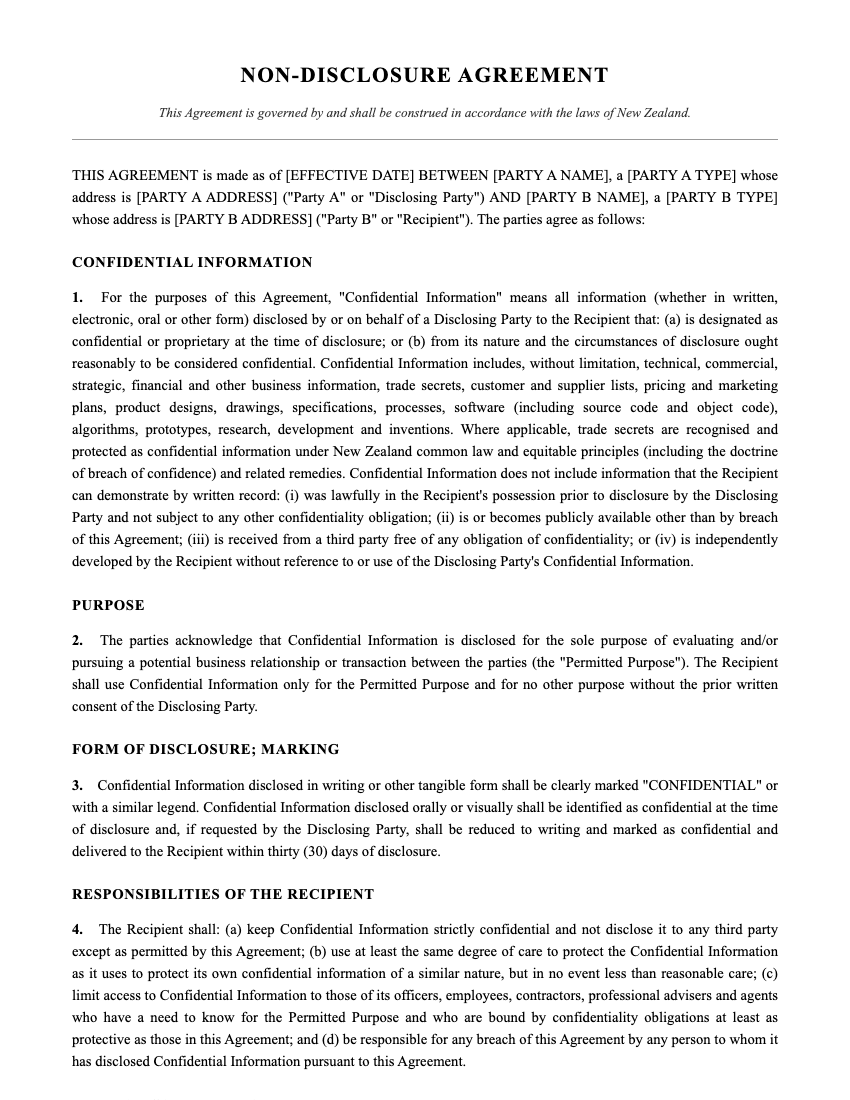
For a complete guide to NDA terms, duration, and standard exclusions, see our NDA Agreement Guide.
Why "Generic" NDAs Are Dangerous in New Zealand
Many free template NDAs are drafted for jurisdictions with different statutory protections and enforcement norms. Using them in New Zealand exposes you to several local traps.
- Overbroad confidentiality can be treated as a restraint of trade
New Zealand courts will scrutinise clauses that effectively prevent someone from using general skills or working in their industry. A blanket prohibition on "using any information" may be read as a de facto restraint of trade and declared unenforceable if it is not reasonably necessary to protect legitimate interests.
Paradigm-shifting insight (NZ): NDAs that look like ordinary confidentiality clauses can quietly operate as restraints of trade. New Zealand courts will assess whether the restriction is reasonably necessary, proportionate in scope and duration, and protects a legitimate interest (client relationships, specialised methodologies, or true trade secrets). In practice, narrowly tailored definitions and purpose clauses are essential.
- You cannot lawfully silence whistleblowers or statutory disclosures
The Protected Disclosures Act 2000 and the Privacy Act 2020 protect certain disclosures to regulators and the Privacy Commissioner. NDAs that purport to prevent employees or contractors from reporting serious wrongdoing or making privacy complaints are likely void to the extent they restrict those statutory rights.
- Data and privacy obligations change NDA delivery and storage
The Privacy Act 2020 imposes obligations on how personal information is handled. NDAs that require indefinite retention of personal data or transfer of personal information offshore without specifying safeguards may conflict with privacy obligations and the Information Privacy Principles.
- Limitation periods and remedies differ
Under the Limitation Act 2010, many contractual claims must be started within six years. If your NDA prescribes short notification periods for breaches or tries to limit statutory remedies (e.g., claims under the Fair Trading Act 1986), those provisions may be limited by statute.
Real Legal Development to Note
The Privacy Act 2020 (in force since December 2020) updated data-handling duties and expanded the Privacy Commissioner’s enforcement powers — a practical development affecting NDAs that include personal data. MBIE and Employment Ministry guidance on restrictive covenants emphasise reasonableness and the need to tailor restraints to protect legitimate interests rather than punish competition.
What’s Included in This Template? (Key Clauses)
- Clear Definitions: Distinguish between "Confidential Information" (time-limited, business info) and "Protected Trade Secrets" (information that derives value from secrecy and is subject to reasonable protective measures).
- Purpose Clause: Strictly limits permitted uses (e.g., "to evaluate a potential supply arrangement for Product X").
- Limited Duration: Two-tier approach — typical confidential business information (commonly 2–5 years) and trade secrets (protected while secret).
- Exclusions: Public domain, prior knowledge, independent development, and legally compelled disclosure (with procedures for notice to the discloser).
- Whistleblower / Statutory Carve-Outs: Explicit language preserving rights under the Protected Disclosures Act 2000 and obligations to co-operate with regulators and the Privacy Commissioner.
- Residuals/Memory Clause (optional): Narrow, negotiated wording to avoid unduly restricting future employment while permitting unaided memory of general skills.
- Remedies and Injunctive Relief: Acknowledgement that injunctive relief may be sought; clarity on limitation periods and jurisdiction (New Zealand courts)
- Electronic Execution: Recognises signatures by electronic means consistent with the Electronic Transactions provisions in New Zealand law.
Who Needs This Document?
| User Persona | Usage Scenario | Key NZ Benefit |
|---|---|---|
| Tech startups | Pitching to investors or sharing protoypes | Protects IP while preserving investor diligence flow, consistent with privacy duties |
| Professional services | Sharing client lists with subcontractors | Limits use and retention of client data; tailored non-solicit and confidentiality clauses |
| Employers | Senior hires or contractors | Narrowly protects sensitive methods and client relationships without overbroad restraints |
| Exporters | Sharing manufacturing specs with offshore partners | Includes data transfer safeguards and trade-secret protections |
How to Execute a Valid New Zealand NDA
Step 1: Choose the Right Form — One-way or Mutual
Decide whether information flows in one direction (use unilateral) or both (use mutual). Overusing mutual NDAs can create unnecessary obligations.
Step 2: Define Purpose and Scope Precisely
Spell out the purpose and narrowly define the categories of confidential information. Courts in NZ will strike back at vague, catch-all definitions.
Step 3: Take Reasonable Steps to Keep Secrets
Mark documents, use access controls, limit distribution, and record who receives confidential files. Reasonable protective steps strengthen equitable remedies.
Step 4: Sign Before Sharing — Electronic Signatures Work
Get the agreement executed before disclosure. Electronic signatures are generally effective under New Zealand’s electronic transactions framework (see Contract and Commercial Law Act 2017 and associated provisions).
Getting NDAs from Others
When a client or partner sends you an NDA, review it for: overly broad definitions, questionable non-compete language, absence of statutory carve-outs for whistleblowing and privacy, and unrealistic retention obligations. Use an AI contract review tool to spot risky clauses and compare terms to New Zealand law instantly.
Related NDA Templates
Get the Template
Sign up for our newsletter to receive the template.
Frequently Asked Questions

About Designer Content
Designer Content creates practical legal document resources for landlords, contractors, and small business owners. We simplify complex legal concepts into actionable guidance. Connect with us on LinkedIn.