
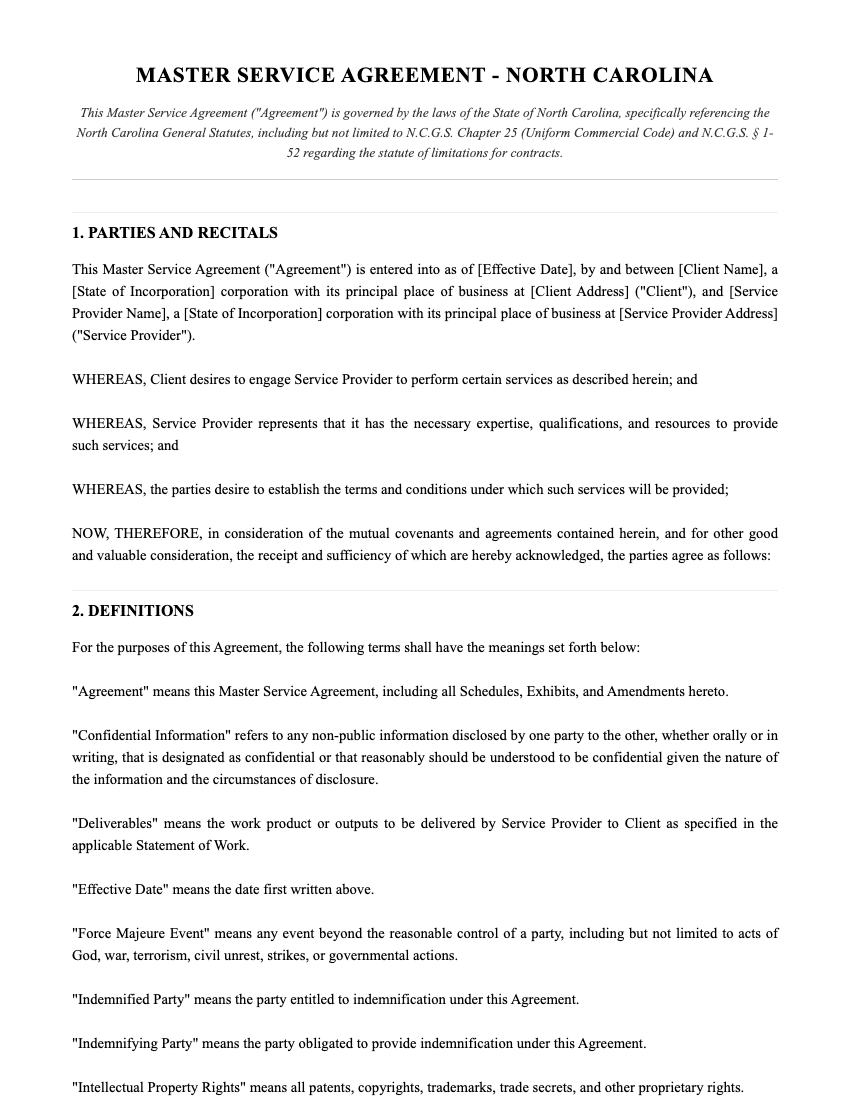
A North Carolina Master Services Agreement (MSA) is a reusable contract that sets the core legal terms for ongoing services between a provider and a client doing business in North Carolina. Instead of renegotiating payment, liability, IP ownership, confidentiality, and dispute rules for every project, you sign one MSA and then attach Statements of Work (SOWs) for each engagement. For SMBs, consultants, and agencies, an NC-specific MSA helps reduce “scope creep,” speed approvals, and avoid state-law pitfalls.
Definition: A North Carolina Master Services Agreement is a governing services contract that establishes baseline legal terms—pricing mechanics, invoicing and interest on late payments, IP ownership and licensing, confidentiality, warranties, limitation of liability, indemnities, and dispute/venue rules—for a series of projects performed in North Carolina. Individual projects are documented in short Statements of Work that plug into the MSA. This structure matters because North Carolina enforces reasonable non-competes, uses a fact-specific worker classification standard, and has strong consumer/business protections under the Unfair and Deceptive Trade Practices Act (N.C.G.S. Chapter 75) that can turn sloppy contract practices into expensive claims.
Why You Cannot Use a Generic MSA in North Carolina
A generic “U.S. MSA template” is usually written to be acceptable everywhere—which often means it is not optimized for anywhere. In North Carolina, three areas commonly create real problems: (1) independent contractor classification, (2) restrictive covenants (non-competes), and (3) intellectual property language that doesn’t actually transfer rights when you think it does. On top of that, North Carolina’s UDTPA (Chapter 75) can amplify exposure if your contract and billing practices look unfair or deceptive, even in a business-to-business relationship.
3a. Worker Classification Rules
North Carolina does not use California’s ABC test by default; it generally applies a common-law “right to control” analysis for employee vs. independent contractor status, meaning the facts of how the work is performed matter more than the label you put in the contract. In unemployment insurance, the state uses the “employment” definition in the Employment Security Law (N.C.G.S. § 96-1 et seq.) and applies a multi-factor control test in practice. Your MSA should reinforce contractor status: the provider controls the method and manner of work, supplies its own tools, can hire assistants, sets work hours, and can serve other clients.
For a comprehensive guide to structuring MSAs and SOWs that protect your business, see our Freelancer Contracts Guide.
Why it matters: misclassification can trigger back withholding and payroll tax issues, unemployment insurance assessments, and wage/hour claims depending on the relationship. A template that reads like an employment handbook (mandatory schedule, day-to-day supervision, “manager approval” language) undermines your position. A North Carolina-ready MSA avoids over-control in the legal drafting, keeps performance measured by deliverables in each SOW, and includes representations that each party is responsible for its own taxes and benefits.
3b. Non-Compete Enforceability
Unlike some states that broadly prohibit non-competes, North Carolina generally enforces non-compete agreements if they meet strict requirements developed under North Carolina case law. A non-compete must be in writing, part of a valid contract, supported by consideration, and reasonable as to time and territory, and designed to protect a legitimate business interest (like customer relationships or confidential information). North Carolina courts also scrutinize whether the restriction is no broader than necessary; overreaching language can fail.
A generic MSA often includes aggressive restrictions: nationwide territory, multi-year duration, or blanket bans on working “in any competitive capacity.” That is risky in North Carolina because the enforceability analysis is intensely reasonableness-based, and courts may refuse to enforce an overbroad restriction. The safer approach for most service providers is to use narrow, business-justified provisions: (1) confidentiality and trade secret protection, (2) non-solicitation of the other party’s customers tied to clients the provider actually worked with, and (3) non-solicitation of employees/contractors, if carefully limited.
Trade secret protection can be supported by statute (North Carolina Trade Secrets Protection Act, N.C.G.S. § 66-152 et seq.), which makes it important that your MSA defines “Confidential Information” clearly, sets handling requirements, and provides injunctive relief language. If you do include a non-compete, the template should prompt you to fill in a specific time period and geographic scope consistent with the actual market where the services are performed, and to confirm consideration (for example, tying it to the start of a new relationship or new benefits).
3c. IP/Work-for-Hire Considerations
“Work made for hire” is mainly a federal copyright concept (17 U.S.C. § 101), and many service relationships in North Carolina don’t qualify unless the work fits a statutory category and the agreement is properly structured. Generic MSAs often assume that saying “work for hire” automatically transfers all rights, which can be false. A North Carolina-friendly template should use a belt-and-suspenders approach: (1) a present-tense assignment of IP created under each SOW (effective upon creation, and in any event upon payment), (2) a license-back (if needed) for provider tools, and (3) clear treatment of pre-existing materials and open-source components. This avoids surprises when a client expects to own deliverables but the contract only granted a limited license.
What's Included in This Template
Flexible SOW Structure
The template separates the “legal engine” (the MSA) from the “project specs” (each SOW). Your SOW can define deliverables, acceptance criteria, milestone dates, fees, change orders, and dependencies—without rewriting confidentiality, liability caps, or dispute terms every time. This is especially useful for retainers and recurring projects.
North Carolina-Specific Indemnification
Indemnity language is drafted to be usable in North Carolina service relationships without accidentally promising insurance-like coverage for everything. The template makes indemnities mutual where appropriate and includes carve-outs for a party’s gross negligence or willful misconduct. It also ties IP infringement indemnity to the scope you control (your deliverables), while limiting exposure for client-provided materials.
Dispute Resolution and Venue
A generic template may force you into another state’s courts. This template points disputes to North Carolina law and a North Carolina venue, which reduces cost and uncertainty. It also aligns timing expectations with North Carolina limitation concepts—most notably the three-year statute of limitations for many contract-related civil actions under N.C.G.S. § 1-52, which parties should keep in mind for record retention and claim notice provisions.
Additional North Carolina-friendly provisions included:
- Late-payment interest language tied to N.C.G.S. § 24-5 (interest on judgments), used as a statutory reference point for interest expectations
- Commercial reasonableness concepts and sale-of-goods hooks if your SOW includes deliverables covered by the North Carolina UCC (N.C.G.S. Chapter 25)
- UDTPA risk-reduction drafting (clear invoices, no deceptive fee practices) tied to N.C.G.S. Chapter 75
- Data-security and breach-notification alignment concepts referencing N.C.G.S. § 75-60 et seq. (Identity Theft Protection Act)
Who Needs This Document?
| User Type | Relationship | Key Benefit |
|---|---|---|
| Marketing or Creative Agency | Ongoing campaigns with multiple SOWs | Prevents scope creep and standardizes approvals and change orders |
| IT / Managed Services Provider | Monthly services + project add-ons | Clear SLAs in SOWs with consistent liability limits in the MSA |
| Business Consultant | Advisory retainer with periodic deliverables | Clean payment terms, confidentiality, and ownership of work product |
| Software Developer / Dev Shop | Build + maintenance phases | IP assignment tied to payment; clear treatment of pre-existing code |
How to Use This MSA Template
Step 1: Identify the parties correctly
Use the exact legal names (LLC/Inc. names) and addresses. If someone signs on behalf of a company, include title/authority language to reduce enforceability disputes later.
Step 2: Set the term and termination mechanics
Choose an initial term (for example, 12 months) with renewal options, and specify termination for convenience vs. for cause. The SOW should address what happens to in-progress work and fees if termination occurs midstream.
Step 3: Attach (and fully complete) your first SOW
Put the “business deal” in the SOW: scope, timeline, acceptance, rate card, expenses, and change order process. The MSA should stay stable; the SOW should be the only thing you frequently update.
Step 4: Sign once; reuse for future projects
After the MSA is signed, each new project should be a short SOW referencing the master agreement. This keeps negotiations focused and reduces the chance of conflicting terms across projects.
Related MSA Templates
Get the Template
Sign up for our newsletter to receive the template.
Frequently Asked Questions

About Designer Content
Designer Content creates practical legal document resources for landlords, contractors, and small business owners. We simplify complex legal concepts into actionable guidance. Connect with us on LinkedIn.