
A North Carolina Non-Disclosure Agreement (NDA) is a contractual tool that protects confidential information and trade secrets while complying with North Carolina statutory and common-law rules—particularly the state’s Uniform Trade Secrets provisions (see N.C.G.S. §66-152 et seq.), the Unfair and Deceptive Trade Practices Act (Chapter 75), and the state’s short contract statute of limitations (N.C.G.S. §1-52).
What Is a North Carolina NDA?
Definition: In North Carolina, an NDA is a private contract by which one or both parties agree to keep certain information confidential and to use it only for a specified purpose. Trade secret protection in North Carolina is governed by the state’s adoption of the Uniform Trade Secrets Act (N.C.G.S. §66-152 et seq.), which uses the familiar two-part test: information that (1) has independent economic value from not being generally known and (2) is subject to reasonable efforts to keep it secret.
Unlike California, North Carolina courts will enforce reasonable restrictive covenants (including non-competes) if they are supported by proper consideration and are reasonable in time, territory, and scope. That enforcement posture means NDAs in NC can include narrowly tailored prohibitions on use and disclosure — but employers must draft carefully to avoid overbroad restraints that a court could invalidate.
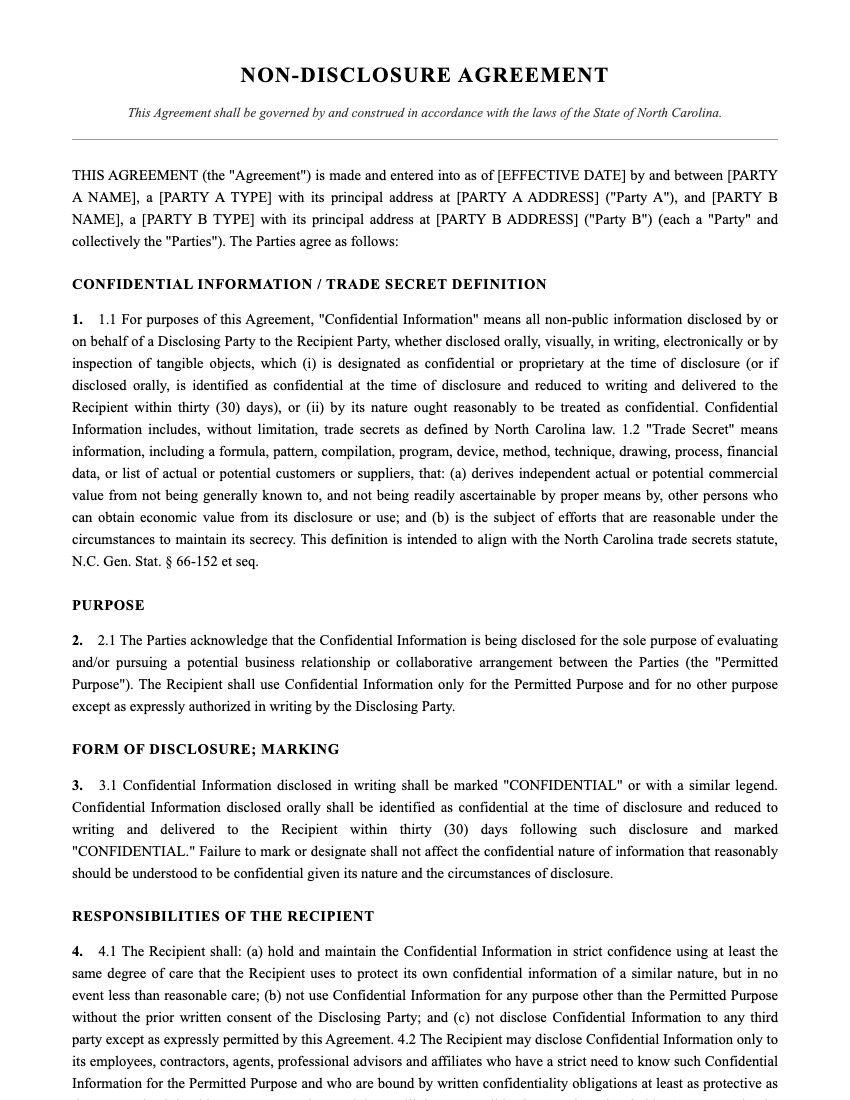
For a complete guide to NDA terms, duration, and standard exclusions, see our NDA Agreement Guide.
Why “Generic” NDAs Are Dangerous in North Carolina
Using a generic template from another state creates at least three local risks:
- Overbroad restraints that a North Carolina court will refuse to enforce — and that may jeopardize other clauses.
- Missing federal DTSA whistleblower language (important for recovering enhanced damages in federal trade secret suits). See 18 U.S.C. §1833(b).
- Clauses that attempt to bury or excuse unlawful conduct that could run afoul of the North Carolina Unfair and Deceptive Trade Practices Act (Chapter 75).
Paradigm-shifting insight: Don’t treat NC like California or Texas
North Carolina’s distinctive risk isn't a constitutional ban on non-competes (like California) nor a rigid consideration trap (like some Texas cases). The shift to internalize: NC will enforce reasonable restrictive covenants, but it treats NDAs as part of a larger statutory and public-policy landscape. Two consequences flow from that:
- Employers can and should use NDAs to forbid misuse of trade secrets, but they must avoid language that functions as an indefinite, territorial ban on competing; courts will scrutinize time/scope and consideration.
- NDAs used to silence whistleblowers or obscure unfair practices risk exposure under Chapter 75 and federal law. Even where a private contract seems to permit nondisclosure, statutory protections and public policy may render those provisions unenforceable.
This combined focus on reasonableness and public policy is the unique drafting challenge in North Carolina and what the template solves.
Real statutory touchstones and practice points
- Trade secrets: N.C.G.S. §66-152 et seq. (North Carolina’s Uniform Trade Secrets Act).
- Unfair practices: N.C.G.S. Chapter 75 (Unfair and Deceptive Trade Practices Act), which allows private suits and can affect confidentiality arrangements used to hide wrongful conduct.
- Time to sue on most contracts: three years under N.C.G.S. §1-52—be mindful of preservation timing when drafting notice and discovery triggers.
- Federal DTSA whistleblower notice: include the DTSA-prescribed notice to preserve eligibility for exemplary damages and fee-shifting in federal trade secret litigation (18 U.S.C. §1833(b)).
What’s Included in This Template? (Key Clauses)
- Purpose-limited confidentiality: Precise “Purpose” language to limit permissible uses and reduce scope disputes.
- Trade secret carve-out and indefinite protection: Distinguishes trade secrets (protected while secret under N.C.G.S. §66-152) from general confidential info (time-limited).
- Narrow non-use covenant: Prohibits use of disclosed confidential information for competitive advantage without imposing a blanket non-compete.
- Whistleblower/DTSA notice: Federal DTSA notice language required for enhanced remedies in federal court (18 U.S.C. §1833(b)).
- Exclusions: Information that is public, previously known, independently developed, or compelled by law.
- Remedies and injunctive relief: Recognizes North Carolina courts’ willingness to grant equitable relief for misappropriation while aligning remedies to avoid overbroad penalties.
Mutual vs. Unilateral options
- One-Way (Unilateral): For employers, startups pitching investors, or businesses sharing confidential specs.
- Mutual (Two-Way): For due diligence, JV talks, or collaboration where both sides exchange secrets.
Choose the narrower template that fits your transaction; overbroad mutual promises can create unnecessary obligations for a disclosing party.
Who Needs This Document?
| User Persona | Use Case | NC-specific Benefit |
|---|---|---|
| Manufacturing supplier | Sharing specs with a vendor | Protects tooling and formulae while allowing reasonable supplier competition clauses |
| Tech startup | Investor pitches or hiring engineers | Keeps IP confidential while avoiding unenforceable career restraints in NC courts |
| Employer | Hiring executives or sales reps | Limits improper solicitation of clients without imposing an invalid non-compete |
| Professional services firm | M&A due diligence | Protects valuation-sensitive data during buyer review with NC-friendly scope |
How to Execute a Valid North Carolina NDA
- Choose the right template: One-way if you’re disclosing only; mutual if both sides share.
- Be specific about Purpose: Narrow purpose reduces later disputes over permitted use.
- Mark documents and take secrecy steps: Label materials, use access controls, and document confidentiality practices—these “reasonable efforts” help qualify data as a trade secret under N.C.G.S. §66-152.
- Sign before sharing and specify governing law: Execute before disclosing and include North Carolina choice-of-law and forum provisions if desired. Electronic signatures are generally recognized (federal E-SIGN and state UETA implementations)—but an executed PDF or wet signature is best evidence.
Already Receiving NDAs from Clients?
Before signing, check for overbroad non-use clauses that function as non-competes, missing whistleblower notice (DTSA), or indemnities that attempt to waive statutory rights under Chapter 75. This template is written for NC practice but is not a substitute for tailored legal advice.
an AI contract review tool can automatically flag clauses that conflict with North Carolina law, call out missing DTSA notices, and compare incoming NDAs against this template to speed review.
Related NDA Templates
Get the Template
Sign up for our newsletter to receive the template.
Frequently Asked Questions

About Designer Content
Designer Content creates practical legal document resources for landlords, contractors, and small business owners. We simplify complex legal concepts into actionable guidance. Connect with us on LinkedIn.