
A North Dakota Master Services Agreement (MSA) is a contract used by North Dakota businesses and independent service providers to set reusable legal terms for ongoing or repeat projects. Instead of negotiating payment, liability, confidentiality, and IP rules every time, you sign one MSA and then attach a short Statement of Work (SOW) for each project. This helps agencies, consultants, and tech vendors move faster while keeping terms consistent. A North Dakota-specific template matters because state rules on contract timing, interest, and restrictive covenants can change what is enforceable.
Definition: A North Dakota Master Services Agreement (MSA) is a governing agreement between a “Provider” (the service business) and a “Client” that establishes baseline terms—scope framework, fees, confidentiality, intellectual property, warranties, limitation of liability, and dispute resolution—for a series of future services performed in North Dakota. Individual projects are documented through Statements of Work (SOWs) that describe deliverables, milestones, and pricing while incorporating the MSA by reference. This structure is common in B2B relationships because it reduces negotiation friction and provides predictable risk allocation and payment expectations for both parties.
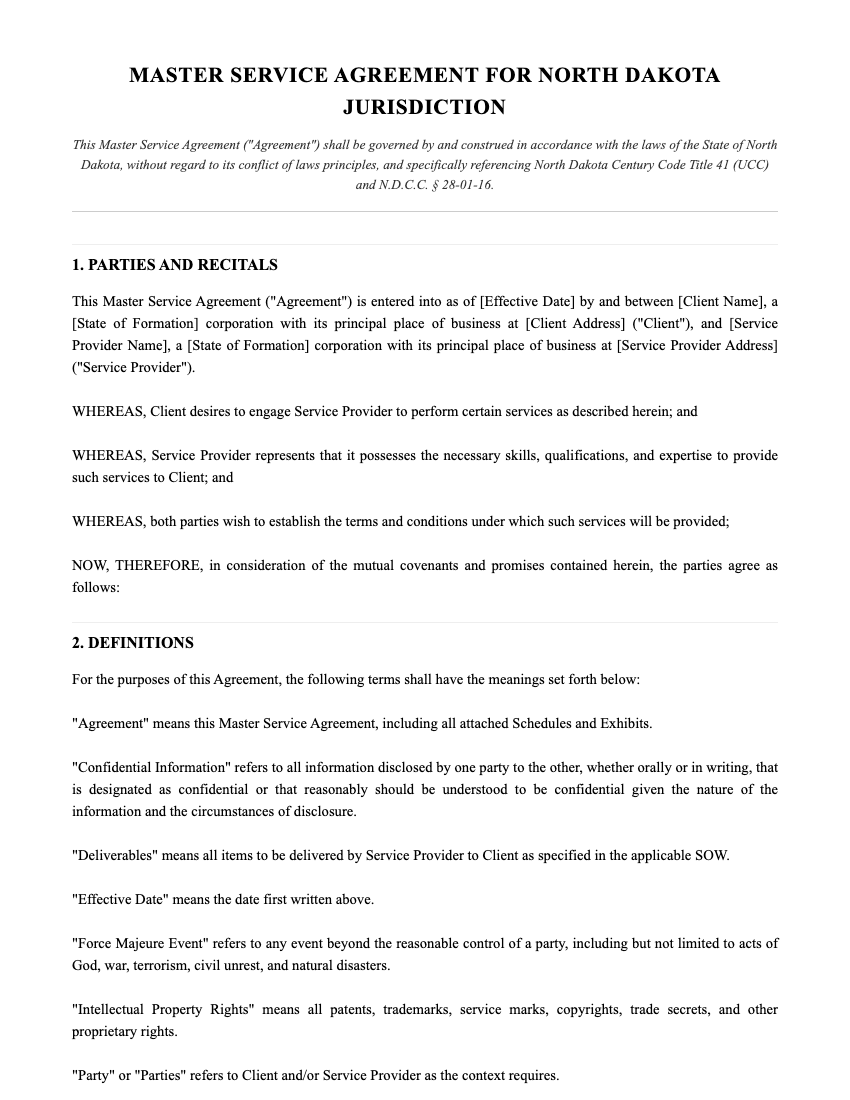
Why You Cannot Use a Generic MSA in North Dakota
A generic MSA downloaded online is usually written to be “50-state friendly,” which often means it is specific to no state at all. In practice, that can create enforceability gaps for North Dakota businesses—especially around worker classification, restrictive covenants, and intellectual property ownership. North Dakota courts generally enforce contracts as written, but only if the terms fit state statutes and public policy. When a clause is copied from another jurisdiction, it may be too broad, cite the wrong legal standards, or assume protections that North Dakota law does not provide.
One major reason to localize your MSA is timing. Contract disputes are often decided years after the work is completed. North Dakota’s statute of limitations for actions upon a written contract is six years under N.D.C.C. § 28-01-16. A template that assumes a longer window (or tries to shorten the period too aggressively) may set expectations that don’t match North Dakota reality. Similarly, late-payment interest language is frequently wrong: North Dakota has a statutory interest rate rule in N.D.C.C. § 47-14-05, and your MSA should align with it when you charge interest on unpaid invoices.
For a comprehensive guide to structuring MSAs and SOWs that protect your business, see our Freelancer Contracts Guide.
3a. Worker Classification Rules
North Dakota does not use California’s “ABC test” for most independent contractor decisions. Instead, worker classification is commonly analyzed using a right-to-control / common-law approach, focusing on whether the hiring party controls the manner and means of performance. For unemployment insurance purposes, North Dakota law provides guidance on what counts as “employment” and when services are excluded, including the definition of “employment” and covered services in N.D.C.C. § 52-01-01 (and related provisions in Title 52).
Why this matters for an MSA: if your template reads like an employment agreement (fixed schedule, mandatory daily supervision, required tools, exclusivity), it undercuts your “independent contractor” position. Misclassification can trigger back taxes, unemployment contributions, penalties, and disputes over who bears responsibility for workplace injuries or employment benefits. A North Dakota-focused MSA template should include (1) clear independent contractor status language, (2) responsibility for taxes and insurance, and (3) boundaries that preserve contractor autonomy while still allowing the client to define deliverables and deadlines. It should also avoid “control” language that contradicts how the relationship actually operates.
3b. Non-Compete Enforceability
Unlike states that broadly ban non-competes, North Dakota generally prohibits non-compete agreements. The core statute is N.D.C.C. § 9-08-06, which states that contracts restraining a person from exercising a lawful profession, trade, or business are void, subject to narrow statutory exceptions. Practically, this means a generic MSA that contains a standard “Provider shall not compete with Client for two years” clause is a red flag in North Dakota and may be unenforceable.
The better approach in a North Dakota MSA is to use enforceable alternatives that protect legitimate business interests without functioning as a blanket restraint on trade. Common substitutes include: (1) confidentiality and trade secret clauses, (2) non-solicitation provisions that are carefully drafted to protect customer relationships (and still should be reviewed for overbreadth), and (3) clear return/destruction of information obligations at termination. If you truly need restrictions, you should consult North Dakota counsel to determine whether an exception applies and whether the clause can be structured to fit within North Dakota’s statutory framework. In most B2B service relationships, strong confidentiality, data security, and IP ownership provisions accomplish the practical goals that parties mistakenly try to solve with a non-compete.
3c. IP/Work-for-Hire Considerations
North Dakota contract law generally allows parties to allocate intellectual property ownership by written agreement, but “work made for hire” is primarily a federal copyright concept. A North Dakota MSA should not rely on a bare “work for hire” sentence and assume the client automatically owns everything. The safer structure is: the provider retains pre-existing materials and tools, while project deliverables are assigned to the client upon full payment (or licensed, if that fits the deal). Clear assignment language reduces disputes over source files, code, templates, and reusable methods.
What’s Included in This Template
Flexible SOW Structure
This template uses the MSA as the umbrella agreement and keeps project details in SOWs. That lets you sign once, then add new projects with short SOWs that specify scope, pricing model, milestones, acceptance criteria, and change orders.
North Dakota-Specific Indemnification
Indemnification language is drafted for typical North Dakota B2B risk allocation: third-party claims, IP infringement allegations, and confidentiality breaches. It also includes practical carve-outs so indemnity does not become a backdoor “insurance policy” for a party’s own misconduct.
Dispute Resolution and Venue
The template includes an option for North Dakota venue (state court) or arbitration language consistent with North Dakota’s arbitration framework (see N.D.C.C. ch. 32-29.3). Choosing ND venue helps SMBs avoid litigating in a distant forum.
Additional North Dakota provisions included (with citations):
- Contract timing awareness: 6-year limitations period for written contracts (N.D.C.C. § 28-01-16)
- Late-payment interest alignment (N.D.C.C. § 47-14-05)
- Consumer-fraud sensitivity for mixed B2B/B2C offerings (N.D.C.C. § 51-15-01 et seq.)
- Optional waiver language tailored to ND’s waiver-of-unknown-claims statute (N.D.C.C. § 32-03-39)
Who Needs This Document?
| User Type | Relationship | Key Benefit |
|---|---|---|
| Marketing agencies | Retainers + recurring campaigns | Faster SOW approvals and consistent payment/ownership terms |
| IT/MSP providers | Ongoing support + projects | Clear service levels, limits of liability, and ND dispute venue |
| Consultants | Advisory and implementation | Controls scope creep through change orders and acceptance steps |
| Software/dev shops | Builds and integrations | IP assignment or licensing tied to payment and delivery |
How to Use This MSA Template
Step 1: Identify the parties correctly
Use the exact legal names (LLC/Inc./individual) and ND registered addresses. If you use a DBA, list the legal entity and then the DBA to avoid signature and collection issues.
Step 2: Choose your payment and late-fee structure
Set invoice timing, approval process, and interest for late payments consistent with N.D.C.C. § 47-14-05. If you charge a fixed late fee, keep it reasonable and explain it clearly.
Step 3: Attach the first SOW
Put deliverables, timeline, assumptions, and acceptance testing in the SOW, not the MSA. This makes future projects easier: you reuse the MSA and just swap in a new SOW.
Step 4: Pick dispute resolution
Decide whether you want North Dakota courts or arbitration (see N.D.C.C. ch. 32-29.3). For many SMBs, ND venue is the simplest way to control costs and travel.
Related MSA Templates
Get the Template
Sign up for our newsletter to receive the template.
Frequently Asked Questions

About Designer Content
Designer Content creates practical legal document resources for landlords, contractors, and small business owners. We simplify complex legal concepts into actionable guidance. Connect with us on LinkedIn.