
A North Dakota Non-Disclosure Agreement (NDA) is a written contract that limits use and disclosure of confidential information while respecting North Dakota’s long-standing public policy against restraints on trade. NDAs are perfectly enforceable in North Dakota when they protect legitimate trade secrets and confidential information, but they cannot be used as a backdoor to restrict someone’s right to work in a lawful profession under N.D.C.C. § 9‑08‑06.
What is a North Dakota NDA?
Definition: A North Dakota NDA is an agreement that requires a receiving party to keep specified information confidential and to use it only for an expressly stated purpose. The NDA should define "Confidential Information" and, where applicable, distinguish "Trade Secrets" as defined by the North Dakota Uniform Trade Secrets Act (N.D.C.C. ch. 47‑25.1).
Key statutory anchors:
- Non‑compete prohibition: N.D.C.C. § 9‑08‑06 (prohibits contracts restraining anyone from exercising a lawful profession, trade, or business). The ban dates to 1865 and remains one of the strictest in the United States.
- Trade secrets: North Dakota adopted the Uniform Trade Secrets Act; see N.D.C.C. ch. 47‑25.1 for definitions and remedies.
- Written contract limitations: actions on written contracts are governed by the six‑year limitation in N.D.C.C. § 28‑01‑16 (consult counsel for precise accrual rules).
For a complete guide to NDA terms, duration, and standard exclusions, see our NDA Agreement Guide.
Why generic NDA templates are dangerous in North Dakota
Most online NDA generators are written for jurisdictions that allow restraints on competition. Using those templates in North Dakota risks three problems:
- Backdoor non‑competes: Common protective phrases like "Receiving Party shall not use Confidential Information to compete with Disclosing Party" can be read as employment restraints. Under N.D.C.C. § 9‑08‑06, such language risks being void as a restraint on trade or—worse—having the court refuse to enforce parts of the agreement.
- Missing DTSA notice: The federal Defend Trade Secrets Act (DTSA) (18 U.S.C. § 1833(b)) creates a whistleblower‑immunity requirement. If you want access to certain federal remedies (enhanced damages, attorneys’ fees), include DTSA notice that the recipient may disclose trade secrets to a government official or in a court filing under certain conditions.
- Overbroad definitions: Labeling routine business information as a "trade secret" invites courts to refuse protection. North Dakota law expects reasonable specificity and demonstrable secrecy efforts under N.D.C.C. ch. 47‑25.1.
Paradigm‑shifting insight (North Dakota): The non‑compete ban in North Dakota is not new experimentation—it is a foundational public‑policy rule dating from 1865. That historical depth makes two practical consequences unique to ND: (a) ND courts are particularly reluctant to allow choice‑of‑law provisions to be used as an end‑run around § 9‑08‑06 when the parties or the subject matter have significant ND ties; and (b) employers cannot rely on venue or forum selection clauses to impose out‑of‑state restraints if the employee relationship is primarily rooted in North Dakota. In short: do not assume a governing‑law clause will resurrect a restraint that § 9‑08‑06 forbids.
Real development to watch
North Dakota’s non‑compete statute remains one of the earliest and clearest bans in the U.S. While there is less high‑profile litigation in ND than in larger states, the combination of an old statutory ban and modern trade secret law means litigants more often frame disputes as trade‑secret misappropriation under N.D.C.C. ch. 47‑25.1 and federal DTSA rather than as contract enforcement of restraints. When drafting an NDA for ND parties or ND‑based work, structure protection around identifiable information and secrecy measures—not employment restraints.
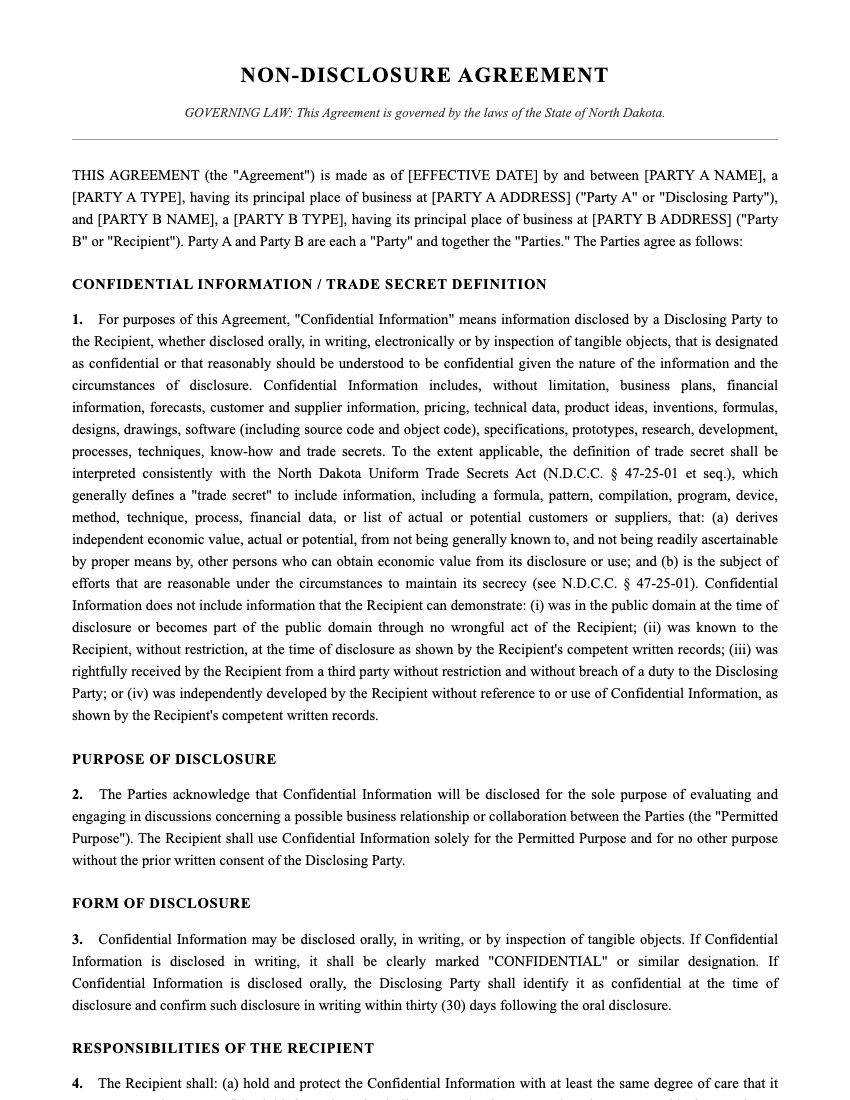
What’s included in this North Dakota template (key clauses)
- Purpose clause: narrowly limits permitted uses (e.g., "evaluating a potential supply agreement for Project X").
- Confidential Information definition: tiered definitions distinguishing general confidential business information (time‑limited protection) and trade secrets (indefinite protection so long as secrecy is maintained), aligned with N.D.C.C. ch. 47‑25.1.
- Exclusions: public domain, prior knowledge, independent development, compelled disclosures—standard carve‑outs expected by ND courts.
- No restraint language: explicit language stating that the NDA is not intended to operate as a non‑compete or to restrict employment, to avoid any implication of an illegal restraint under N.D.C.C. § 9‑08‑06.
- DTSA/whistleblower notice: a short notice preserving federal remedies under 18 U.S.C. § 1833(b).
- Remedies: injunctive relief for trade‑secret misappropriation and recovery for actual damages; preserve statutory remedies under N.D.C.C. ch. 47‑25.1 and federal law.
- Choice of law: an express ND‑sensitive clause that selects governing law but recognizes public policy limits of N.D.C.C. § 9‑08‑06 (see drafting note inside template).
Who needs this document?
| User Persona | Usage Scenario | Key North Dakota Benefit |
|---|---|---|
| Farmers & Agritech Startups | Sharing proprietary crop data with a consultant | Protects field‑specific algorithms without chilling contractor work choices |
| Energy & Pipeline Vendors | Due diligence for supply contracts | Protects engineering specs while avoiding enforceable employment restraints |
| Small Manufacturers | Sending designs to local fabricators | Keeps designs secret; clarifies you won’t try to limit the maker’s future business |
| Professional Service Firms | Hiring independent contractors | Protects client lists and processes without imposing forbidden post‑work restraints |
How to execute a valid North Dakota NDA
Step 1: Choose One‑Way or Mutual. Use One‑Way when only you disclose; use Mutual for joint projects. Selecting the right form limits unintended promises.
Step 2: Define the Purpose. Be specific—"Evaluating potential software services for Disclosing Party’s agricultural yield analytics"—and limit use accordingly.
Step 3: Show reasonable secrecy efforts. Label documents "CONFIDENTIAL," restrict access, and keep an access log. These measures help establish trade‑secret status under N.D.C.C. ch. 47‑25.1.
Step 4: Sign before sharing. Use a signed PDF or an electronic signature compliant with the Uniform Electronic Transactions Act principles; do not disclose secret information until all parties have executed the NDA.
If a client sends you an NDA, watch for disguised restraints (any clause that curtails the recipient’s ability to work) and missing DTSA notice. an AI contract review tool can flag risky language and compare the clause against North Dakota law in seconds.
Related NDA Templates
Get the Template
Sign up for our newsletter to receive the template.
Frequently Asked Questions

About Designer Content
Designer Content creates practical legal document resources for landlords, contractors, and small business owners. We simplify complex legal concepts into actionable guidance. Connect with us on LinkedIn.