
A Ohio Master Services Agreement (MSA) is a reusable contract that sets the legal “ground rules” for ongoing service work performed in Ohio, while each specific project is documented in a separate Statement of Work (SOW). For Ohio SMBs, consultants, agencies, and freelancers, the MSA/SOW structure speeds up sales cycles, reduces renegotiation, and makes payment, scope changes, IP ownership, and disputes far clearer than relying on email threads. The key is that Ohio law matters: late-payment interest, limitation periods, and enforceability of restrictive covenants can vary from other states.
Definition: A Ohio Master Services Agreement is a written contract between a service provider and a client that governs a series of current and future service engagements where the parties expect repeat work. The MSA sets the baseline terms—payment, invoicing, confidentiality, intellectual property, warranties, risk allocation, and dispute resolution—while each engagement’s deliverables, timeline, and pricing are placed into one or more SOWs that incorporate the MSA by reference. In Ohio, this structure is especially useful because written contracts have an eight-year statute of limitations (Ohio Revised Code § 2305.06), and because late-payment interest can be claimed under Ohio Revised Code § 1343.03 when the agreement is properly drafted.
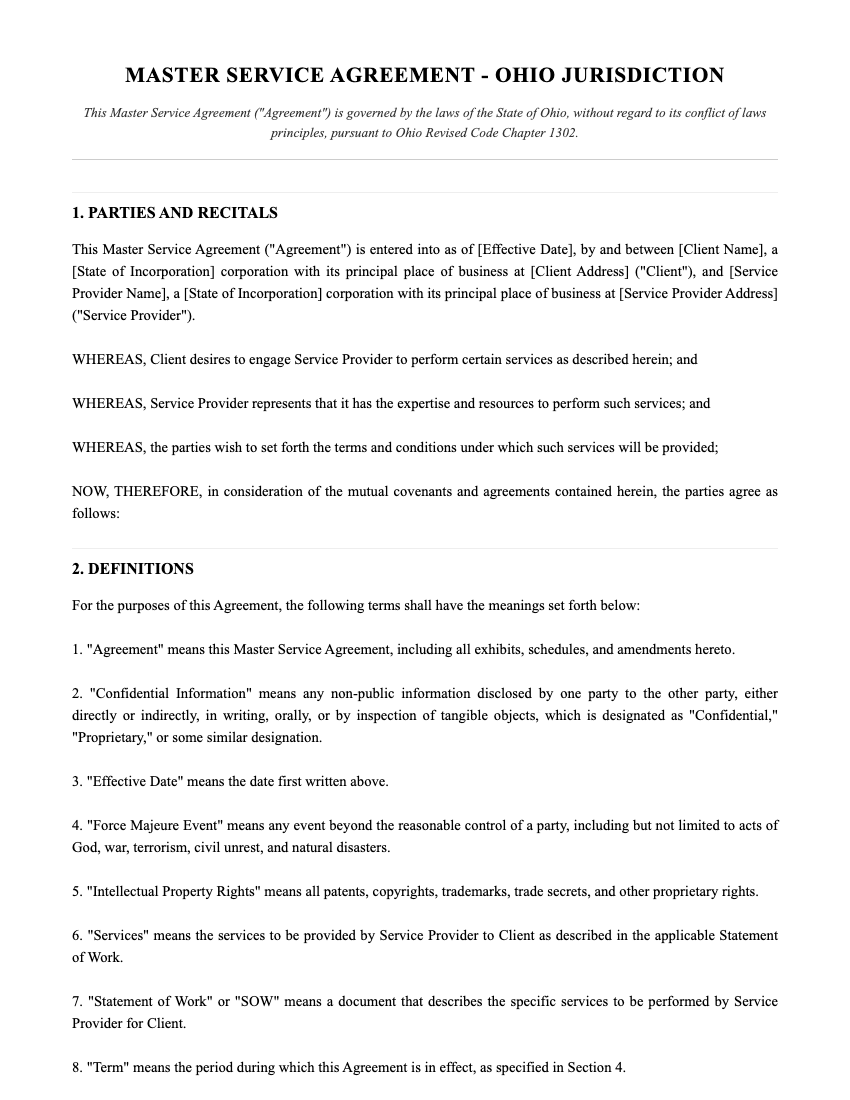
Why You Cannot Use a Generic MSA in Ohio
A “generic” MSA template is usually written to be broadly acceptable across the U.S. That sounds convenient, but it often fails in practical Ohio situations: local hiring models (employees vs. independent contractors), enforceability of non-competes, and IP ownership rules can turn a standard clause into an expensive dispute. Ohio is a common-law state where courts look closely at reasonableness, the parties’ conduct, and the contract’s exact wording. A template that defaults to “Delaware law,” vague payment terms, or overbroad restrictions may be hard to enforce—or may create compliance risk you didn’t expect.
3a. Worker Classification Rules
Ohio does not use California’s “ABC test” as a universal rule for all contexts; instead, worker classification is largely driven by common-law control factors, with specific statutory guidance in the unemployment and workers’ compensation frameworks. For unemployment, Ohio’s test is framed around “employment” and the right to direction and control under Ohio Revised Code § 4141.01(B). In workers’ compensation, Ohio Revised Code § 4123.01 defines covered employment relationships, and misclassification disputes commonly arise when a business treats a controlled worker as a contractor while directing hours, tools, or methods.
For a comprehensive guide to structuring MSAs and SOWs that protect your business, see our Freelancer Contracts Guide.
Why this matters in an Ohio MSA: a generic contract might declare “independent contractor” status but then include operational terms that look like employment (set schedules, mandatory meetings, exclusive service, or detailed supervision). If a worker is reclassified, your costs can include back unemployment contributions, interest, and penalties administered through the Ohio Department of Job and Family Services (ODJFS), plus potential exposure in wage-and-hour disputes. Your Ohio-ready MSA should align the legal label (independent contractor) with reality: the SOW should define deliverables and deadlines, not day-to-day control. It should also clarify tax responsibility, benefits, insurance, and the contractor’s right to serve other clients.
3b. Non-Compete Enforceability
Ohio generally enforces non-compete agreements, but only if they are reasonable and no broader than necessary to protect legitimate business interests. The leading Ohio authority is the Ohio Supreme Court’s decision in Raimonde v. Van Vlerah, 42 Ohio St.2d 21 (1975), which holds that courts may enforce reasonable restrictions and may “blue pencil” (modify) overbroad terms to make them reasonable rather than voiding the clause entirely.
A generic MSA often drops in an aggressive non-compete (e.g., “no competing anywhere in the U.S. for two years”). In Ohio, that can invite litigation and judicial rewriting you cannot predict. A better Ohio-specific approach is to tailor any restrictive covenant to (1) a legitimate protectable interest—like trade secrets, customer relationships, or specialized training—(2) a reasonable duration (often measured in months, not years, depending on role), (3) a reasonable geographic scope (tied to the actual market served), and (4) a reasonable scope of prohibited activities (limited to what the worker actually did).
If your relationship is B2B (agency-to-company) rather than employer-to-employee, consider whether a “non-solicitation” clause or confidentiality/trade secret protections accomplish the business goal with less enforceability risk. Ohio has adopted the Uniform Trade Secrets Act at Ohio Revised Code § 1333.61 et seq., which supports strong contractual confidentiality provisions and legal remedies when trade secrets are misused. A good Ohio MSA template uses non-competes carefully (when appropriate) and leans on narrower, more defensible tools: confidentiality, non-solicitation of customers, and return/destruction of confidential information.
3c. IP/Work-for-Hire Considerations
Ohio MSAs frequently involve copyrightable work (software, designs, copy, and marketing assets). Copyright “work made for hire” is primarily a federal concept under 17 U.S.C. § 101, and many generic templates misuse it. In practice, if the provider is an independent contractor, work-for-hire only applies in limited categories and with a proper written agreement—otherwise, the contractor owns copyright by default until rights are assigned.
An Ohio-focused MSA should clearly choose an IP model: (1) client ownership via an express assignment upon payment, or (2) provider ownership with a license to the client. If your SOW includes third-party components or pre-existing tools, the MSA should carve out “Background IP” to avoid accidentally transferring what you never intended to sell.
What’s Included in This Template
Flexible SOW Structure: The template treats the MSA as the umbrella agreement and uses SOWs to define scope, milestones, and pricing. This keeps the legal terms consistent across projects while letting you add work quickly—without renegotiating confidentiality, IP, or liability every time a new initiative starts.
Ohio-Specific Indemnification: Indemnity language is drafted to be practical for Ohio service relationships: it distinguishes third-party claims (where indemnity is most useful) from ordinary contract disputes, and it pairs indemnity with clear limits, insurance expectations, and carve-outs for a party’s gross negligence or willful misconduct.
Dispute Resolution and Venue: The template includes Ohio governing law language and a venue selection that keeps disputes in Ohio courts (or a specified Ohio county). This matters when the other party’s form contract defaults to another state, increasing travel, cost, and uncertainty.
Additional Ohio-ready provisions include:
- Late-payment interest aligned to Ohio Revised Code § 1343.03 (set expectations for interest on overdue amounts).
- Written-contract statute of limitations awareness under Ohio Revised Code § 2305.06 (supporting good recordkeeping and survival clauses).
- Consumer-protection guardrails: Ohio Consumer Sales Practices Act, Ohio Revised Code § 1345.01 et seq. (important if any work could be viewed as consumer-facing, even if your intent is B2B).
- Data-privacy and security program alignment: Ohio Revised Code § 1354.01 et seq. (safe-harbor style framework for written cybersecurity programs).
- UCC awareness for mixed goods/services deals under Ohio Revised Code Chapter 1302 (helpful when an SOW includes hardware or tangible deliverables).
Who Needs This Document?
| User Type | Relationship | Key Benefit |
|---|---|---|
| Marketing agencies | Retainers and campaign SOWs | Controls scope creep, approvals, and reuse of creative assets |
| IT managed service providers | Ongoing support + project work | Standardizes SLAs, change orders, and liability limits |
| Software/dev freelancers | Milestone-based builds | Clear IP assignment on payment and acceptance workflow |
| Business consultants | Advisory engagements | Defines deliverables vs. “ongoing advice,” protects confidentiality |
How to Use This MSA Template
Step 1: Identify the parties correctly
Use the exact legal names and entity types (LLC, corporation, sole proprietor) and an Ohio address for notice. If the client is out-of-state, list a reliable notice address and email to avoid “we never received it” disputes.
Step 2: Keep project details in the SOW
Put deliverables, timelines, dependencies, and acceptance criteria in the SOW—not the MSA. This keeps the MSA stable while letting you swap in new SOWs as the relationship evolves.
Step 3: Set payment and late-fee expectations
Specify invoice timing, due dates, reimbursable expenses, and what happens if payment is late. If you want interest on overdue amounts, align your clause with Ohio Revised Code § 1343.03 and apply it consistently.
Step 4: Sign once, then reuse
Have both parties sign the MSA, then issue SOWs for each new project. The MSA should state that each SOW incorporates the MSA by reference and resolves conflicts in a clear order of precedence.
Related MSA Templates
Get the Template
Sign up for our newsletter to receive the template.
Frequently Asked Questions

About Designer Content
Designer Content creates practical legal document resources for landlords, contractors, and small business owners. We simplify complex legal concepts into actionable guidance. Connect with us on LinkedIn.