
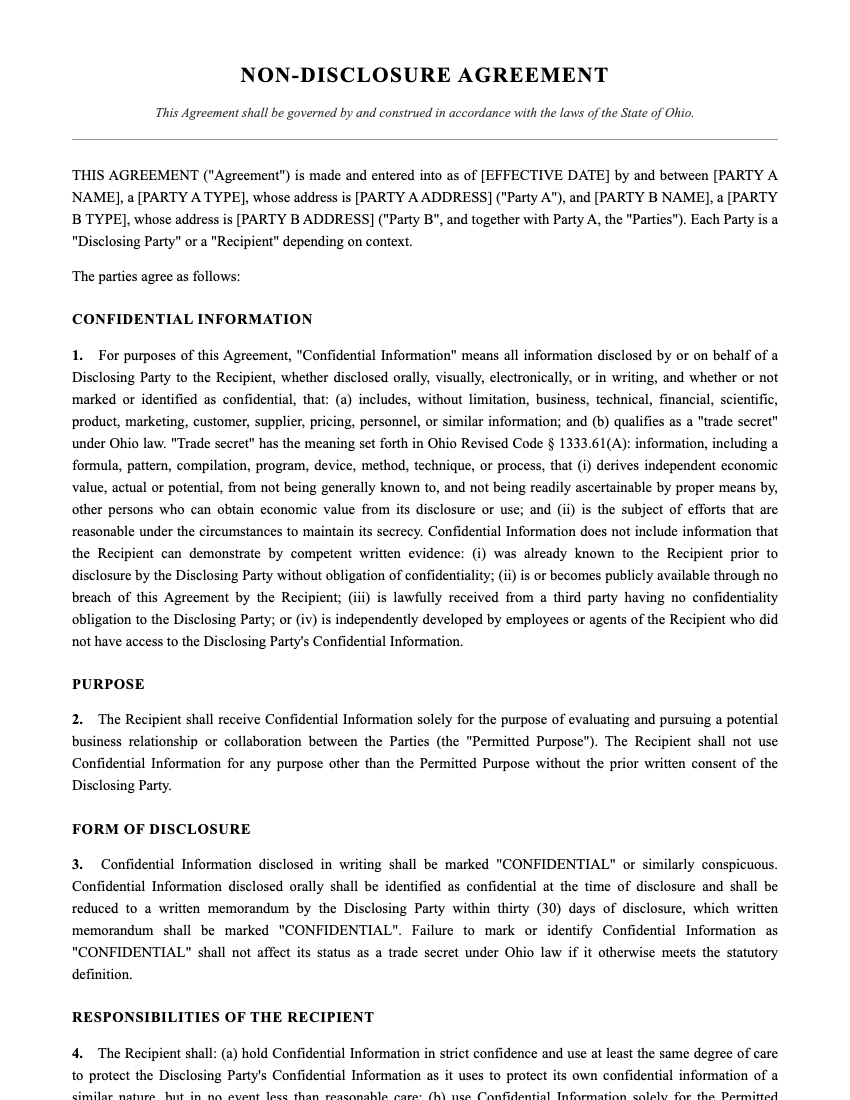
An Ohio Non-Disclosure Agreement (NDA) is a contract that protects confidential information and trade secrets while reflecting Ohio's legal standards: trade secrets under Ohio Rev. Code §1333.61 et seq., generally enforceable restraints under a reasonableness standard, and federal DTSA notice obligations for whistleblower disclosures.
What Is an Ohio NDA?
Definition: An Ohio Non-Disclosure Agreement is a written commitment between parties to keep certain information confidential. In Ohio the legal protection for trade secrets is codified in the Ohio Uniform Trade Secrets Act (Ohio Rev. Code §1333.61 et seq.), and courts will enforce confidentiality and related restraints so long as they protect a legitimate business interest and are reasonable in scope, geography, and duration.
An important practical distinction: unlike California, Ohio does not treat non-competes as per se void. Ohio courts routinely enforce restrictive covenants when an employer shows a protectable interest—customer relationships, trade secrets, or specialized training—and the restraint is reasonable.
For a complete guide to NDA terms, duration, and standard exclusions, see our NDA Agreement Guide.
Why Generic NDAs Are Dangerous in Ohio
Templates written for other states can be risky in Ohio for three distinct reasons.
Overbroad “confidentiality” clauses can operate like enforceable non-competes
Because Ohio enforces restraints subject to reasonableness, a broad NDA that effectively prevents a recipient from working in the same field may be enforced—sometimes more eagerly than you expect. A template that bars “use of Confidential Information to compete” without limiting scope, duration, or purpose can morph into a restraint Ohio courts will uphold, producing unexpected exposure for employees or contractors.
Paradigm-shifting insight (Ohio): In Ohio the real trap is the opposite of California. Instead of voiding backdoor non-competes, Ohio may enforce them—so sloppy or overreaching NDA language can grant employers a de facto competitive advantage. That means drafters must carefully calibrate purpose, time, and scope: overly broad NDAs can both be enforced and litigated, creating unexpected liability and business risk.
- Missing DTSA whistleblower notice
At the federal level, the Defend Trade Secrets Act (DTSA, 18 U.S.C. §1833(b)) permits trade-secret claims in federal court and conditions enhanced damages and attorneys’ fees on providing certain whistleblower notice in the NDA. Even in Ohio, failing to include the DTSA notice (per 18 U.S.C. §1833(b)) can foreclose recovery of exemplary damages and fees in a federal trade-secret suit.
- Statute of limitations and contract survival
Ohio affords a long statute of limitations for written contracts: ORC §2305.06 provides a 15-year period for written causes of action. That means written NDAs can trigger long-lived obligations and exposures—so be clear about survival clauses and limitations. Also consider UCC and commercial contract rules (see Ohio Rev. Code chapter 1302) when NDAs intersect with licensing or sale of goods.
Real legal development to watch
The 2016 federal DTSA changed enforcement nationwide and has had direct effects in Ohio federal courts: employers now routinely plead federal trade-secret claims alongside state-law claims. In Ohio, practitioners have adjusted NDAs to include the DTSA notice and specific procedures for compelled disclosures. The practical effect: if you want full remedies for trade-secret theft, your NDA must combine state-law trade-secret definitions (ORC §1333.61) with the DTSA notice.
Key Clauses (Ohio-focused)
- Purpose and Narrow Use: Limit the recipient’s permitted uses to a specific business purpose (e.g., evaluating a distribution agreement for Product X). Avoid blanket “do not compete” language unless you intend to create an enforceable restraint.
- Trade Secret Definition: Use the Ohio statutory definition (Ohio Rev. Code §1333.61) and require reasonable secrecy measures (access limitations, marked documents, password controls) so the information qualifies as a trade secret.
- Duration: For non-secret confidential business information, choose a fixed term (commonly 1–5 years). For trade secrets, protect them so long as they remain secret (indefinitely). Given ORC §2305.06, decide whether any contractual obligations should terminate earlier.
- Narrow Non-Use/Non-Disclosure: Prohibit use of Confidential Information except for the defined Purpose. Avoid broad prohibitions on competitive activity unless you include geographic and temporal limits and consideration where required.
- DTSA Whistleblower/Authorized Disclosure Notice: Include the DTSA disclosure notice required by 18 U.S.C. §1833(b) (employees may report suspected violations to government officials or make protected disclosures under certain conditions) to preserve access to enhanced federal remedies.
- Carve-Outs: Exclude information already public, independently developed, already known by recipient, or compelled by law (with a notice-and-cooperate requirement).
- Remedies, Injunctive Relief, and Choice of Law: Specify injunctive remedies but be realistic: Ohio courts weigh equities. Include governing law (Ohio Rev. Code references if you want Ohio law) and a clear venue clause.
Who Needs This Document?
| User Persona | Usage Scenario | Key Benefit |
|---|---|---|
| Ohio tech startups (Columbus, Cleveland) | Sharing prototypes with contractors | Protects source code and designs while allowing developers to continue working elsewhere with limited restrictions |
| Manufacturers (Midwest supply chain) | Factory or OEM conversations | Protects drawings and processes; narrow duration to avoid overly broad restraints |
| Small businesses selling to regional buyers | M&A / due diligence | Allows due diligence while preserving trade-secret protection under ORC §1333.61 |
| Service firms and consultants | Sharing client lists or processes | Protects customer relationships where courts recognize legitimate interest |
How to Execute an Enforceable Ohio NDA
- Choose the right type (one-way vs mutual)
- Define the Purpose precisely and limit permitted uses
- Mark documents and adopt reasonable security measures to preserve trade-secret status under ORC §1333.61
- Execute before sharing; use clear signatures (electronic signatures are valid under the federal E-SIGN Act and Ohio’s electronic signature practices)
Practical tip: If the relationship involves an employee, ensure the NDA is supported by appropriate consideration—continued employment, special access, or other bargained-for benefits—since courts evaluate the employment context closely.
Receiving an NDA from a Client?
If a client sends you an Ohio-form NDA, review it for overbroad non-use language, indefinite survival of obligations, or missing DTSA notice. an AI contract review tool can instantly flag risky provisions, compare terms against Ohio statutory frameworks (ORC §1333.61; ORC §2305.06), and suggest precise redlines.
Related NDA Templates
Get the Template
Sign up for our newsletter to receive the template.
Frequently Asked Questions

About Designer Content
Designer Content creates practical legal document resources for landlords, contractors, and small business owners. We simplify complex legal concepts into actionable guidance. Connect with us on LinkedIn.