
Opening
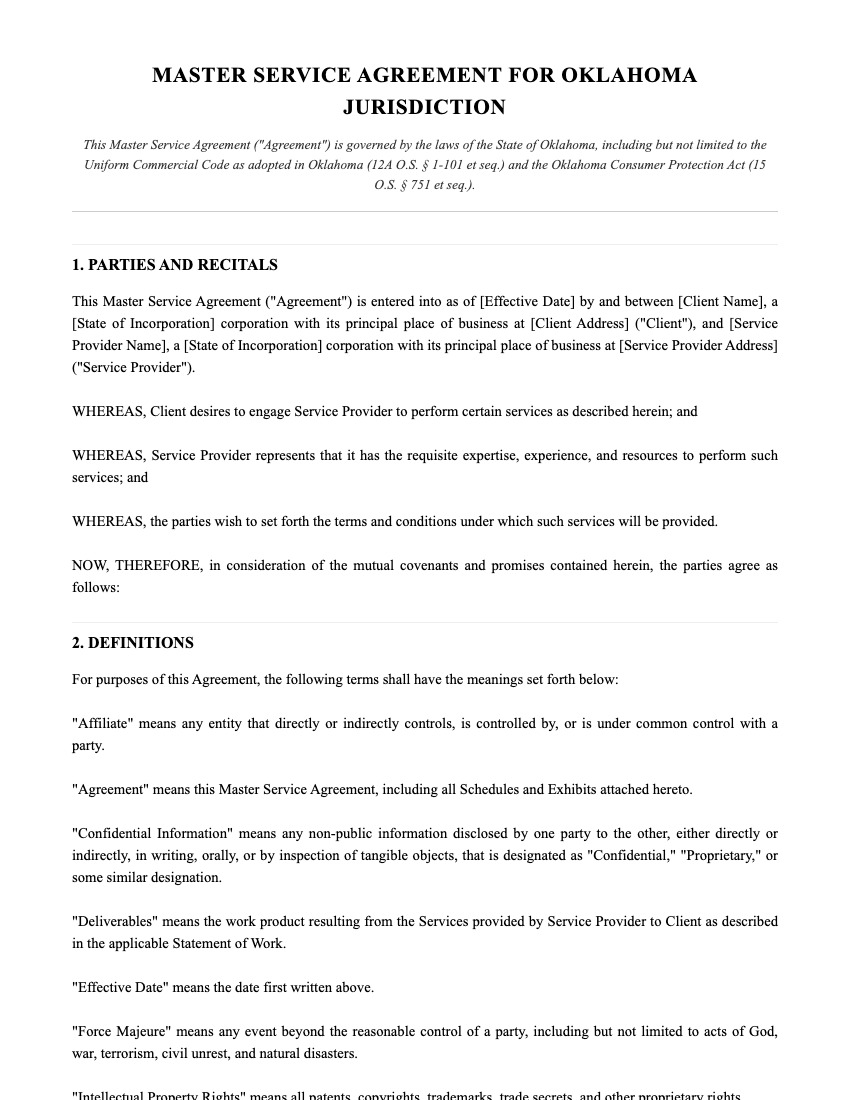
An Oklahoma Master Services Agreement (MSA) is a reusable contract that sets the core legal terms for ongoing service work performed for a client in Oklahoma. Instead of renegotiating payment, liability, confidentiality, and IP on every project, you sign one MSA and attach a Statement of Work (SOW) each time you start new work. If you operate in Oklahoma, a state-specific MSA helps you avoid unenforceable restrictive covenants, worker misclassification risk, and venue/choice-of-law surprises.
For a comprehensive guide to structuring MSAs and SOWs that protect your business, see our Freelancer Contracts Guide.
Definition Box
Definition: An Oklahoma Master Services Agreement is the “umbrella” contract between a service provider and a client that establishes the baseline rules for all current and future projects governed by Oklahoma law. The MSA typically covers pricing mechanics, invoicing, late-payment interest, confidentiality, ownership of deliverables, indemnification, limitation of liability, and where disputes must be resolved. Each project is then described in a separate Statement of Work (SOW) with the scope, milestones, timeline, and fees. In Oklahoma, drafting these clauses correctly matters because restrictive covenants are narrowly regulated (15 O.S. § 219A) and contract timing can affect enforceability and risk.
Why You Cannot Use a Generic MSA in Oklahoma
Generic MSAs often assume rules that are true in other states but wrong—or risky—in Oklahoma. The biggest problems show up in worker classification language, non-compete provisions, and IP clauses that don’t match how Oklahoma courts and statutes treat restrictive covenants and business-to-business relationships.
Worker Classification Rules
Oklahoma does not use California’s AB 5 “ABC test” as a default for all contracting. Instead, classification is typically analyzed under a right-to-control/common-law approach used by agencies and courts: the more the client controls how the work is done (hours, methods, tools, supervision), the more likely the person is an employee rather than an independent contractor. For unemployment tax issues, Oklahoma’s Employment Security Commission uses statutory definitions and applies a control-focused analysis under the Oklahoma Employment Security Act (40 O.S. §§ 1-101 et seq.). Misclassification can create cascading exposure: unpaid employment taxes, unemployment contributions, wage claims, and potential penalties depending on the agency involved. A generic MSA that promises “independent contractor” status without operational safeguards (no set hours, contractor supplies tools, ability to work for others) can backfire. A strong Oklahoma MSA should pair status language with practical control-limiting provisions and require the contractor to handle their own taxes and insurance.
Non-Compete Enforceability
Oklahoma is one of the strictest states on traditional non-compete clauses in ordinary service contracts. Under 15 O.S. § 219A, an employer generally may not prohibit a former employee from working for a competitor; the statute allows only narrow restrictions that prevent a former employee from soliciting established customers of the former employer. Broad “no competition” language (e.g., “Contractor shall not provide similar services anywhere in the U.S. for two years”) is a common generic-template clause—and it is a red flag in Oklahoma.
For B2B MSAs with freelancers, consultants, and agencies, the safer (and typically enforceable) alternatives are: (1) a confidentiality and trade secret clause, (2) a non-solicitation of customers clause drafted to mirror the limits of 15 O.S. § 219A, and (3) a non-interference clause covering poaching of employees or subcontractors if narrowly tailored. If you truly need restrictions, keep them tied to customer solicitation and clearly define “established customers” and the time window.
IP/Work-for-Hire Considerations
Many generic MSAs overuse “work made for hire” language. Under U.S. copyright law, “work made for hire” is limited (17 U.S.C. § 101), and many service deliverables won’t qualify unless they fit a statutory category and there is a written agreement. In Oklahoma service relationships, the cleaner approach is usually: the provider retains pre-existing tools and know-how, while assigning deliverable IP upon payment through an express assignment clause. Your MSA should also address open-source components, portfolio rights, and a license-back if the provider needs reusable components.
What's Included in This Template
Flexible SOW Structure
This Oklahoma MSA template uses a two-part structure: the MSA for legal terms and a short SOW for each project’s scope, milestones, and pricing. That helps prevent “scope creep” because anything not in the SOW is either excluded or treated as a change order with new fees.
Oklahoma-Specific Indemnification
The indemnity language is written for typical B2B service risks: third-party claims tied to infringement, bodily injury/property damage, and each party’s negligence or willful misconduct. It pairs indemnity with insurance expectations and a duty-to-cooperate process so claims are handled quickly and predictably.
Dispute Resolution and Venue
The template sets a clear choice-of-law and venue clause designed to keep disputes in Oklahoma (often Oklahoma County/Oklahoma City). For transactions involving the UCC, choice-of-law principles can be informed by 12A O.S. § 1-301, which permits parties to choose governing law within defined limits.
Additional Oklahoma-ready provisions include:
- Late-payment interest aligned with 15 O.S. § 266 (ensure your rate and notice are consistent with the statute and your invoice terms).
- Written-contract limitation period awareness under 12 O.S. § 95 (commonly five years for written contracts; confirm the applicable subsection for your claim type).
- Consumer-facing carve-out referencing the Oklahoma Consumer Protection Act, 15 O.S. § 751 et seq. (important if any work could be construed as consumer-directed).
Who Needs This Document?
| User Type | Relationship | Key Benefit |
|---|---|---|
| Marketing agencies | Ongoing campaigns with OK businesses | Faster new-project launches using SOWs |
| IT managed service providers (MSPs) | Monthly support + project work | Clear uptime limits and liability caps |
| Freelance consultants | Advisory retainers | Scope control and payment protections |
| Software/dev shops | Build + maintenance phases | IP assignment upon payment and reuse rules |
How to Use This MSA Template
Step 1: Fill in the parties correctly
Use the exact legal names (LLC/Inc.) and addresses. If you’re an Oklahoma entity, match your Secretary of State registration and sign with the correct title.
Step 2: Set the commercial terms framework
Define invoicing cadence, due dates, late charges, and reimbursable expenses. Align any late-payment interest with 15 O.S. § 266 and keep invoice language consistent.
Step 3: Attach your first SOW
Put deliverables, milestones, acceptance criteria, and fees in the SOW—not the MSA. If scope changes, use a written change order to protect both sides.
Step 4: Sign once, reuse often
After signature, future work is documented through new SOWs only. The MSA’s confidentiality, IP, indemnity, and dispute terms automatically apply.
Already Receiving Contracts from Clients?
If you’re a provider, you’ll often be asked to sign the client’s MSA instead of using yours. That’s where Oklahoma-specific issues hide: a broad non-compete that conflicts with 15 O.S. § 219A, an out-of-state venue clause, or IP terms that assign your pre-existing tools. Before signing, compare the client’s paper to your risk tolerance and your delivery model. For a fast clause-by-clause triage, use an AI contract review tool.
Download Options
Free PDF Version: Best for reading, printing, or sharing with a counterparty for markup.
Editable Word/Google Docs Version: Best for customizing defined terms, SOW language, and negotiation fallback positions. Includes an SOW template and optional exhibits (confidentiality, security, and subcontractor terms).
Disclaimer
This template is general information, not legal advice. For advice about your Oklahoma contract, consult an Oklahoma-licensed attorney for your situation.
Related MSA Templates
Get the Template
Sign up for our newsletter to receive the template.
Frequently Asked Questions

About Designer Content
Designer Content creates practical legal document resources for landlords, contractors, and small business owners. We simplify complex legal concepts into actionable guidance. Connect with us on LinkedIn.