
A Oklahoma Non-Disclosure Agreement (NDA) is a confidentiality contract tailored to protect trade secrets and proprietary information while complying with Oklahoma’s statutory prohibition on non-compete covenants. It safeguards what you share without crossing the line into unlawful restraints on trade under 15 O.S. § 219A.
What Is an Oklahoma NDA?
Definition: An Oklahoma NDA is a contract that requires a receiving party to keep specified information confidential and restricts use other than as authorized for a defined business purpose. In Oklahoma, valid NDAs must protect legitimate trade secrets under the Oklahoma Uniform Trade Secrets Act (78 O.S. § 85 et seq.) without operating as a disguised restraint on competition proscribed by 15 O.S. § 219A.
That distinction matters. Oklahoma — like California — bars non-compete covenants in most employment contexts. An NDA that effectively prevents someone from working in their industry or using general skills can be treated as a forbidden restraint and exposed to legal challenge.
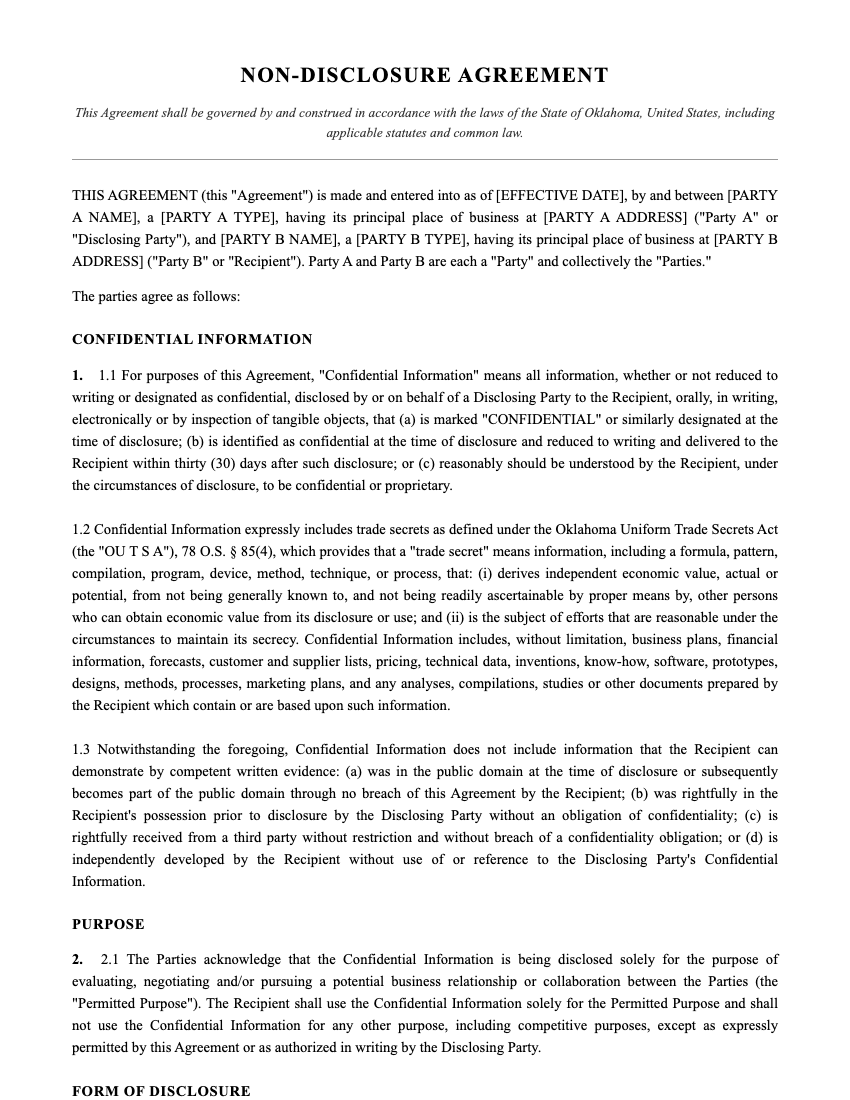
For a complete guide to NDA terms, duration, and standard exclusions, see our NDA Agreement Guide.
Why "Generic" NDAs Are Dangerous in Oklahoma
Many free templates were drafted for jurisdictions that permit post-employment restraints and therefore include broad "no-use" or "no-compete" style language. In Oklahoma those clauses are high risk for three reasons:
- Statutory Ban on Non-Competes. 15 O.S. § 219A prohibits non-compete covenants except for the narrow sale-of-business goodwill exception. If an NDA contains language that looks or operates like a non-compete, it can be challenged as void under 15 O.S. § 219A.
- Overbroad "Use" Restrictions. Clause wording like "Receiver shall not use Confidential Information to compete" may be read as a de facto non-compete if it prevents ordinary tasks in the receiving party’s trade. Oklahoma courts and litigants examine the practical effect of restrictions — not just the label.
- Federal Trade Secret Remedies and Whistleblower Notice. The Defend Trade Secrets Act (DTSA) (18 U.S.C. § 1833(b)) conditions certain enhanced remedies (exemplary damages and attorney’s fees) on giving an NDA recipient notice that they may disclose a trade secret to government officials or in a court filing for reporting wrongdoing. Omitting that DTSA notice can limit federal remedies.
Paradigm-shifting insight for Oklahoma: the biggest drafting trap is the sale-of-business exception. NDAs used in acquisition or asset-sale contexts must explicitly accommodate a post-sale restraint where the parties intend to protect goodwill; otherwise, transplanting a standard NDA into an M&A workflow can accidentally make the buyer forfeit goodwill protection later. In short — when an NDA will be used around an acquisition, draft with the sale-of-goodwill exception in mind to preserve lawful post-sale restraints.
Recent Legal Development (Statutory)
Oklahoma’s statutory framework — 15 O.S. § 219A (non-compete prohibition) and the state’s adoption of the Uniform Trade Secrets Act at 78 O.S. § 85 — is the controlling law. Those statutes make clear that NDAs should target trade-secret-level information with reasonable secrecy measures rather than broad career restraints.
Key Clauses to Include (Oklahoma-Focused)
- Clear Purpose: Limit permitted use to a narrow purpose (e.g., "evaluation of a potential supply agreement for Product X").
- Precise Definition of Confidential Information: Distinguish between "Trade Secrets" (as defined by 78 O.S. § 85) and other confidential information. Trade secrets get indefinite protection while other confidential data typically has a reasonable time limit.
- Narrow Use Restrictions: Prohibit misuse of confidential information, not the receiving party's ability to work. Avoid blanket "no competition" language.
- Exclusions: Public domain, prior knowledge, independent development, and compelled disclosure carve-outs.
- DTSA Whistleblower Notice: Include the federally required notice under 18 U.S.C. § 1833(b) that a person may disclose a trade secret to a government official or in a court filing under limited conditions without liability for that disclosure.
- Remedies and Limitations: Allow injunctive relief for trade secret misappropriation under 78 O.S. § 85 and preserve statutory damages where applicable.
- Severability and Governing Law: Be cautious — if you choose outside governing law, Oklahoma courts may still refuse to enforce unlawful restraints affecting Oklahoma workers; whenever possible, make the contract’s scope and forum clear and narrowly tailored.
Who Needs This Document?
| User Persona | Usage Scenario | Key Benefit in Oklahoma |
|---|---|---|
| Tech Startups | Sharing product roadmaps with contractors | Protects source code and trade secrets without unlawful restrictive covenants |
| Small Manufacturers | Sending designs to suppliers | Keeps designs confidential and preserves trade secret claims under 78 O.S. § 85 |
| Employers | Onboarding employees (confidential info only) | Limits disclosure of secrets without creating a prohibited non-compete under 15 O.S. § 219A |
| Buyers/Sellers | M&A due diligence | Enables safe diligence while reserving sale-of-goodwill language where appropriate |
How to Execute a Valid Oklahoma NDA
Step 1 — Choose the Right Type: Use One-Way (unilateral) for employer-to-contractor or seller-to-buyer disclosures; use Mutual when both sides will exchange secrets.
Step 2 — Define the Purpose Precisely: Narrow-purpose language reduces the risk that a court will read the NDA as an unlawful restraint.
Step 3 — Take Reasonable Secrecy Steps: Mark documents "CONFIDENTIAL," restrict distribution, use password-protected files, and keep an access log. Those measures support trade-secret status under 78 O.S. § 85.
Step 4 — Sign Before Sharing: Don’t share secret materials before execution. Electronic signatures are generally recognized (the federal E-SIGN Act and state adoption of the Uniform Electronic Transactions Act permit enforceable e-signatures), but retain a clear execution record.
Getting NDAs from Others
If presented with a third-party NDA, watch for disguised restraints (broad non-use, post-termination geographic limits, or extended durations). Push back on provisions that prevent normal post-employment work or freelance practice. Use an AI contract review tool to scan incoming contracts for unlawful or risky clauses under Oklahoma law and the DTSA checklist.
Related NDA Templates
Get the Template
Sign up for our newsletter to receive the template.
Frequently Asked Questions

About Designer Content
Designer Content creates practical legal document resources for landlords, contractors, and small business owners. We simplify complex legal concepts into actionable guidance. Connect with us on LinkedIn.