
Opening
An Oregon Master Services Agreement (MSA) is a reusable contract that sets the ground rules for ongoing service work between a provider and a client in Oregon. Instead of renegotiating legal terms for every project, the parties sign one MSA and then attach a short Statement of Work (SOW) for each engagement. For Oregon businesses, the best template also accounts for state-specific issues like worker classification, non-compete limits, interest on late payments, and construction anti-indemnity rules.
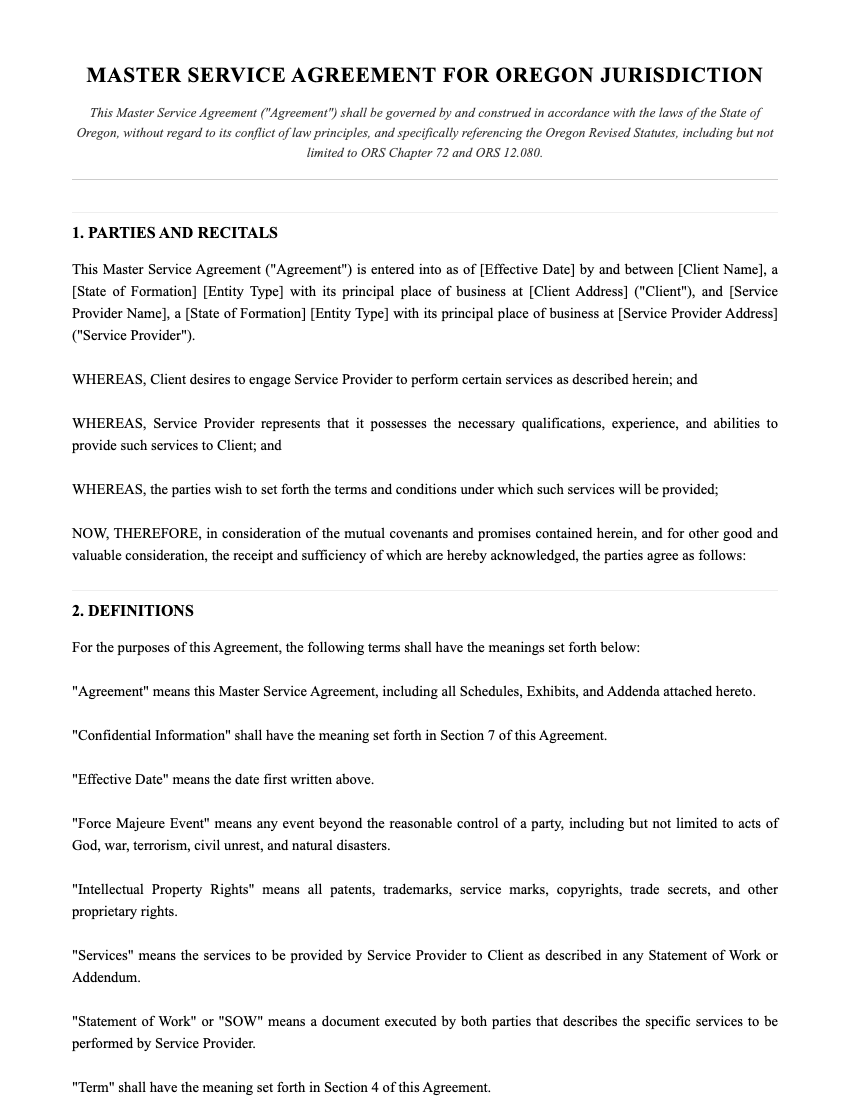
For a comprehensive guide to structuring MSAs and SOWs that protect your business, see our Freelancer Contracts Guide.
Definition Box
Definition: An Oregon Master Services Agreement (MSA) is a governing written contract used in Oregon to standardize the legal terms that will apply to multiple service projects between the same parties. The MSA typically covers payment mechanics, late fees/interest, confidentiality, intellectual property ownership, warranties, limitation of liability, indemnification, dispute resolution, and termination. Each new project is documented in a separate Statement of Work (SOW) that describes the specific deliverables, timeline, pricing, and acceptance criteria. This structure reduces contract friction while keeping Oregon-specific compliance risks in view.
Why You Cannot Use a Generic MSA in Oregon
Generic MSAs are usually written to be “50-state” documents. That sounds convenient, but it often means the template quietly relies on rules from another state (like Delaware) and ignores Oregon-specific limitations. In practice, that can create unenforceable clauses, extra tax exposure, or avoidable litigation cost—especially when a dispute hinges on worker classification, non-competes, or how risk is allocated.
Worker Classification Rules
Oregon does not rely on a single, universal “ABC test” for all purposes. Worker classification can vary depending on the agency and context, and Oregon law uses statutory tests for whether someone is an “independent contractor” rather than an employee in particular settings. For example, Oregon’s independent contractor standards appear in ORS 670.600 (often applied in state agency determinations) and interact with wage and hour concepts under ORS chapter 652 and Oregon’s wage claim enforcement framework. A generic MSA may say “Contractor is an independent contractor” and stop there—yet Oregon disputes usually turn on the real relationship: control, integration into the business, and whether the contractor operates an independent business.
Misclassification can create cascading costs: unpaid payroll taxes, wage claims, and penalties. A practical Oregon-ready MSA template should include clear scope boundaries, contractor control language, invoicing practices consistent with an independent business, and responsibility allocations that match Oregon’s statutory approach—so the contract supports (rather than contradicts) your operational reality.
Non-Compete Enforceability
Unlike California’s broad ban, Oregon allows certain employee non-competes—but only under strict statutory conditions. Oregon’s non-compete statute, ORS 653.295, generally requires (among other items) advance notice and limits enforceability to a defined duration (commonly up to 12 months, subject to statutory conditions and exceptions). Importantly, these rules are aimed at employment relationships; many “MSAs” are actually B2B service agreements with a company-to-company provider. If your template is aimed at freelancers/consultants, importing a heavy employee-style non-compete can backfire by (a) being unenforceable as drafted, and (b) creating worker-classification arguments that the relationship looks like employment.
A smarter Oregon approach is to use enforceable alternatives that protect real business interests without overreaching: a strong confidentiality clause, narrowly tailored non-solicitation (where appropriate), return/destruction of data, and clear IP ownership/assignment terms. If you truly need restrictive covenants, tailor them to ORS 653.295 requirements and to the correct relationship type.
IP/Work-for-Hire Considerations
Oregon follows federal copyright principles: “work made for hire” is limited to specific categories and usually requires a written agreement, and many contractor deliverables are not automatically owned by the client unless properly assigned. A generic template often labels everything “work for hire” and assumes that settles ownership. A better Oregon MSA gives two clear mechanisms: (1) an IP assignment effective upon payment (common for custom deliverables) and (2) a limited license for pre-existing tools and know-how. This avoids accidental loss of provider background IP while still giving the client what it needs.
What's Included in This Template
Flexible SOW Structure
The template is designed so the MSA holds the legal baseline and each SOW captures the business deal: deliverables, milestones, rates, expenses, and acceptance testing. This helps prevent “scope creep” because anything not in the SOW is either excluded or billed under a change-order process.
Oregon-Specific Indemnification
Indemnity is drafted with Oregon limits in mind. For construction-related services, the template flags Oregon’s anti-indemnity rule in ORS 30.140, which can void clauses that require one party to indemnify another for the other party’s negligence in certain construction agreements.
Dispute Resolution and Venue
Venue and governing law default to Oregon to avoid being dragged into a distant forum. The template also aligns timing expectations with Oregon’s written-contract limitations period—six years under ORS 12.080—so record retention and claim windows are realistic.
Additional Oregon-focused provisions include:
- Late-payment interest references ORS 82.010 (statutory interest rate concepts)
- Unfair/deceptive practices risk control referencing ORS 646.605 et seq. (Oregon UTPA)
- Data security and breach-notice alignment referencing ORS 646A.600 et seq.
- Construction indemnity limitation callout referencing ORS 30.140
Who Needs This Document?
| User Type | Relationship | Key Benefit |
|---|---|---|
| Marketing agencies | Ongoing campaigns with Oregon clients | Standardizes approvals, change orders, and IP transfer rules |
| IT consultants/MSPs | Recurring support + project work | Separates baseline liability/confidentiality from each SOW scope |
| Freelance designers/developers | Multiple clients per year | Clear payment terms, late interest framing, and portfolio rights options |
| Construction-adjacent service firms | Design support, PM, site tech | Flags ORS 30.140 anti-indemnity issues before signing |
How to Use This MSA Template
Step 1: Identify the Parties Correctly
Use the exact legal names (LLC/Corp/individual) and Oregon business addresses. If you operate through an LLC, list the entity—not your personal name—to match invoicing and tax reporting.
Step 2: Set the Term and Termination
Pick a fixed term (e.g., 12 months) or evergreen auto-renewal. Include a practical off-ramp (like 30 days’ notice) and what happens to in-flight SOWs.
Step 3: Attach the First SOW
Put deliverables, deadlines, assumptions, and acceptance criteria in the SOW. Keep the MSA stable so future SOWs are quick to sign.
Step 4: Sign, Store, and Use Consistently
Execute the MSA once, then sign new SOWs per project. Store signed copies and change orders so you can prove scope and payment terms if a dispute arises.
Already Receiving Contracts from Clients?
Many Oregon providers don’t get to “send their template”—clients send theirs. Before you accept a client MSA, check for Oregon-specific red flags: overly broad indemnities (especially if any construction work is involved under ORS 30.140), aggressive non-competes that may not meet ORS 653.295 standards, and payment terms that undermine your right to interest or collection leverage. If you want a faster first-pass review, use an AI contract review tool to flag risky clauses.
Download Options
Free PDF Version: Use the PDF to review structure, clause concepts, and Oregon statute references. It’s ideal for internal approval and sharing with stakeholders.
Editable Word/Google Docs Version: Use the editable version to customize indemnity, IP, and SOW pricing models. It also includes placeholders for Oregon venue, notices, and security terms.
Disclaimer
This template is for Oregon B2B service contracts and educational use, not legal advice. Consult an Oregon attorney for specific risk, tax, or employment questions.
Related MSA Templates
Get the Template
Sign up for our newsletter to receive the template.
Frequently Asked Questions

About Designer Content
Designer Content creates practical legal document resources for landlords, contractors, and small business owners. We simplify complex legal concepts into actionable guidance. Connect with us on LinkedIn.