
A well-drafted Oregon Non-Disclosure Agreement (NDA) protects trade secrets and confidential business information while reflecting Oregon statutory law and local enforcement practice. Unlike California’s near‑total ban on non‑competes, Oregon’s legal landscape generally enforces restrictive covenants under a reasonableness standard. That affects how you draft confidentiality obligations, carve-outs, and remedies.
What Is an Oregon NDA?
Definition: An Oregon NDA is a written contract that obligates a receiving party to keep certain information confidential and limits use and disclosure of proprietary materials. In Oregon, trade secret misappropriation and remedies are governed by the Oregon Uniform Trade Secrets Act (UTSA) at ORS 646.461 et seq.; unfair or deceptive practices tied to confidentiality promises can implicate the Oregon Unlawful Trade Practices Act (ORS 646.605 et seq.).
Think of an NDA as two related protections: (1) contract-based confidentiality obligations, and (2) statutory protection for trade secrets if the information qualifies under the UTSA. Both interact with Oregon’s contract law (including the six‑year written‑contract statute of limitations under ORS 12.080) and with enforcement mechanics in state courts.
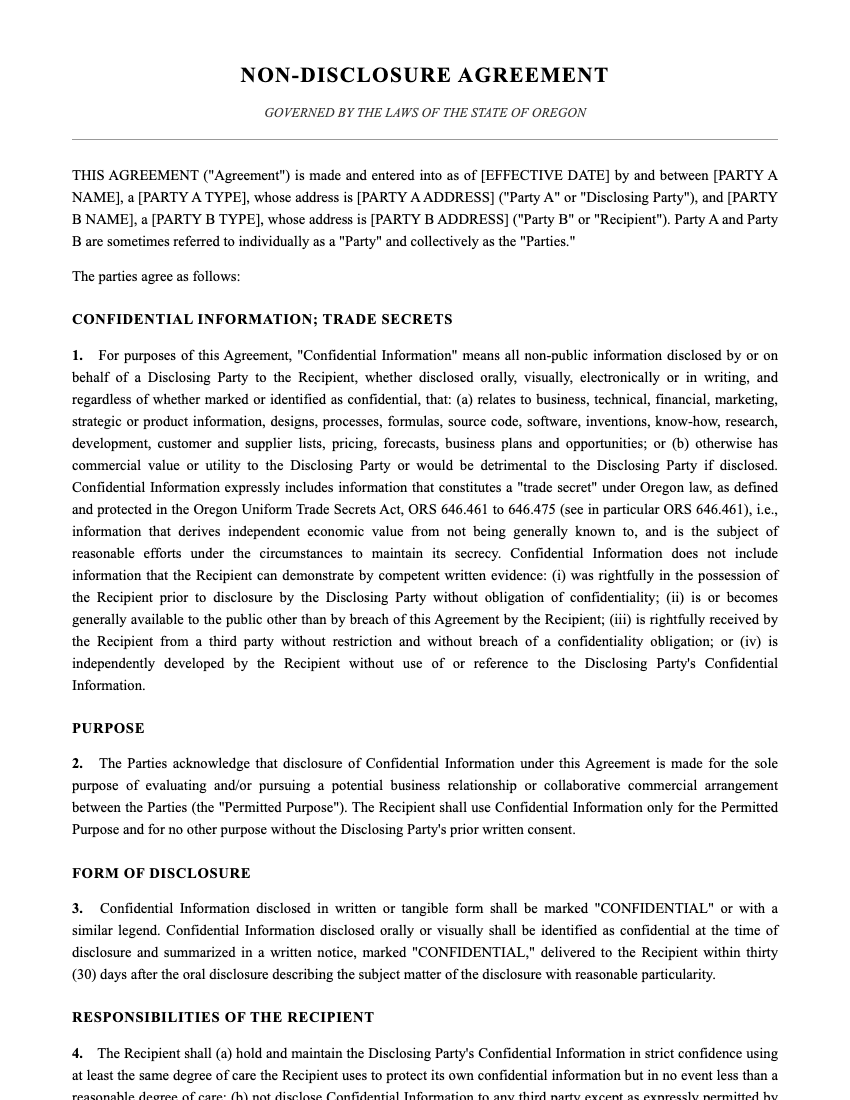
For a complete guide to NDA terms, duration, and standard exclusions, see our NDA Agreement Guide.
Why "Generic" NDAs Are Dangerous in Oregon
Many free NDA templates are written for jurisdictions with different approaches to
restrictive covenants or that ignore state-specific statutes. Using a generic form in Oregon can create three risks:
- Vagueness about trade-secret status. Oregon courts apply UTSA standards (see ORS 646.461) to determine whether information qualifies as a trade secret. Overbroad labels like "All information is a trade secret" risk losing protection for genuinely secret materials.
- Overreaching scope that invites modification. Oregon generally enforces non‑compete and usage restrictions if they are reasonable in duration, geography, and scope. But if a clause is obviously overbroad, a court may refuse enforcement or—depending on the facts—modify (reform) it. Drafting to reasonableness up front reduces litigation risk.
- Unclear remedies and limitations periods. A breach of contract claim for an NDA is subject to Oregon’s written‑contract statute of limitations (ORS 12.080 — six years). A statutory misappropriation claim under the UTSA has its own limitations mechanics. If you conflate remedies or fail to preserve contractual damages alongside statutory remedies, you may weaken your remedies.
Paradigm-shifting insight (Oregon): Oregon sits between extremes—unlike California’s categorical ban on restraints, Oregon will enforce restraints that are narrowly tailored and supported by legitimate business interests. The practical consequence: NDAs drafted in Oregon should be deliberately calibrated to avoid both excessive breadth (which invites refusal to enforce) and unnecessary specificity that looks like a disguised non‑compete. In short, precision + reasonableness wins.
Real development to know: Oregon has not adopted a blanket prohibition like California’s SB 699. Instead, enforcement trends follow a fact‑specific reasonableness review. For national context and state comparisons, see the National Conference of State Legislatures’ summary of state non‑compete laws.
Key Clauses — Oregon Best Practices
- Purpose and Narrow Scope: Limit permissible uses to a defined business purpose (e.g., "evaluating a potential joint venture regarding Product X"). Courts in Oregon favor concrete, limited purposes.
- Clear Trade‑Secret Definition: Mirror ORS 646.461: identify information that derives independent economic value from not being generally known and is subject to reasonable secrecy efforts.
- Term and Survival: Use a two‑tiered approach — a limited term (e.g., 2–5 years) for general confidential information and indefinite protection for bona fide trade secrets while they remain secret.
- Use vs. Non‑Compete Language: Do not include broad language that prevents employment in a field. Instead, prohibit use or disclosure of specific confidential information. If you need a non‑compete or non‑solicit, draft it separately and justify it with legitimate business interests (customer relationships, specialized training), ensuring reasonableness in time, geography, and activity.
- Remedies and Attorneys' Fees: State whether breaches give rise to contract damages, injunctive relief, and statutory UTSA remedies. Preserve the option to seek injunctive relief and recovery of fees where permitted.
- Electronic Signatures: Oregon recognizes electronic records and signatures under the Uniform Electronic Transactions Act (see ORS 84.001 et seq.). Include an e‑sign consent clause.
- Carve‑outs: Include standard exceptions (prior knowledge, public domain, independently developed, compelled disclosure). Also include whistleblower/authorized disclosures language in line with federal DTSA practice if you want to preserve certain federal remedies.
Who Needs This Document?
- Startups — pitching investors or hiring contractors: protect pitch decks, IP roadmaps, and customer lists.
- Employers — hiring specialized employees: limit misuse of training materials and confidential processes while considering separate non‑competes if justified.
- Buyers and Sellers — M&A due diligence: permit document exchange while protecting valuation drivers.
- Manufacturers and Designers — outsourcing production: protect designs and specifications when manufacturing offshore.
How to Execute an Oregon NDA (practical steps)
- Decide One‑Way vs. Mutual. Use one‑way when only one party discloses; use mutual when both share sensitive information.
- Tailor the Purpose. Be specific about the permitted use to avoid vagueness and overbreadth.
- Label and Limit. Mark confidential materials, keep distribution lists tight, and limit disclosure cohorts to those who need the information.
- Sign and Preserve Evidence. Have the agreement executed before disclosure. Oregon recognizes e‑signatures under ORS 84.001, but keep a signed PDF and audit trail.
Cross‑sell: an AI contract review tool flags clauses that conflict with Oregon law, highlights disguised non‑competes, and compares your NDA to Oregon statutes and best practice patterns—saving review time and litigation risk.
Related NDA Templates
Get the Template
Sign up for our newsletter to receive the template.
Frequently Asked Questions

About Designer Content
Designer Content creates practical legal document resources for landlords, contractors, and small business owners. We simplify complex legal concepts into actionable guidance. Connect with us on LinkedIn.