
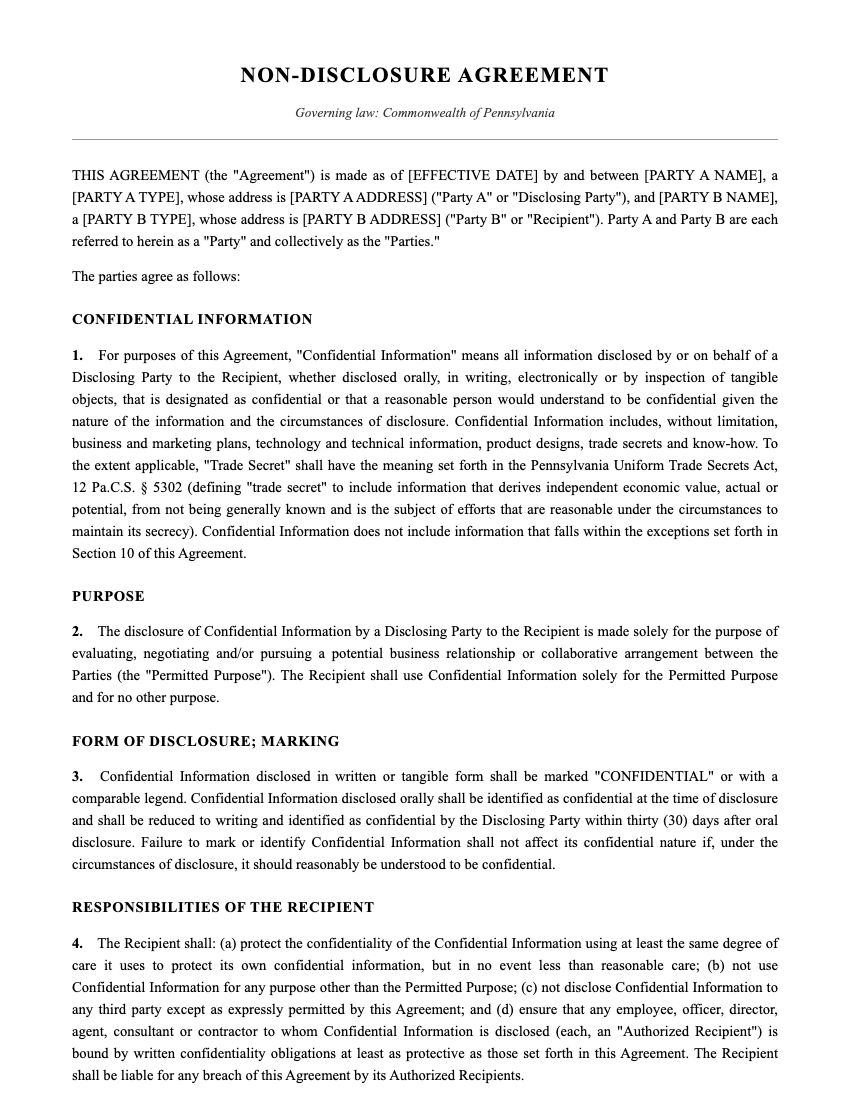
A Pennsylvania Non-Disclosure Agreement (NDA) is a contract that lets parties share confidential business information while preserving legal remedies if that information is misused. Unlike some states that categorically void non-compete language, Pennsylvania enforces reasonable restraints and protects trade secrets under the Pennsylvania Uniform Trade Secrets Act (12 Pa.C.S. §§ 5301–5308). This template is drafted to reflect that landscape and to avoid common traps that turn well‑intentioned NDAs into litigation landmines.
What is a Pennsylvania NDA?
Definition: A Pennsylvania NDA is a legally binding contract that limits disclosure and use of Confidential Information and Trade Secrets. "Trade secret" is defined under 12 Pa.C.S. § 5302 as information that (a) derives independent economic value from not being generally known and (b) is subject to reasonable efforts to maintain its secrecy.
Pennsylvania courts generally respect parties' freedom to contract, and non-compete and confidentiality provisions are enforceable if reasonable in scope, duration, and geographic reach. But "reasonable" is fact-specific, and improperly drafted NDAs can either be narrowed by a court or invalidated in part—so precision matters.
For a complete guide to NDA terms, duration, and standard exclusions, see our NDA Agreement Guide.
Why "Generic" NDAs Are Dangerous in Pennsylvania
Generic templates often assume either a full ban on restraints or utter enforceability depending on the drafters' home state. In Pennsylvania that mismatch creates three main risks:
- Overbroad confidentiality definitions that effectively function as restraints on employment or commerce will be litigated. Pennsylvania courts will enforce legitimate trade-secret protections, but they will not allow an NDA to be used as a disguised, unlimited restraint on trade.
- Missing DTSA (federal) whistleblower language. If you want the option of enhanced damages under the federal Defend Trade Secrets Act, you must include the notice required by 18 U.S.C. § 1833(b). Without it, you can still sue, but you may forfeit exemplary damages and attorney's fees in federal actions.
- Statute of limitations pitfalls. Contract claims in Pennsylvania are governed by a four‑year statute of limitations (42 Pa.C.S. § 5525). Trade-secret or unjust-enrichment claims may have different accrual rules—don’t assume unlimited time to sue.
Paradigm-shifting insight: Pennsylvania will enforce non-competes and confidentiality clauses, but it also gives courts broad remedial tools to modify or limit overbroad provisions rather than void an entire agreement. That means a cleverly worded NDA that tries to be "absolute" can be trimmed or partially enforced—resulting in unpredictable outcomes. In practice, narrowly tailored protection of specific categories of information and a clear, limited Purpose are your strongest protection in Pennsylvania.
Real case study
In federal and state courts within Pennsylvania, litigants regularly obtain injunctions enforcing trade-secret and confidentiality clauses when the protected information meets UTSA standards and the restraint is reasonable. For practical guidance see case law cited in the Pennsylvania courts applying the UTSA framework (12 Pa.C.S. §§ 5301–5308) and decisions upholding injunctive relief where secrecy measures and tangible harm were shown.
What’s Included in This Template? (Key Clauses)
- Clear definitions: Separate "Confidential Information" from "Trade Secrets". Narrow definitions increase enforceability in Pennsylvania.
- Purpose limitation: Restrict use to a defined commercial purpose (e.g., "evaluating a license agreement for Product X").
- Reasonableness limits: Optional duration and geographic caps tailored for employment and contractor relationships to reflect Pennsylvania's reasonableness standard.
- Exclusions: Information already public, independently developed, or lawfully received from third parties.
- DTSA whistleblower / government disclosure notice: Required to preserve enhanced remedies under 18 U.S.C. § 1833(b).
- Confidentiality remedies & injunctive relief: Explicit acknowledgement that injunctive relief is an available remedy for trade-secret misappropriation in Pennsylvania.
- Severability & blue-pencil clause: Allows a court to reform or sever overbroad provisions rather than void the whole NDA—reflecting Pennsylvania's court practice.
- Electronic execution: Language confirming electronic signatures and copies are binding, consistent with E‑SIGN (15 U.S.C. § 7001) and Pennsylvania's electronic transaction rules.
Who Needs This Document?
| User Persona | Usage Scenario | Key Pennsylvania Benefit |
|---|---|---|
| Tech startups (PA) | Sharing code with contractors | Protects source code and trade secrets while limiting duration to what Pennsylvania courts consider reasonable |
| Manufacturers | Sending designs to vendors | Clear trade-secret labeling and injunctive remedy language helps obtain quick relief in PA courts |
| Employers | Protecting client lists and proprietary processes | Narrow, time-limited restraints and explicit trade-secret standards reduce litigation risk |
| M&A Buyers | Due diligence exchange | Mutual NDA with carve-outs and DTSA notice preserves remedies if secrets are misused |
How to Execute a Valid Pennsylvania NDA
- Choose the right form: One-way for a single disclosing party; mutual for two-sided exchanges.
- Define Purpose narrowly: Be specific; avoid open-ended language like "future business relationships."
- Mark and secure materials: Use confidentiality legends and reasonable access controls—necessary to satisfy the UTSA's "reasonable efforts" requirement (12 Pa.C.S. § 5302).
- Sign before sharing: NDA protections start on execution. Keep signed copies and audit logs; electronic signatures are enforceable under E‑SIGN (15 U.S.C. § 7001).
Already Receiving NDAs from Clients?
When a client sends an NDA, review for overbroad use restrictions, automatic assignment of IP, and provisions that waive Pennsylvania statutory protections. Use this template to counter-propose limited confidentiality obligations and preserve your right to work, consistent with Pennsylvania law.
an AI contract review tool (link) helps by scanning NDAs for Pennsylvania-specific red flags—identifying overbroad scope, missing DTSA notices, and problematic employee non-compete language—so you can negotiate from a position of knowledge.
Related NDA Templates
Get the Template
Sign up for our newsletter to receive the template.
Frequently Asked Questions

About Designer Content
Designer Content creates practical legal document resources for landlords, contractors, and small business owners. We simplify complex legal concepts into actionable guidance. Connect with us on LinkedIn.