
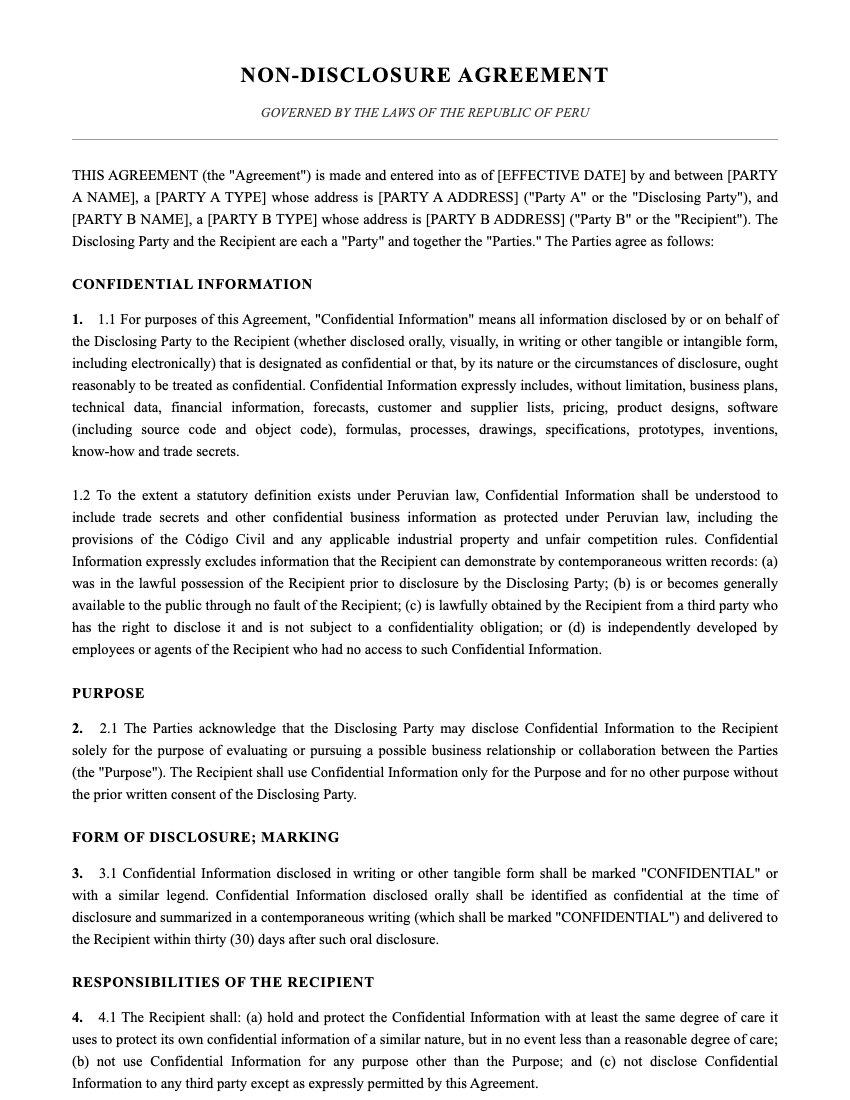
A Peru Non-Disclosure Agreement (NDA) is a contract designed to protect confidential business information, trade secrets and personal data disclosed between parties while complying with Peruvian civil law, data protection rules (Ley N° 29733) and regional industrial property rules (Andean Decision 486).
What Is a Peru NDA?
Definition: A Peru NDA is a written agreement that creates contractual duties of confidentiality over information exchanged for a limited purpose (business negotiation, services, licensing). NDAs in Peru must respect Código Civil provisions on contracts, consumer and labor protections, and data-protection obligations under Ley N° 29733 (Ley de Protección de Datos Personales). Trade secrets and "secreto empresarial" protections are also informed by Andean Community Decision 486 and national practice.
Unlike some jurisdictions where a single boilerplate NDA suffices, NDAs in Peru must be calibrated to: (1) avoid infringing workers' labor rights, (2) respect data-subject rights under Ley N° 29733, and (3) preserve the confidentiality requirements that support trade-secret protection under domestic and Andean rules.
For a complete guide to NDA terms, duration, and standard exclusions, see our NDA Agreement Guide.
Why Generic NDAs Are Dangerous in Peru
Using a generic Anglo- or U.S.-style NDA in Peru creates three common local risks:
- Data-protection conflicts. Peru's Ley N° 29733 gives data subjects rights (access, rectification, deletion, portability in some cases). An NDA that attempts to waive or block these rights is ineffective and may attract administrative sanctions from the national data protection authority or the Ministry of Justice.
- Employment-law limits on restrictive covenants. While commercial non-compete clauses are generally enforceable when reasonable, restrictive covenants imposed on employees are scrutinized under labor law and the Código Civil's general principle against excessive restrictions. NDAs that function as indefinite or excessive non-compete measures may be recharacterized or declared unenforceable.
- Failure to meet trade-secret standards. Peruvian practice follows the Andean Community framework (Decision 486) for industrial protection of undisclosed information. Courts and tribunals expect the disclosing party to show concrete secrecy measures—labeling, access controls and contractual limits—otherwise a court may deny remedies.
Paradigm-shifting insight for Peru: the interplay between data-protection law and secrecy. Unlike many jurisdictions where NDAs are primarily a private-law matter, in Peru an NDA that covers personal data triggers Ley N° 29733 obligations (security, lawful basis, processing limits) and administrative oversight. In practice, a poorly drafted NDA can convert a commercial dispute into a sanctionable data-protection violation.
Real development: Peru's regulation of Law N° 29733 (Supreme Decree No. 003-2013-JUS) and subsequent guidance from the national data-protection authority have increased administrative scrutiny of contracts that process personal data. Companies have been fined for failing to implement minimal technical and organizational measures in contracts—showing that NDAs are not just civil instruments but can also be evidence in administrative enforcement.
Key Clauses Adapted for Peruvian Practice
- Purpose and scope: Narrowly describe the reason for disclosure (e.g., "to evaluate Project X partnership") and list permitted uses.
- Definition of Confidential Information vs. Trade Secret: Distinguish general confidential information (time-limited) from "secreto empresarial" (information that has commercial value because it is secret and that has reasonable secrecy measures). Reference Decision 486 standards and require specific identification of trade secrets where feasible.
- Data-protection clause: Specify lawful basis for processing personal data, obligations to comply with Ley N° 29733, minimum security measures, and instructions for cross-border transfers. State which party is data controller/processor where applicable.
- Duration: Use a two-tier term—time-limited protection (e.g., 2–5 years) for non-critical information and indefinite protection for trade secrets while secrecy is preserved. Note the Código Civil prescription rules (personal actions commonly run on a 10-year prescriptive period) when planning remedies.
- Permitted disclosures and carve-outs: Public domain, pre-existing information, independently developed information, and compulsory legal disclosure (with notice where allowed).
- Employee and contractor carve-outs: For contractors, include clear IP ownership and confidentiality mechanics. For employees, avoid blanket non-compete language; instead protect specific trade secrets and limit use.
- Remedies and forum: Specify injunctive relief, contractual damages and Peruvian jurisdiction; be mindful that Peruvian courts will examine unfairness under Código Civil principles.
Mutual vs. Unilateral Options
- One-way (Unilateral): Use when only one party discloses (investor pitches, vendor demos).
- Mutual (Two-way): Use when both sides exchange confidential materials (M&A due diligence, joint development).
Choose the right form to avoid unintended reciprocal obligations.
Who Needs This Document?
| User Persona | Usage Scenario | Local Benefit |
|---|---|---|
| Peruvian startups | Pitching to local or foreign investors | Protects business plans and client lists while meeting data-law obligations |
| Manufacturers in Lima | Sharing prototypes with suppliers | Protects diseño and técnico know-how; supports trade-secret claims under Decision 486 |
| Law firms & consultants | Advising clients and sharing reports | Ensures data handling complies with Ley N° 29733 |
| Employers | Hiring key technicians | Protects technological secrets without breaching labor protection rules |
How to Execute a Valid Peru NDA
Step 1: Identify whether personal data will be processed. If yes, include a Ley N° 29733 compliant data clause and name the data controller/processor.
Step 2: Define and mark trade secrets. Label documents, restrict access, and record the fact of labeling—this is persuasive evidence in Peruvian courts and for administrative authorities.
Step 3: Consider labor implications. When dealing with employees, avoid blanket non-compete wording. Instead, limit obligations to non-use of specified trade secrets and provide reasonable temporal limits.
Step 4: Sign and retain evidence. Peru recognizes electronic signatures under domestic e-signature rules (use an accepted digital-signature platform and retain audit trails). Keep originals or authenticated copies for enforcement and administrative review.
Already Receiving NDAs from Clients?
If a client sends you an NDA, review it for: unlawful data-processing waivers, indefinite non-compete language affecting employment rights, lack of security commitments for personal data, or broad assignment of IP without compensation. an AI contract review tool can flag these risks against Peruvian law in seconds.
Related NDA Templates
Get the Template
Sign up for our newsletter to receive the template.
Frequently Asked Questions

About Designer Content
Designer Content creates practical legal document resources for landlords, contractors, and small business owners. We simplify complex legal concepts into actionable guidance. Connect with us on LinkedIn.